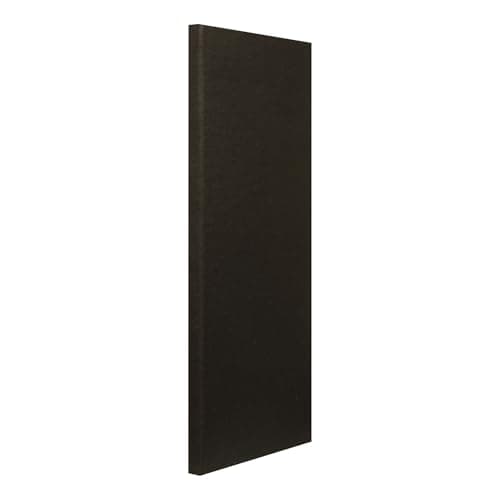
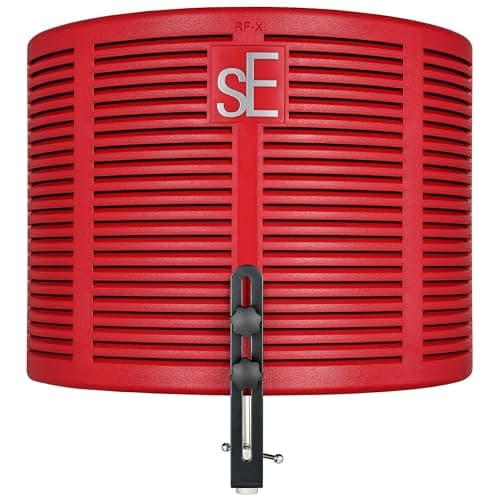
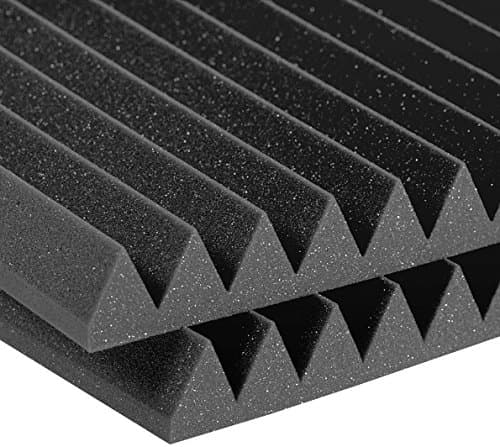
The ATS Acoustics 2-inch panel is the pick under $100: NRC 0.95 and 0.67 absorption at 250 Hz from a Rockwool mineral wool core, in a finished fabric wrap you can hang on one wall and keep. The budget pick is Auralex Studiofoam Wedges, which cost less and absorb 0.23 at 125 Hz against mineral fiber's 0.53 - buy them only if your complaint is a hard, flappy echo. If nothing can be fixed to the walls, the sE Electronics RF-X is the portable answer. Prices come from the daily price check and each button carries its own date.
Start with what $100 cannot do, because every other page on this subject is vague about it. A room's boxiness and uneven bass come from standing waves and low-mid buildup below roughly 250 Hz, and absorbing those requires depth - 4 inches of mineral fiber at minimum, in volume, usually in corners. One hundred dollars does not buy that. What it does buy is the removal of the single strongest early reflection reaching your microphone, which is the difference between a voice that sounds like it was recorded in a room and one that sounds like it was recorded at a desk. In practical terms: one or two 2 inch panels, placed deliberately, beat a full kit of thin foam tiles spread across a wall.
Read the first two columns together and the shape of this budget becomes clear. The ATS panel's 0.12 at 125 Hz is low - and its 0.67 at 250 Hz is where it earns its place, because 250 Hz to 2 kHz is the band that carries the reflected copy of your voice. The foam's 0.23 at 125 Hz at 3 inch thickness looks better in that one column than the thinner mineral wool panel, and it is still the weaker product overall: NRC under ASTM C423 is computed from 250 Hz to 2 kHz and the foam does not publish a figure there, while the mineral wool panel publishes 0.95. One honest figure is worth more than a favorable one, which is why the panel is first.
The three, ranked under $100
Each card carries the published absorption figure with its source, the live price with the date it was checked, and the specific complaint the product does and does not fix.
ATS Acoustics Panel (2-inch)
Top pickATS Acoustics · The value finished panel
The best value in a finished panel for flutter echo and first reflections, and the money saved buys the depth that actually changes the room. Read its own `125 Hz` figure before you buy four of them to fix boxiness: at `0.12` it will not, and the 4-inch version of the same panel reaches `0.65`.
Why it is here
- Mineral-wool core at a price close to foam kits
- NRC 0.95 is within a rounding error of panels costing twice as much
- Publishes its figure at `125 Hz` as well as its NRC, which is the honest way to describe a thin panel
What it costs you
- `0.12` at `125 Hz` is the 2-inch depth limitation stated plainly — this is a high-frequency device
- Edges are softer than Primacoustic's resin-hardened ones
- Not fire rated, which rules it out of some rented rooms
sE Electronics RF-X
sE Electronics · The most absorptive portable shield
Worth it if you cannot fix anything to the walls — a rented room, a shared space. If you can hang two panels, panels at the first reflection points do more for less, and leave your stand alone.
Why it is here
- Four layers with an air gap is a real absorber, not a foam semicircle
- Reduces the rear-wall reflection that makes untreated vocal takes sound hollow
- Mounts on a normal stand with the mic inside it
What it costs you
- Five pounds hung on a mic stand needs a heavy base or it tips
- Treats one reflection path; the ceiling and the floor are untouched
- Makes the mic position fussier to set
Auralex Studiofoam Wedges
Auralex · Killing flutter echo, and nothing more
Buy it only if your specific complaint is a hard, flappy echo in a tiled or bare room. If your complaint is that your voice sounds boxy or your mixes have too much bass, this is the wrong product and mineral wool is the right one.
Why it is here
- Genuinely effective above roughly 1 kHz, which does tame slap echo in a hard room
- Light, so it mounts with adhesive rather than fixings
- The real Auralex product, with published performance data, unlike the unbranded kits
What it costs you
- 0.23 at 125 Hz is less than half what mineral wool of the same depth achieves
- The low-mid buildup that makes a bedroom sound boxy is exactly what it does not touch
- Foam yellows and crumbles over years
Where to put it, if you only buy one
- Behind the microphone, facing you. Sound leaves your mouth, passes the capsule, hits the wall behind the mic and comes back into the capsule a few milliseconds later. That delayed copy is the room tone you are trying to remove, and one panel there removes most of it.
- Then the wall behind your head, if you are recording and the wall is closer than about 3 feet. Same reflection, longer path.
- Then the side wall nearest the microphone. A 24 x 48 in panel at mouth height does this job; a line of foam squares at eye level does not.
- Never spread thin tiles evenly over one wall. It looks like treatment and does the least per dollar of any arrangement. Do acoustic foam panels work covers why.
- Corners come last and need depth. With $100 they are out of reach. Best bass traps is the honest version of that purchase when the budget grows.
What we did not pick, and why
- The ATS 4-inch panel. The right first panel for anyone who can stretch past this band: 0.65 at 125 Hz against the 2-inch version's 0.12 is the largest single jump in this hub. It sits above $100.
- Owens Corning 703. The most absorption per dollar if you build the frames yourself, and above this band as sold. Acoustic treatment on a budget covers the DIY route properly.
- Moving blankets and duvets. They absorb above about 1 kHz and almost nothing below it, which dulls a recording without fixing the reflection pattern. Useful over a window; not a plan.
- Egg cartons. No published absorption data exists because there is nothing to publish. They scatter high frequencies slightly and are flammable.
- Soundproofing products. A different problem entirely - soundproofing vs acoustic treatment has the figures. Nothing under $100 reduces sound leaving a room.
How these are ranked
- Published absorption at 125 Hz, where the manufacturer publishes it, because that is where small rooms go wrong and NRC does not measure it.
- Published absorption from 250 Hz up, which is the band carrying the reflected copy of a voice.
- Whether the data exists at all. A product with no published figures is ranked below one with unflattering figures.
- Whether it survives the room. A finished, fabric-wrapped panel outlasts bare foam and can move house with you.
- Buyable now, with a live Amazon listing under $100 from the daily price check at the time this page was written.
Pair it with
- The five-minute diagnosis, before you buy. How to treat a room for recording.
- The full panel ranking, when the budget grows. Best acoustic panels.
- The foam-versus-wool evidence in full. Acoustic foam vs mineral wool panels.
- A microphone that forgives an untreated room. Best dynamic microphones for vocals.
If this budget is genuinely fixed, there is one more option worth naming: spend it on a microphone that rejects the room instead of a product that absorbs it. A broadcast dynamic at 4 inches hears far less of a bare wall than a condenser does, and that trade is often the better use of $100 in a room you do not control. Dynamic vs condenser microphones sets out the choice, and treating a bedroom studio covers what to do when the room is also somewhere you sleep.