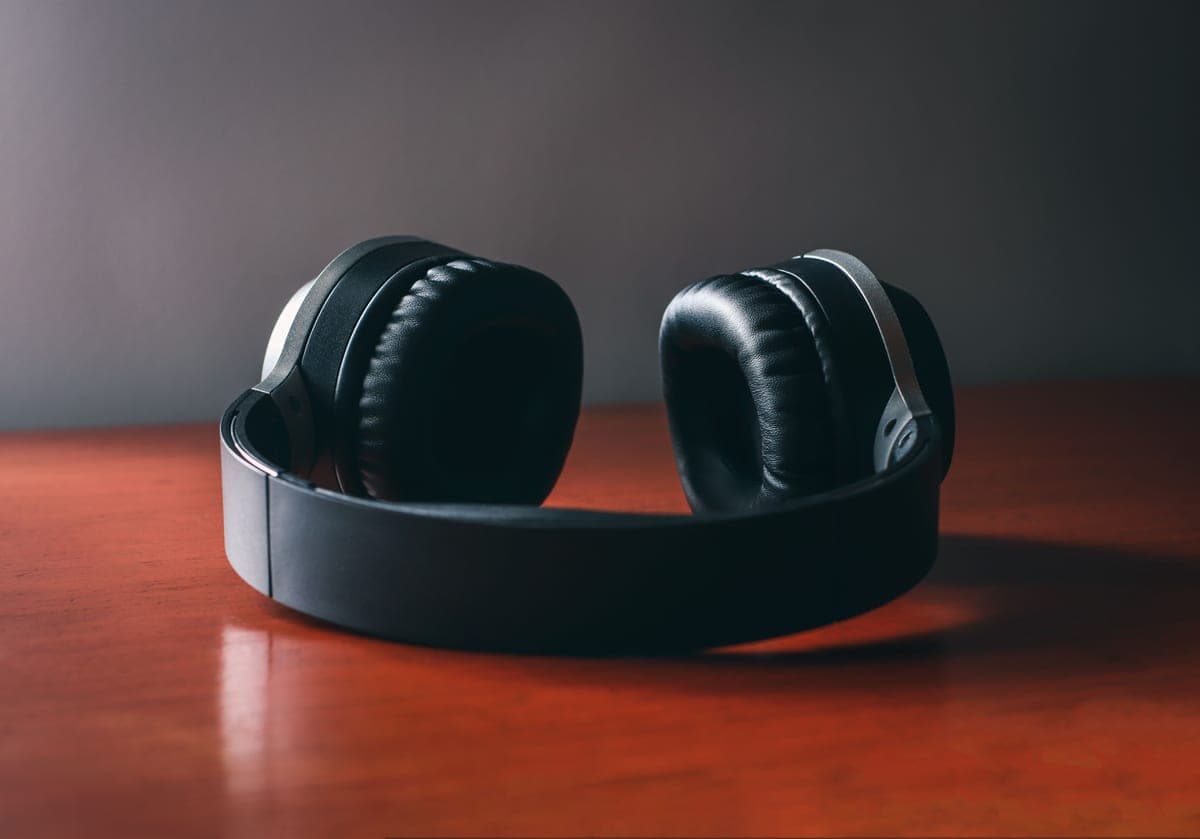
The Sennheiser HD 600 remains the mixing reference if your interface can drive 300 ohms. If it cannot, or if you also track with a live microphone in the room, the AKG K371 is the best single-pair compromise — closed-back, 36 ohms, and independently measured as one of the flattest closed-backs at any price.
Two facts decide almost everything here, and neither is about sound quality. The first is impedance, which decides whether your interface can drive them properly. The second is open versus closed, which decides whether you can wear them next to a live microphone without the headphone mix leaking into the recording.
Open versus closed is a job description, not a quality tier
Open-back lets air move freely behind the driver, which gives a more natural sense of space and lets reverb tails and stereo width read honestly. It also leaks sound in both directions, so wearing one next to a live microphone puts your headphone mix onto your recording.
Closed-back isolates, so you can track with a microphone two feet away. The physical enclosure also creates resonances that compress your sense of depth, which is why closed-backs are generally the weaker tool for mix decisions about reverb and space.
If you only buy one pair and you record with a live microphone, buy closed-back — an open-back that ruins your takes is not a bargain. The K371 exists to make that compromise as small as possible.
The seven headphones, ranked
Sennheiser HD 600
Top pickSennheiser · The long-standing mixing reference
Buy it for mixing if your interface can drive 300 ohms — the SSL 2+ and MOTU M2 can, a bus-powered budget box may struggle. Do not buy it as your only pair if you also track with a live mic in the room.
Why it is here
- The midrange presentation most mixing engineers have calibrated their ears against
- Open-back, so reverb depth and stereo width read honestly
- Fully serviceable — pads, cable and headband are all replaceable
What it costs you
- 300 ohms needs a headphone output with real voltage swing; a weak one sounds thin and quiet
- Open-back leaks straight into any live microphone, so it is useless for tracking
- Low end rolls off early by modern standards
AKG K371
AKG · The closed-back that measures closest to a target curve
The best single-pair compromise on this site: closed enough to track with, flat enough to make real mix decisions on. Choose the DT 770 instead if durability matters more than measured flatness.
Why it is here
- Independently measured as one of the flattest closed-backs at any price
- 36 ohms and 117.9 dB SPL means anything drives it loudly
- Folds flat, with three detachable cables
What it costs you
- Plastic build that does not inspire the confidence a DT 770 does
- Clamping force is light, so it moves if you do
- Closed-back still compresses your sense of reverb depth
Sennheiser HD 490 Pro
Sennheiser · A modern open-back that laptops can drive
The pick if you mix on a laptop or a modest interface and the HD 600's 300 ohms would leave you short of level. If your interface has a strong headphone amp, the HD 600 gets you most of the way for much less.
Why it is here
- 130 ohms and 105 dB SPL means it plays loud enough from modest outputs, unlike the HD 600
- Ships with two pad sets that genuinely change the voicing for mixing versus listening
- Lighter than the HD 600 over a long session
What it costs you
- Costs considerably more than the HD 600 it is voiced against
- Two pad sets means two references, which is one more variable than you wanted
- Open-back, so still no good for tracking
Beyerdynamic DT 900 Pro X
Beyerdynamic · Open-back detail with no amplifier requirement
The right open-back if you want mixing honesty from a laptop or an interface with a weak headphone amp. The HD 600 is still the more neutral midrange if you can drive it.
Why it is here
- 48 ohms is the easiest open-back here to drive — a phone dongle manages it
- Detachable cable with two lengths in the box
- Beyerdynamic spare-part support, same as the DT 770
What it costs you
- Slightly bright, in the family tradition
- Open-back rules out tracking with a live mic
- Beyerdynamic does not publish a full response spec for this model in the same detail as the DT 770
Beyerdynamic DT 770 Pro (80 ohm)
Beyerdynamic · Tracking with a live mic in the room
The right headphone for recording, where leakage is the problem you are solving. For mixing decisions, an open-back pair will tell you more truth about depth and reverb.
Why it is here
- Closed-back, so nothing leaks into an open microphone two feet away
- 80 ohms drives properly from any interface headphone output on this site
- Every wear part is a user-replaceable spare, which is why these last a decade
What it costs you
- A lifted top end that flatters detail and misleads on sibilance decisions
- Closed-back soundstage narrows your sense of reverb depth
- Velour pads get warm over a long session
Audio-Technica ATH-M50x
Audio-Technica · A tough closed-back for tracking, not mixing
Use them for tracking and for checking a mix against a consumer-style bass lift. Do not make low-end decisions on them — the K371 costs similar money and measures far flatter.
Why it is here
- Drives easily from anything at 36.6 ohms
- Physically robust, and folds for transport
- Good isolation for tracking next to a live mic
What it costs you
- A pronounced bass lift that makes mixes translate badly
- Narrow soundstage even by closed-back standards
- Pads compress and need replacing sooner than the Beyerdynamic equivalents
Sony MDR-7506
Sony · The broadcast standard for hearing problems
Buy them as the pair you check edits and noise on, not the pair you mix on. If you only own one set of headphones, the K371 is the better choice.
Why it is here
- Forward, slightly harsh presentation that makes clicks, hum and sibilance obvious
- 63 ohms drives from anything, including a camera
- Decades of parts availability and a price that has barely moved
What it costs you
- Not flat, and not pleasant — this is a fault-finding tool
- Coiled cable is fixed, not detachable
- Thin pads that flake with age
What we did not pick, and why
- Anything with active noise cancellation. ANC applies a processed correction to what you hear, which is precisely what you do not want when judging a mix.
- Wireless headphones. Codec processing and latency both disqualify them for monitoring while recording.
- Consumer headphones with a deliberate bass lift. They make you under-mix low end, consistently, which is the single most common headphone-mixing failure.
- Planar magnetic headphones above this price band. Often excellent, and the money is better spent on treatment until the room is no longer the limit.
- Headphones without published or independently measured impedance. Compatibility is the first question and you cannot answer it without the figure.
Pair it with
- An interface that can drive them. Best audio interfaces for a home studio; note the SSL 2+ MKII has two headphone outputs, which matters with a co-host.
- Monitors as a cross-reference, once the room allows it. Best studio monitors under $500.
- A closed-back pair for each person, if you record together. Two-person podcast setup.
How to choose
- Do you track with a live microphone? Yes means closed-back. This overrides everything else.
- What can your interface drive? If you are on a laptop or a bus-powered box, skip the HD 600 and take the HD 490 Pro or the DT 900 Pro X.
- One pair or two? One pair means the K371. Two means a closed-back for tracking and an open-back for mixing.
- How long are your sessions? The HD 600 and HD 490 Pro are the most comfortable over hours; the M50x's pads compress.
- Do you need a fault-finding pair? The MDR-7506's forward, unflattering presentation makes clicks, hum and sibilance obvious. It is a tool, not a reference.