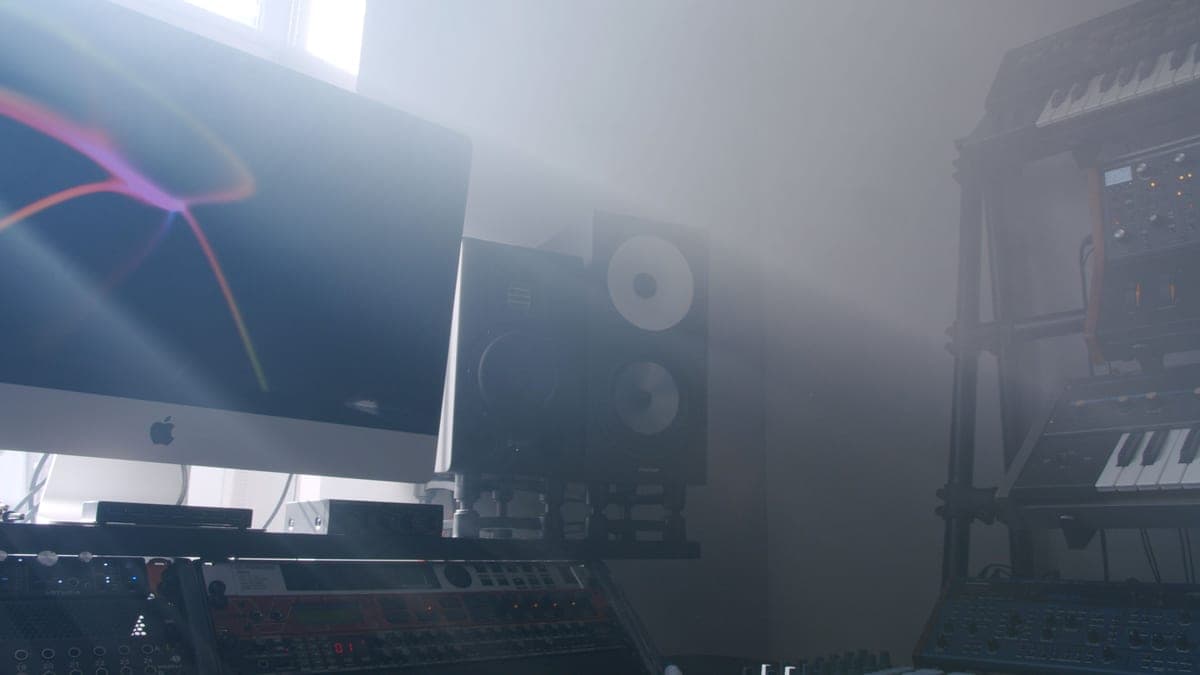
The Yamaha HS5 is the pick: 74 Hz at +/-3 dB is an honest figure, the midrange is the flattest here, and in a small room that flatness is worth more than bandwidth. The JBL 305P MkII is the choice if your listening position cannot be properly centered.
Why 5-inch is the right size for most home rooms
Room modes are the reason. A room's lowest standing wave sits at roughly 170 / (length in meters) hertz. A 3.5-meter room has its first mode near 49 Hz, with peaks and nulls of 10 dB or more around it, and in a bare room nothing damps that.
A larger woofer puts more energy into that region. It does not give you more information about it — it gives you more of your room's opinion about it. So in a room under roughly 150 square feet, a 5-inch driver that rolls off before the worst of the modal region is genuinely the more useful tool, not a compromise.
The five 5-inch monitors, ranked
Yamaha HS5
Top pickYamaha · The flat midrange reference for a small room
The right monitor for an untreated or lightly treated small room, precisely because it does not pretend to have low end your room could not reproduce honestly anyway. If you need to hear below 74 Hz, add a treated room before you add a bigger speaker.
Why it is here
- The honest -3 dB figure of 74 Hz tells you what it will not do, which is rarer than it should be
- Midrange is flat and unflattering, which is the entire job of a monitor
- Small enough to sit at ear height on a desk without dominating the room
What it costs you
- Nothing below about 74 Hz, so you mix low end by trust rather than by ear
- Unforgiving — a rough mix sounds rough, which some people hate
- Rear port needs clearance from the wall
JBL 305P MkII
JBL · The widest usable sweet spot at the price
The right monitor when your listening position is not, and cannot be, the textbook equilateral triangle. If you can sit properly centered, the HS5's flatter midrange is the more useful reference.
Why it is here
- 49 Hz at +/-3 dB from a 5-inch driver is a genuinely good result
- The waveguide gives a wide, stable sweet spot, which forgives a desk you cannot center yourself at
- Magnetically shielded, so it can sit beside a monitor without buzzing
What it costs you
- 108 dB peak SPL is the lowest headroom in this group
- Slightly hyped low end compared with the HS5's flat presentation
- Plastic cabinet
Adam Audio T5V
Adam Audio · Detail at the top, from a ribbon tweeter
Buy it if your work is voice and acoustic material where sibilance and reverb decisions matter, and you will listen at moderate levels. If you mix loud, or find bright speakers tiring, the HS5 is the safer reference.
Why it is here
- The ribbon tweeter resolves reverb tails and sibilance detail a dome cannot
- 45 Hz from a 5-inch cabinet is excellent
- Response to 25 kHz means no audible top-end rolloff at all
What it costs you
- That top-end detail is fatiguing over a long session until you adapt to it
- 20 W on the tweeter is modest if you mix loud
- Ribbon tweeters are less robust than domes if you clip them
Kali Audio IN-5
Kali Audio · A coincident three-way at a two-way price
The pick if you sit close, move around while working and want a stable stereo image — that is exactly what coincident drivers buy. If your room is untreated, spend the difference on panels first; the IN-5 will not out-engineer your walls.
Why it is here
- The coincident mid and tweeter share an acoustic center, so the image does not move as you do
- Crossing over at 280 Hz keeps the woofer out of the vocal range entirely
- 160 W tri-amped, with the same boundary EQ as the LP-6
What it costs you
- Three-way complexity in a small room is often solving a problem the room is causing
- Deep cabinet needs a proper stand, not a desk edge
- Meaningfully more money than the LP-6 for the same published bandwidth
KRK Rokit 5 G4
KRK · Onboard DSP room correction presets
Reasonable if the DSP presets genuinely match your placement and you cross-check mixes on headphones. As a sole reference, the flatter HS5 or 305P MkII will teach you more about your own mixes.
Why it is here
- 43 Hz is the deepest published figure of the 5-inch group here
- Onboard DSP presets address desk and wall placement without external hardware
- Kevlar drivers are physically tough
What it costs you
- 104 dB max SPL is the lowest headroom here
- The Rokit voicing is historically flattering rather than flat — mixes translate less predictably
- 55 W is modest for the claimed bandwidth
What we did not pick, and why
- 6.5-inch and 8-inch monitors. The whole argument of this page. If your room is over about 200 square feet and treated, that changes — see best studio monitors under $500 for the LP-6 V2.
- 4-inch monitors. They roll off so early that the vocal range's lower octave becomes guesswork, and you gain nothing in a room that a 5-inch would trouble.
- Monitors with DSP room correction as their headline feature. Correction can flatten a frequency response measured at one point; it cannot remove a null, because you cannot boost energy the room is canceling.
- Coaxial designs above this price band. The IN-5 is here because it is affordable; the tier above is a better speaker in a better room.
Pair it with
- Stands or pads. Best studio monitor stands — getting a tweeter to ear height matters more than the model.
- Corner treatment. Best bass traps is the purchase that makes any of these more accurate.
- Correct placement. Studio monitor placement, which is free.
- A headphone reference. Best headphones for mixing.
How to choose
- Flattest midrange and an honest spec: HS5.
- Cannot sit centered: JBL 305P MkII, for the waveguide's wide sweet spot.
- Voice and acoustic detail, at moderate levels: Adam T5V and its ribbon tweeter.
- You move around while working and want a stable image: Kali IN-5's coincident drivers.
- You need DSP placement presets and will cross-check on headphones: KRK Rokit 5 G4.