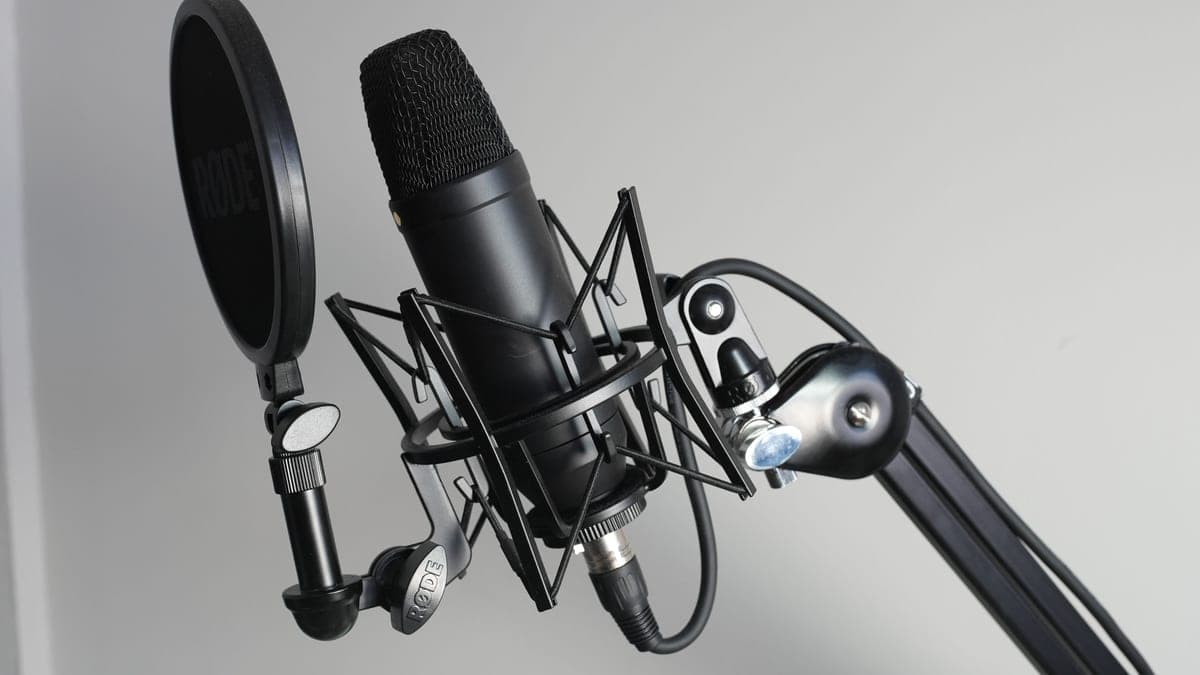
The Audio-Technica AT2035 is the best budget condenser for most people: 12 dB SPL self-noise and a switchable 80 Hz high-pass filter, which is the most useful control you can have on a desk-mounted microphone. The Rode NT1 5th Generation is quieter still at 4 dBA if the budget stretches.
With that said: if the room is handled, a condenser gives you something no dynamic does. The capsule responds to far smaller pressure changes, which means transients, breath and the top octave arrive intact. On a sung vocal or a voice-over that needs to sound open rather than close and dry, that is the difference.
Self-noise is the number that matters
Every condenser has active electronics, and those electronics hiss. Self-noise, published in dB SPL or dB(A), is how loud that hiss is. On a loud source it is irrelevant. On a quiet spoken passage that you then compress and normalize, it is the noise floor of your finished recording.
The table looks like it ranks itself, and the two Rode microphones do have a real and measurable advantage. But note that the AT2035 is the only one with a high-pass filter, and in a real home studio — a desk, a keyboard, footsteps through a floor — desk rumble below 80 Hz is a more common problem than an 8 dB difference in hiss. That is why it wins this page despite not winning the column.
The five condensers, ranked
Audio-Technica AT2035
Top pickAudio-Technica · The value condenser with the switches you actually need
The condenser to buy if you are choosing on value: the high-pass filter and the 8 dB quieter noise floor are worth more in a real room than anything else in this price band. Skip it if you have not treated the room, in which case a dynamic is the better purchase.
Why it is here
- 12 dB self-noise against the AT2020's 20 dB is an audible 8 dB of quiet for a small price step
- The 80 Hz high-pass is the single most useful switch on a desk-mounted condenser
- Ships with a real shockmount, not a plastic clip
What it costs you
- Still a condenser, so the room rules apply
- Slightly forward upper midrange that some voices find harsh
- The 10 dB pad is mostly irrelevant for voice work
Rode NT1 5th Generation
Rode · The quietest capsule most home studios can justify
The right condenser if you have treated the room, or are about to. If your room is bare drywall, the 4 dBA noise floor is irrelevant because the loudest thing on the recording will be the room.
Why it is here
- 4 dBA self-noise is quieter than the room you are recording in, which is the whole point of a condenser
- -32 dB sensitivity means no interface on this site struggles to drive it
- 32-bit float over USB makes clipping a non-event on the digital path
What it costs you
- A condenser hears your room, your keyboard and your fridge — treatment is not optional
- The USB path duplicates an interface you probably also want
- Bright enough that a sibilant voice needs a de-esser
Lewitt LCT 440 Pure
Lewitt · A flatter alternative to the bright budget condensers
Worth the step up if the budget condensers have sounded harsh to you and you want flat rather than flattering. If you want on-mic filtering, the AT2035 gives you more control for less.
Why it is here
- 7 dB(A) is competitive with mics costing considerably more
- Voiced flatter than the NT1-A, so less de-essing on a sibilant voice
- Deliberately stripped of switches, which keeps the signal path simple
What it costs you
- No high-pass filter or pad at all, by design
- Costs more than the AT2035 without adding features
- Smaller dealer network than Rode or Audio-Technica
Rode NT1-A
Rode · A very quiet capsule for very little money
The pick when you need a genuinely quiet condenser on a hard budget and can tame brightness in the mix. If your voice is already sibilant, spend the difference on the AT2035 or the current NT1 instead.
Why it is here
- 5 dB(A) self-noise at this price is the best noise-per-dollar figure in the category
- Usually bundled with a shockmount, pop filter and cable, which is real money
- Long production run means plenty of used stock
What it costs you
- Voiced notably bright — the reason it has a reputation for sibilance
- No high-pass or pad switches
- Older design than the 5th Gen NT1 and does not share its connectivity
Audio-Technica AT2020
Audio-Technica · The entry condenser, if the budget is truly fixed
Buy it only if the AT2035 is genuinely out of reach — the step up buys a high-pass filter and a quieter capsule, which are the two things that matter in an untreated room. On a fixed budget the money is better spent on a dynamic and a panel.
Why it is here
- Cheapest credible XLR condenser, and it has been in production long enough to be a known quantity
- -37 dB sensitivity drives easily from any interface
- Light, so it works on a modest stand
What it costs you
- 20 dB self-noise is 8 dB noisier than the AT2035 and audible on a quiet voice-over
- No high-pass filter, so desk rumble goes straight into the take
- Plastic stand mount rather than a shockmount
What we did not pick, and why
- Multi-pattern condensers at this price. Figure-of-eight and omni patterns are genuinely useful, but the pattern switching at the budget end is implemented by summing two capsules, and the cardioid you will actually use is usually worse than a dedicated cardioid for the money.
- Small-diaphragm pencil condensers. Excellent on acoustic instruments and overheads; not what someone searching for a vocal condenser is trying to buy.
- USB condensers. Same argument as on the podcasting roundup: if you are shopping for XLR you have already decided the converter should be a separate, replaceable part.
- Tube condensers. Another power supply, another warm-up ritual, and a noise floor that is higher, not lower. A budget tube condenser is a worse version of everything on this page.
Pair it with
- Treatment, first. How to treat a room for recording is the page that makes this purchase worth making.
- A shockmount, and use it. A condenser transmits desk vibration straight into the take. The AT2035 includes one; the AT2020 does not.
- Phantom power, which every one of these needs. Any interface in best audio interfaces for a home studio supplies it, and none of these needs a booster — condensers are hot.
- A reflection filter if the walls are off-limits. Best reflection filters.
How to choose
- Answer the room question honestly. Untreated and staying that way means buy a dynamic and stop here.
- If you have desk rumble, footfall, or a keyboard within arm's reach, take the AT2035 for the 80 Hz filter.
- If the room is properly treated and quiet, take the NT1 5th Generation for the 4 dBA noise floor.
- If budget condensers have sounded harsh to you before, take the LCT 440 Pure — it is voiced flatter than the Rode pair.
- Only take the AT2020 if the AT2035 is genuinely out of reach, and know that you are giving up the filter and 8 dB of quiet.