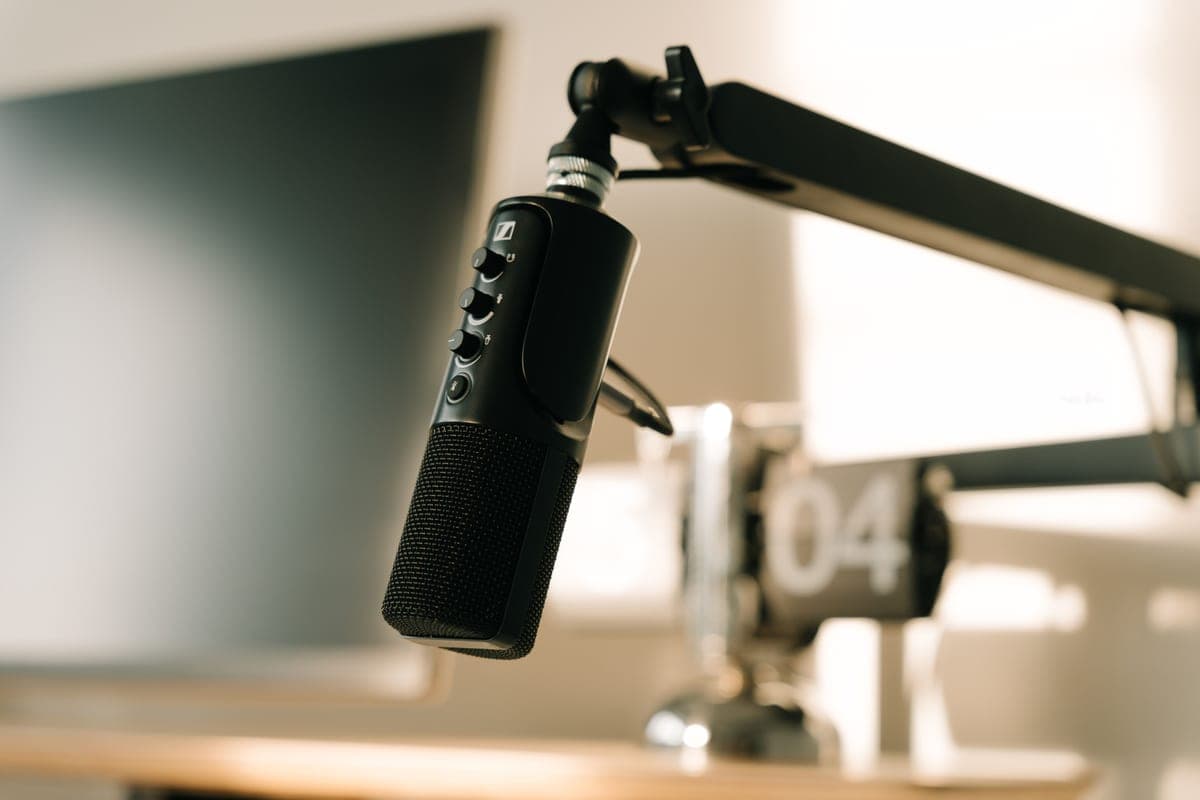
The Shure SM7B is the best dynamic for vocals if your interface supplies 60 dB or more of clean gain. If it does not, the SM7dB is the same capsule with a +28 dB preamp built in, which solves the problem in one purchase rather than two.
A dynamic capsule needs real air movement to generate a signal. That is usually described as a disadvantage — it is why these microphones are quiet and need loud preamps. But it is also the single most useful property a microphone can have in a room you cannot treat, because a reflection arriving off the wall behind you has already lost most of its energy and a dynamic simply does not register it.
That is the whole argument. In a treated room a good condenser will beat any of these on detail. In a bedroom with bare walls, a dynamic sounds closer, drier and more finished, and no amount of processing gets a condenser recording in the same room back to that.
Voicing matters more here than spec sheets suggest
All six of these microphones are cardioid or hypercardioid dynamics with broadly similar bandwidth. What separates them on a voice is how they are voiced through the low-mids and the presence region, and whether they give you any control over it.
If your voice is already bass-heavy, the SM7B's bass rolloff switch is worth more than any tonal difference between the rest. If you cannot keep a fixed distance, the RE20's Variable-D design is worth more than either. Those two facts decide this page for most people.
The six dynamics, ranked
Shure SM7B
Top pickShure · The default upgrade, if your preamp can feed it
Buy it if your interface supplies 60 dB or more of clean gain, or if you are budgeting for a booster alongside it. Buy something else if your only interface is a Scarlett Solo and you are not prepared to add hardware.
Why it is here
- Rejects room and computer-fan noise better than any condenser at any price
- Two voicing switches let one mic cover a thin voice and a boomy one
- Internal shockmount and a yoke that actually holds position on a boom arm
What it costs you
- At -59.0 dBV/Pa it is one of the quietest mics sold, so it demands a loud preamp
- Total cost is the mic plus, very often, a booster
- Heavy enough that a cheap desk arm will droop under it
Shure SM7dB
Shure · An SM7B with the booster problem already solved
The right SM7 for anyone whose interface tops out near 55 dB and who wants one purchase instead of two. Skip it if you already own a Cloudlifter or a 69 dB-gain interface, because you are paying twice for the same 25 dB.
Why it is here
- The +28 dB setting turns a 55 dB-gain interface into enough headroom for this capsule
- One XLR cable, no inline box, no second phantom-power dependency to reason about
- Bypassable, so it behaves as a plain SM7B when you move it to a big preamp
What it costs you
- You pay for the preamp whether your interface needed it or not
- A separate booster can be reused with other low-output mics; this one cannot
- No gain setting between +18 dB and +28 dB
Electro-Voice RE20
Electro-Voice · Movers, leaners and anyone who cannot hold mic distance
Worth the premium if you move while you talk, gesture, or share a mic with someone whose technique you cannot control. If you sit still at a fixed distance, the SM7B's proximity effect is a feature you will use, not a problem you need engineered away.
Why it is here
- Variable-D means the tone barely changes as you drift closer to or further from the grille
- Integral blast filter handles close talking without a separate pop screen
- The bass tilt-down switch is a genuinely useful second voicing, not a gimmick
What it costs you
- Costs more than an SM7B while sounding less immediately flattering on most voices
- Same low-output problem as every broadcast dynamic
- Large and beige, which some people mind
Rode PodMic
Rode · The best value in a broadcast dynamic
The pick for most people upgrading from a USB mic: it gets you 90 percent of the broadcast-dynamic sound without the booster arithmetic. Choose the SM7B instead if your voice is already bass-heavy and you want the bass-rolloff switch.
Why it is here
- At -57 dBV/Pa it needs about 2 dB less gain than an SM7B, which is enough to matter on a 58 dB interface
- Internal pop filter means one less thing clamped to your arm
- All-metal body at a fraction of the SM7B's price
What it costs you
- Voiced with more low-mid weight than the SM7B, so a boomy voice can get boomier
- No voicing switches, so you fix tone in the DAW rather than on the mic
- Still low enough output that a 55 dB interface will be working hard
Audio-Technica BP40
Audio-Technica · Tighter pickup than a cardioid in a live room
The pick when your problem is a live-sounding room and a weak preamp at the same time: the narrow pattern and the hot output solve both. Avoid it if you or your guests cannot stay on-axis.
Why it is here
- At -48 dB it is dramatically hotter than an SM7B and needs no booster on anything modern
- Hypercardioid pattern narrows the pickup further than the cardioid competition
- Switchable 100 Hz rolloff at 6 dB/octave for close work
What it costs you
- 632 g needs a serious arm or stand
- Hypercardioid punishes sloppy mic technique — step off-axis and you vanish
- Voiced large and forward, which is not every voice's friend
Shure SM58
Shure · The cheapest way to hear what a dynamic does for you
The right first XLR mic if the real question is whether a dynamic fixes your room, because it answers that for very little money on the interface you already own. It is a diagnostic, not a destination.
Why it is here
- At -54.5 dBV/Pa it is the hottest dynamic here, and works on genuinely modest preamps
- Light enough for any stand or arm you already own
- Effectively indestructible, and resells for most of what you paid
What it costs you
- Response stops at 15 kHz and it is voiced for a PA, not a studio
- Handheld grille shape is awkward on a desk boom
- You will outgrow it if voice is your main output
What we did not pick, and why
- Ribbon microphones. Genuinely lovely on some voices, and genuinely a bad first purchase: they are even quieter than these, they are fragile, and a phantom-power mistake can destroy one. If you go there, read the phantom-power behavior in Cloudlifter vs FetHead before you plug anything in.
- The Rode Procaster. A capable broadcast dynamic, but we could not verify its published sensitivity from a manufacturer source in this pass, and the whole ranking here turns on that figure. We would rather leave it off than print a number we cannot cite.
- Handheld stage dynamics other than the SM58. They are designed to survive being dropped and to reject feedback, not to sound good eight inches from a desk. The SM58 is here as a deliberately cheap diagnostic, not as a recommendation to buy a stage mic for a studio.
Pair it with
- Gain, before anything else. Five of these six want more than a budget interface supplies. How much clean gain do you need lists which interfaces reach which figure.
- A reflection filter if you cannot treat the room. Best reflection filters — a dynamic plus a shield is a genuinely workable vocal setup in a rented room.
- A stand that holds the weight. The BP40 is 632 g. Best mic stands covers what that means in practice.
How to choose
- Look up your interface's published maximum mic gain. Everything else is downstream of that number.
- If it is 60 dB or more, choose on voicing: SM7B for control, PodMic for value, RE20 for movement.
- If it is 55-58 dB, either add a booster (about the cost of the gap) or buy the SM7dB and be done.
- If it is under 55 dB or unpublished, buy the BP40 or the SM58 — both are hot enough to work on anything.
- If you share the microphone with guests, avoid the BP40's hypercardioid pattern and pick a cardioid.