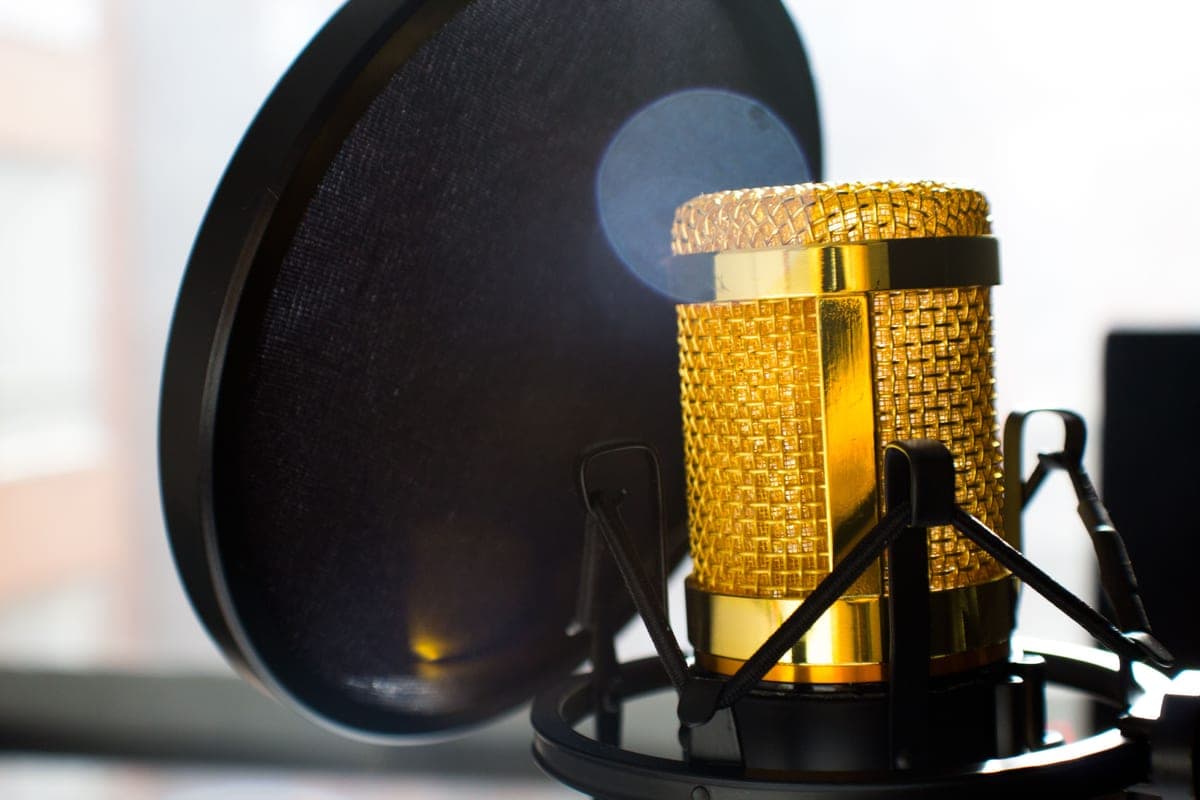
The Stedman Proscreen XL is the pick if you record daily: a patented metal screen that redirects plosive air downward rather than trapping it, a 6.125 inch screen that covers off-axis movement, and you rinse it clean instead of replacing it. The Rode WS2 weighs 10 g against the Stedman's 10 oz, which matters if your arm is near its limit.
A plosive is a burst of air, not a sound. A "p" or "b" fires a slug of moving air at the capsule, which produces a low-frequency thump that is largely unfixable afterwards because the capsule was physically displaced. A filter interrupts the air without meaningfully interrupting the sound.
Two approaches do that. A screen sits a few inches in front of the microphone and breaks up the airflow. A windshield is foam over the capsule itself, which disperses air in the same volume as the microphone. Both work; they fail differently and they weigh very differently.
Why a metal screen is different from a mesh one
A nylon mesh screen slows the air by making it pass through fabric, which also attenuates some high frequencies as a side effect. Stedman's patented approach uses a metal screen shaped to redirect the plosive downward and away rather than trapping it in the material, which is the reason they claim less high-frequency loss.
The practical difference most people notice is not tonal but maintenance: you rinse a metal screen and use it for years, where a nylon mesh filter accumulates whatever comes out of your mouth and becomes a consumable.
Both filters in detail
Stedman Proscreen XL
Top pickStedman · A pop filter you can wash instead of replace
Worth it if you record daily and have replaced a fabric filter more than once. For occasional recording a nylon filter at a tenth of the price does the same acoustic job.
Why it is here
- The patented metal screen redirects plosive air downward rather than trapping it in fabric
- 6.125 inches of screen covers off-axis movement a small filter does not
- Rinse it clean; a nylon mesh filter is a consumable
What it costs you
- 10 oz on a 13-inch gooseneck is real leverage on a boom arm
- Costs many times a nylon filter
- 26.5 inches overall needs somewhere to live when you are not recording
Rode WS2
Rode · Plosive control without anything on your arm
The right choice when your arm is already at its weight limit, or when the mic has to stay portable. A mesh or metal screen keeps the top end cleaner if you have the load capacity for one.
Why it is here
- 10 g adds nothing to your arm's load, unlike a 10 oz metal filter
- Sits on the mic, so the mic can move without re-aiming a separate screen
- Cheapest effective plosive control there is
What it costs you
- Foam over a capsule takes a little top end with it
- Sized for specific Rode bodies — check the fit before ordering
- Foam degrades over a few years
What we did not pick, and why
- Cheap nylon mesh filters on flexible goosenecks. They work acoustically and they are a genuinely reasonable purchase for occasional recording. They are not here because the gooseneck drifts under load and the mesh is a consumable — both fixable by spending once.
- Double-layer mesh filters. More attenuation of the plosive and more attenuation of the top end. If you need two layers, you are too close.
- Foam covers not sized for your microphone. A loose windshield rattles; a tight one compresses the grille. Check the fit list — the WS2 names the Rode bodies it fits.
- Filters that clamp to the microphone body. Adding mass at the capsule is the worst place for it and it compromises whatever shockmount is inside.
What a pop filter does not do
- Fix sibilance. A hard "s" is high-frequency sound, not moving air. That is a de-esser, or a different microphone, or turning slightly off-axis.
- Reduce room noise. It is a windbreak, not an absorber.
- Set your distance. It happens to enforce a minimum distance, which is a useful side effect rather than the purpose.
- Replace technique. Speaking slightly across the capsule rather than straight into it removes most plosives for free.
Pair it with
- An arm with headroom in its load rating. Best boom arms.
- A microphone that does not already have one. The PodMic and RE20 both have internal filtering, so a screen is optional.
- Something absorptive behind you, because the filter does nothing about the room. Best acoustic panels.
How to choose
- Check your arm's remaining load capacity. If it is tight, the decision is made: 10 g not 10 oz.
- How often do you record? Daily means buy the cleanable metal screen once.
- Does your microphone already filter internally? If so, a light foam windshield is plenty.
- Do you move while talking? A 6.125 inch screen covers more off-axis movement than a small one.
- Try technique first. Speaking slightly across the capsule is free and removes most of the problem.