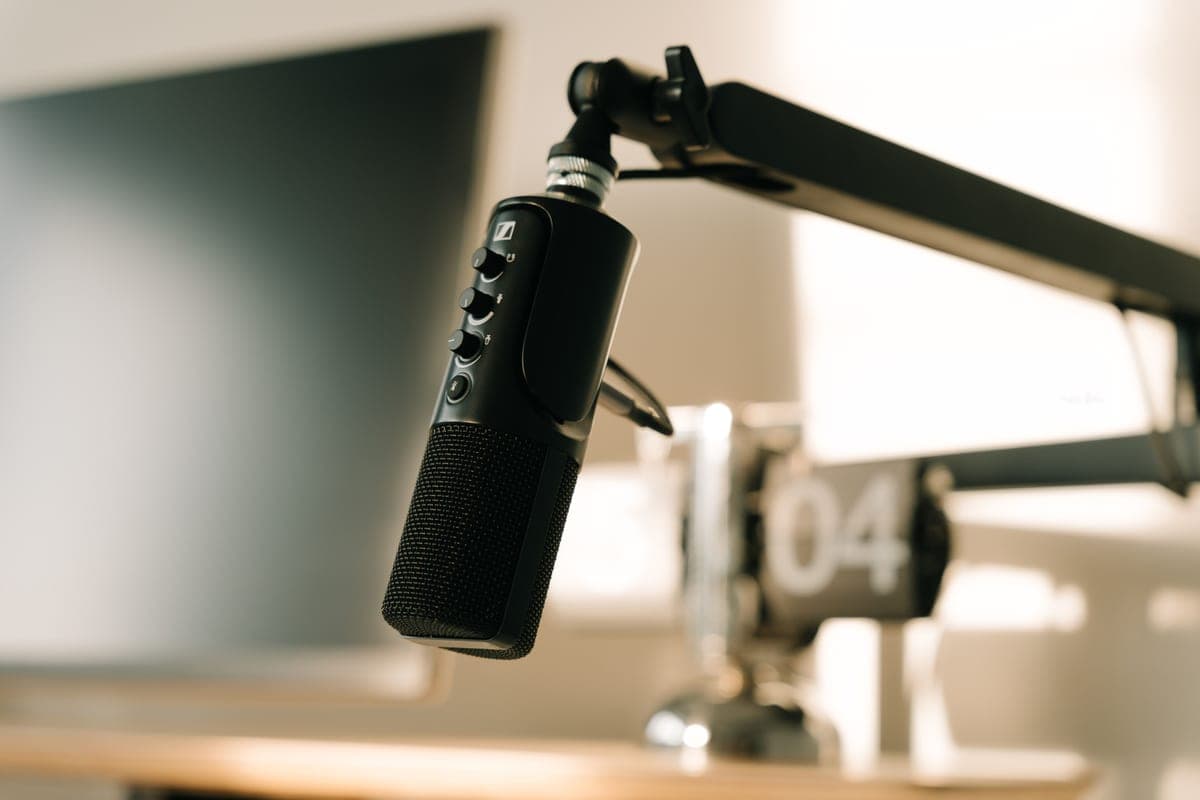
If your interface supplies 60 dB or more of clean gain, buy the SM7B — you would be paying for a preamp you do not need. Below about 58 dB, buy the SM7dB: its +28 dB setting solves the problem in one purchase, and it is bypassable if you later move to a bigger preamp.
This is an unusually clean comparison, because Shure did not change the capsule. The SM7dB is an SM7B with a switchable preamp in the body, and the preamp can be switched out entirely, at which point the two microphones are the same microphone. So there is no tonal debate to have — only an arithmetic one.
Short answer: do the arithmetic once
The SM7B capsule wants roughly 60 dB of clean gain for spoken word at a normal working distance. Your interface publishes a maximum mic gain figure. Subtract, and you know what you need.
Choose the SM7B if
- Your interface already publishes 60 dB or more. Paying for a built-in preamp you will never switch on is simply spending more for the same recording.
- You already own a Cloudlifter or FetHead. You have bought the gain once; buying it again inside a microphone is waste.
- You expect to add a second low-output microphone — a ribbon, another dynamic. A separate booster serves both; a built-in one serves one.
- You want a microphone that needs no phantom power, for instance to use on a passive splitter or an older console.
Choose the SM7dB if
- Your interface tops out at 55-58 dB and you want one box, one cable, one decision.
- You do not want an inline booster hanging off the back of the microphone adding leverage to your boom arm.
- Your interface does not publish a gain figure at all. In that situation the SM7dB is the safe purchase — you are not betting on an unknown.
- You want the option to bypass it later. Buying the SM7dB does not lock you out of using it as a plain SM7B on a big preamp.
What the preamp does and does not fix
It raises the signal before your interface's own preamp sees it, so your interface runs at a lower, quieter gain setting. That removes hiss. What it does not do is change the capsule's frequency response, its off-axis behavior or its proximity effect. If your recordings sound boomy or hollow, this product does not address that — that is the room, and no preamp fixes a room.
Both microphones in detail
Shure SM7dB
Top pickShure · An SM7B with the booster problem already solved
The right SM7 for anyone whose interface tops out near 55 dB and who wants one purchase instead of two. Skip it if you already own a Cloudlifter or a 69 dB-gain interface, because you are paying twice for the same 25 dB.
Why it is here
- The +28 dB setting turns a 55 dB-gain interface into enough headroom for this capsule
- One XLR cable, no inline box, no second phantom-power dependency to reason about
- Bypassable, so it behaves as a plain SM7B when you move it to a big preamp
What it costs you
- You pay for the preamp whether your interface needed it or not
- A separate booster can be reused with other low-output mics; this one cannot
- No gain setting between +18 dB and +28 dB
Shure SM7B
Shure · The default upgrade, if your preamp can feed it
Buy it if your interface supplies 60 dB or more of clean gain, or if you are budgeting for a booster alongside it. Buy something else if your only interface is a Scarlett Solo and you are not prepared to add hardware.
Why it is here
- Rejects room and computer-fan noise better than any condenser at any price
- Two voicing switches let one mic cover a thin voice and a boomy one
- Internal shockmount and a yoke that actually holds position on a boom arm
What it costs you
- At -59.0 dBV/Pa it is one of the quietest mics sold, so it demands a loud preamp
- Total cost is the mic plus, very often, a booster
- Heavy enough that a cheap desk arm will droop under it
If neither: the third option
You can also solve this by not buying an SM7 at all. The Audio-Technica BP40 at -48 dB needs no help from anything, and the Shure MV7+ at -55 dBV/Pa is hotter than an SM7B by 4 dB. Both appear in best SM7B alternatives.