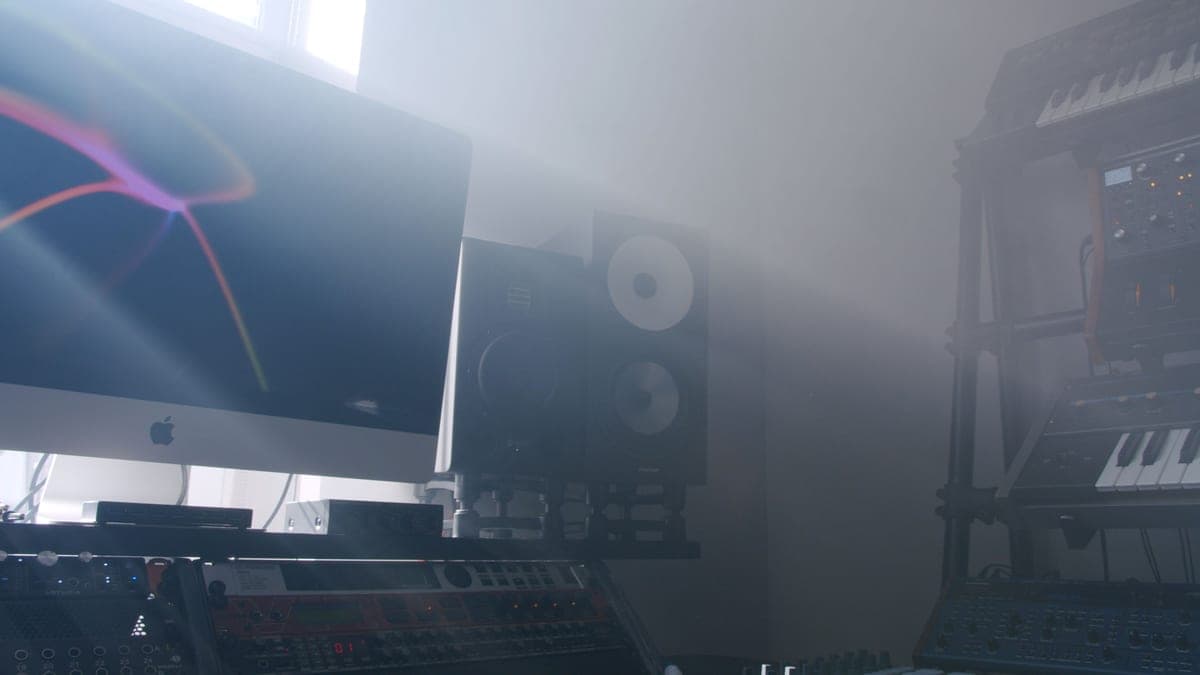
Buy the IN-5 if you sit close, move around while you work, or care about a stereo image that holds still — its coincident mid and tweeter share an acoustic center, and crossing over at 280 Hz keeps the woofer out of the vocal range entirely. Buy the LP-6 V2 if you want the same published bandwidth for meaningfully less money and your listening position is fixed.
This is an unusually clean comparison because Kali publishes the same bandwidth figures for both speakers: 39 Hz to 25 kHz at -10 dB, and 47 Hz to 21 kHz at +/-3 dB. Whatever the extra money buys, it is not more low end. That makes it one of the few monitor comparisons where you can set the frequency-response argument aside and talk about what actually differs.
What a coincident three-way actually gives you
In a conventional two-way monitor the woofer and the tweeter are in different places on the baffle, so the distance from each driver to your ears changes as you move. The result is a stereo image that shifts slightly with your head position, and a crossover region that behaves differently off-axis than on.
The IN-5 puts the tweeter in the center of the midrange driver, so those two share one acoustic center. The image does not move as you do. If you sit close to your speakers — and in a home studio you almost certainly do — that is a more useful property than another few hertz of low end.
The second architectural advantage is the 280 Hz crossover. On a two-way, the woofer is still reproducing the fundamental of a male voice and much of the body of a guitar. On the IN-5, everything from 280 Hz up to 2,800 Hz comes from a dedicated 4 in midrange driver that is doing nothing else — which is the frequency range where vocals are mixed.
Where the LP-6 V2 is the better buy
- Price, for the same published reach. 47 Hz at +/-3 dB is 47 Hz at +/-3 dB, and the LP-6 V2 is the cheaper route to it. It is the best value in best studio monitors under $500 for that reason.
- A published max SPL of `115 dB`, which is huge headroom for a desk speaker. Kali publishes no equivalent figure for the IN-5.
- Shallower cabinet. The IN-5 is a deep box that wants a proper stand rather than a desk edge, and desk depth is the scarcest resource in most home studios.
- Simplicity. A three-way crossover network in a small room is often solving a problem your room is causing. If the room is untreated, the money belongs in acoustic panels and not in a third driver.
The boundary EQ is not optional on either
Both monitors carry boundary EQ switches on the rear, and both need them set honestly. A speaker close to a wall gets a low-frequency lift from that boundary whether you account for it or not; the switches exist to subtract it. Left at the default with the cabinet jammed against drywall, either of these will read as bass-heavy and you will mix thin to compensate.
This is the single most commonly skipped step in setting up a Kali monitor, and it is free. Set it, then set your placement, then worry about which speaker you bought.
Both Kalis, plus the reference the pair are judged against
Kali Audio IN-5
Top pickKali Audio · A coincident three-way at a two-way price
The pick if you sit close, move around while working and want a stable stereo image — that is exactly what coincident drivers buy. If your room is untreated, spend the difference on panels first; the IN-5 will not out-engineer your walls.
Why it is here
- The coincident mid and tweeter share an acoustic center, so the image does not move as you do
- Crossing over at 280 Hz keeps the woofer out of the vocal range entirely
- 160 W tri-amped, with the same boundary EQ as the LP-6
What it costs you
- Three-way complexity in a small room is often solving a problem the room is causing
- Deep cabinet needs a proper stand, not a desk edge
- Meaningfully more money than the LP-6 for the same published bandwidth
Kali Audio LP-6 V2
Kali Audio · The most low end per dollar, with boundary EQ
The best value here if you set the boundary EQ honestly and have corner traps in. In a bare bedroom with the switches left at default, the extra low end makes your mixes worse, not better, and the HS5 is the wiser buy.
Why it is here
- 47 Hz at +/-3 dB is real low end, not a marketing figure
- Boundary EQ switches on the back are the only honest answer to a speaker jammed against a wall
- 115 dB max SPL means huge headroom for a desk speaker
What it costs you
- That low-end reach is a liability in an untreated room — you will chase room modes, not mix decisions
- 6.5-inch driver in a small room needs the boundary EQ set correctly or it is worse than an HS5
- Paper cone is more fragile than the alternatives
Yamaha HS5
Yamaha · The flat midrange reference for a small room
The right monitor for an untreated or lightly treated small room, precisely because it does not pretend to have low end your room could not reproduce honestly anyway. If you need to hear below 74 Hz, add a treated room before you add a bigger speaker.
Why it is here
- The honest -3 dB figure of 74 Hz tells you what it will not do, which is rarer than it should be
- Midrange is flat and unflattering, which is the entire job of a monitor
- Small enough to sit at ear height on a desk without dominating the room
What it costs you
- Nothing below about 74 Hz, so you mix low end by trust rather than by ear
- Unforgiving — a rough mix sounds rough, which some people hate
- Rear port needs clearance from the wall
Why the HS5 is still on this page
Both Kalis reach well below what a small untreated room can reproduce honestly. The Yamaha HS5 publishes 74 Hz at -3 dB — it stops roughly where a bedroom stops being trustworthy — and its midrange is the flattest in the category. In a bare room it will teach you more about your own mixes than either Kali will, which is an uncomfortable thing to say on a page comparing two better-specified speakers. Yamaha HS5 vs Kali LP-6 argues that case in full, and best studio monitors for an untreated room generalises it.
Which to buy
- Treated room, you sit close, you want the best imaging available at the price: IN-5.
- Treated room, fixed listening position, value matters: LP-6 V2.
- Untreated room: neither yet. Two panels and a pair of HS5s, or the LP-6 V2 with its boundary EQ set correctly and corner traps on the shopping list.
- You work with someone sitting beside you: IN-5, or a JBL 305P MkII for its waveguide if the budget is tighter.