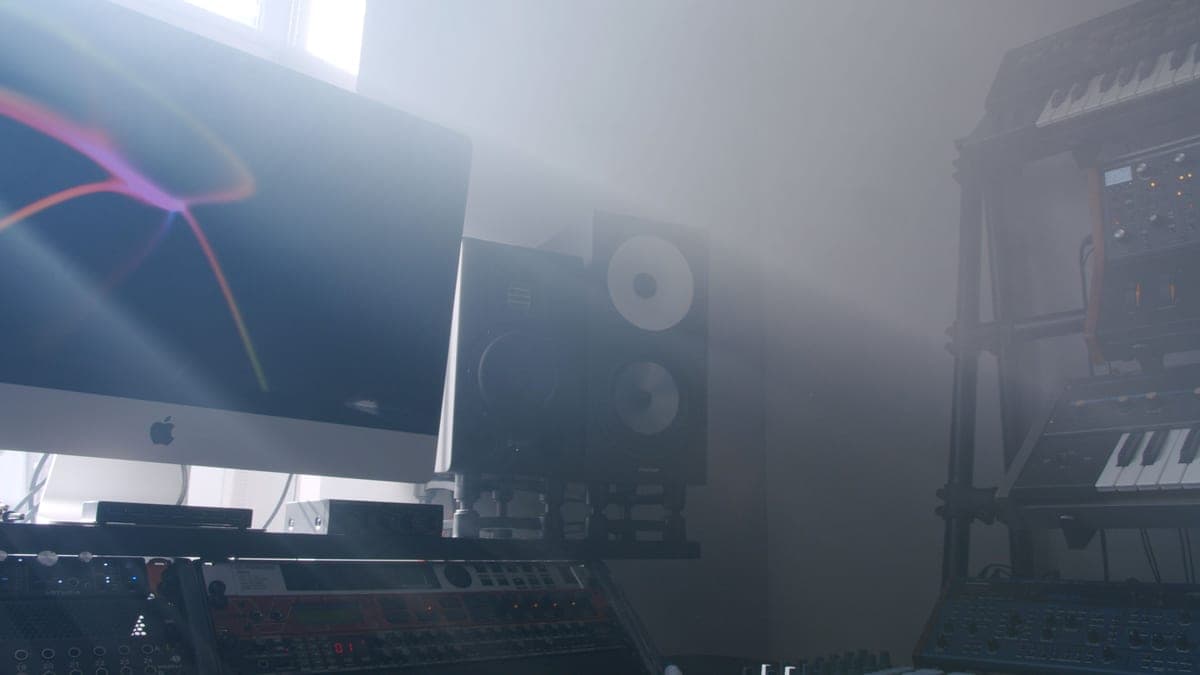
Buy the Yamaha HS5 if your room is untreated — its 74 Hz at +/-3 dB stops before the worst of your room's modal region, which is an advantage rather than a shortcoming. Buy the Kali LP-6 V2 if you have corner treatment and will set the boundary EQ correctly; 47 Hz at +/-3 dB is then genuinely usable extra information.
Why deeper is not automatically better
This is the part that matters, and most comparisons of these two skip it. A small room's lowest standing wave sits around 170 / (length in meters) hertz — near 49 Hz in a 3.5-meter room — with peaks and nulls of 10 dB or more around it. That is an order of magnitude larger than any difference between these two speakers.
The LP-6 V2 puts real energy into that region. In a room with corner absorption, you hear more of the recording. In a bare room, you hear more of the room — and you will make low-end decisions against your walls that do not survive anywhere else. The HS5 rolling off at 74 Hz sidesteps most of it.
So the honest framing is that the LP-6 V2 is the better speaker and the HS5 is often the better purchase. Which one applies to you depends entirely on whether bass traps are in the room or on a wishlist.
Choose the HS5 if
- Your room is untreated or lightly treated, which is most home studios.
- Your work is voice-led — podcast, voice-over, dialogue — where the vocal range matters and the bottom octave does not.
- You want the flattest midrange here. The HS voicing is deliberately unflattering, and that is the job.
- Your desk is shallow and the monitors will sit close to a wall, where a 6.5 inch woofer's output becomes harder to manage.
Choose the LP-6 V2 if
- You have corner treatment in, so 47 Hz is information rather than interference.
- You mix music with real low-frequency content and need to hear it.
- You will actually set the boundary EQ switches on the back to match your placement — this is not optional with this speaker.
- You want the headroom: 115 dB max SPL and 80 W is more than the HS5 offers.
Midrange accuracy and room tolerance
The HS5's reputation for a flat, unforgiving midrange is earned, and it is the main reason it remains a default recommendation after many years. A rough mix sounds rough on it, which is uncomfortable and useful.
The LP-6 V2's midrange is also good, and its boundary EQ is the more honest engineering answer to a speaker jammed against a wall — Yamaha's room control switches do less. But boundary EQ only helps if you use it. Left at default in a corner, the LP-6 V2 is worse in a small room than the HS5 is.
What else you need to buy
- Both: stands or isolation to get the tweeter to ear height and the cabinet off the desk.
- Both: balanced cables from an interface with balanced outputs.
- LP-6 V2 especially: corner bass traps, or you have bought bandwidth you cannot trust.
Both monitors in detail
Yamaha HS5
Top pickYamaha · The flat midrange reference for a small room
The right monitor for an untreated or lightly treated small room, precisely because it does not pretend to have low end your room could not reproduce honestly anyway. If you need to hear below 74 Hz, add a treated room before you add a bigger speaker.
Why it is here
- The honest -3 dB figure of 74 Hz tells you what it will not do, which is rarer than it should be
- Midrange is flat and unflattering, which is the entire job of a monitor
- Small enough to sit at ear height on a desk without dominating the room
What it costs you
- Nothing below about 74 Hz, so you mix low end by trust rather than by ear
- Unforgiving — a rough mix sounds rough, which some people hate
- Rear port needs clearance from the wall
Kali Audio LP-6 V2
Kali Audio · The most low end per dollar, with boundary EQ
The best value here if you set the boundary EQ honestly and have corner traps in. In a bare bedroom with the switches left at default, the extra low end makes your mixes worse, not better, and the HS5 is the wiser buy.
Why it is here
- 47 Hz at +/-3 dB is real low end, not a marketing figure
- Boundary EQ switches on the back are the only honest answer to a speaker jammed against a wall
- 115 dB max SPL means huge headroom for a desk speaker
What it costs you
- That low-end reach is a liability in an untreated room — you will chase room modes, not mix decisions
- 6.5-inch driver in a small room needs the boundary EQ set correctly or it is worse than an HS5
- Paper cone is more fragile than the alternatives
If neither: the third option
If your listening position cannot be properly centered, the JBL 305P MkII has the widest usable sweet spot of the three and reaches 49 Hz at +/-3 dB. The full field is in best studio monitors under $500.