No. Bass traps absorb low-frequency energy inside the room, which flattens the room's own response and shortens its decay. Soundproofing is transmission loss — stopping energy passing through a wall — and that needs mass, decoupling and airtight sealing, none of which a porous absorber provides. A corner trap will make your recordings and mixes better and will not make you a quieter neighbour.
This is the most expensive misunderstanding in home studio buying, because the two problems feel like the same problem. Both involve low frequencies, both involve walls, and both are described in marketing copy with the word 'soundproofing'. They are governed by different physics and solved by opposite material properties.
Absorption and transmission loss are opposite requirements
An absorber works by being porous. Sound enters the material, air moves through a tortuous path of fibres, friction converts the acoustic energy into a tiny amount of heat, and less energy comes back out. Low density and open structure are what make that work.
A barrier works by being heavy, airtight and, ideally, decoupled from the structure on the other side. Sound hits it, the mass resists being moved, and very little energy is radiated on the far side. High density and complete sealing are what make that work.
So a good absorber is light and open, and a good barrier is heavy and closed. Mineral wool is one of the best absorbers you can buy and one of the worst barriers, which is exactly why a wall full of it still needs two layers of drywall to be quiet. Soundproofing vs acoustic treatment is the full version of this distinction.
Those 125 Hz figures are genuinely good — 0.65 from the 4-inch panel means it removes about two-thirds of the energy arriving at it down there, which is why thickness is the specification that matters for a trap. And none of those numbers has any bearing on how much sound your neighbour hears, because absorption coefficients describe energy removed from the room, not energy stopped at the boundary.
What bass traps actually do for you
- They flatten the low end at your listening position. Room modes cause 10 dB or more of variation below 200 Hz in a bedroom-sized room; corner trapping reduces that spread so your monitors tell you something closer to the truth.
- They shorten low-frequency decay. A bass note that rings for half a second after it stops is the reason small-room mixes end up bass-light — you compensate for a ring that is the room's, not the track's.
- They reduce boxiness on recordings. The thick, hollow quality in home voice recordings is low-mid energy arriving late, and a thick absorber at the right place is the only thing that removes it.
- They make a monitor's extension meaningful. A speaker reaching 39 Hz in an untreated room measures a response the room has already ruined. Are expensive studio monitors worth it runs that argument with figures.
Every one of those is a real, audible improvement to work done in the room. None of them is soundproofing.
What to buy if the problem is the room, not the wall
Three absorbers thick enough to publish a real 125 Hz figure - the finished panel, the rigid-edge option, and the raw board if you build your own frames.
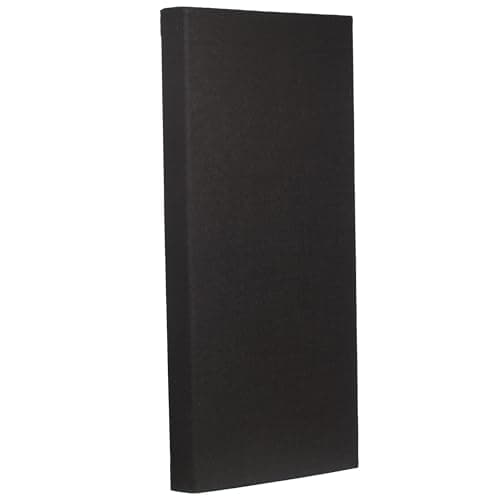
ATS Acoustics Panel (4-inch)
Top pickATS Acoustics · The deepest panel that still publishes a 125 Hz figure
The pick if you only treat two positions and want them to reach low-mid frequencies: at `0.65` against the two-inch panel's `0.12` at `125 Hz`, the extra two inches buy more than a second pair of thin panels would. Choose the two-inch version instead if you are covering a lot of wall and the room's problem is flutter echo rather than boxiness.
Why it is here
- Publishes `0.65` at `125 Hz` — the band that decides whether a small room sounds boxy, and the one almost no panel maker quotes
- Four inches of mineral wool does the work that no amount of NRC marketing on a two-inch panel can
- Arrives finished and fabric-wrapped, so there is no frame to build
What it costs you
- Four inches is a visible object on a wall, not a discreet tile
- Costs more than the two-inch version of the same panel for the same wall area
- Not fire rated, which rules it out of some rented or commercial rooms
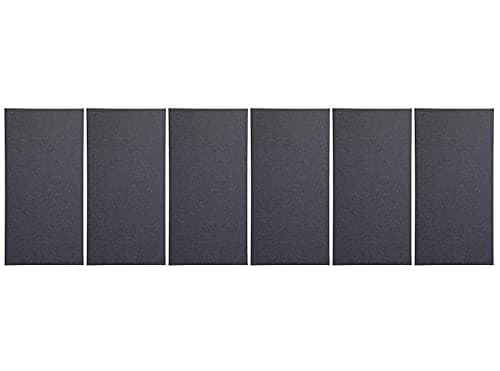
Primacoustic Broadway Broadband Panel (6-pack)
Primacoustic · Rigid-edge panels that survive being moved
The right buy if you are treating a whole room at once, want a finished durable panel and cannot build your own — six panels is enough for both first-reflection points plus the wall behind you. Note that NRC 1.00 at 2 inches is not a low-frequency claim: corners still need depth, so pair it with something thicker.
Why it is here
- 6 lb/ft3 density is at the high end of what is used for broadband absorption
- Resin-hardened edges mean the corners survive handling, unlike bare mineral wool
- Class A/1 fire rating, which matters if the room is rented
What it costs you
- The 2-inch version's NRC of 1.00 says nothing about what it does below 250 Hz
- Sold only as a six-panel set, so it is the largest single outlay on this page by a wide margin
- Color range is limited
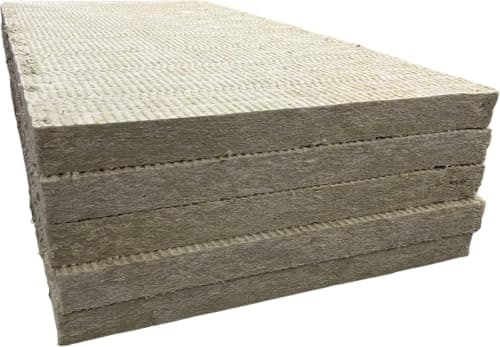
Rockwool Mineral Wool Board, 3-inch (DIY panels)
Rockwool · DIY panels at a thickness that reaches low frequencies
Buy it if you will actually build the frames and you want depth rather than a finished look — three inches of mineral wool beats any two-inch finished panel below `250 Hz`. Buy Owens Corning 703 instead if you want the best-documented figure at `125 Hz`, which is `0.53` at `3 in`.
Why it is here
- Three inches of mineral wool is where DIY absorption starts reaching the low-mid band that matters in a small room
- Rigid enough at `8 lb/ft3` to hold its own shape in a frame, unlike a soft batt
- Cheapest route to a lot of absorbing depth if you are willing to build frames
What it costs you
- You are buying a raw building material: frames, fabric and labour are all on you
- At `8 lb/ft3` it is denser than the classic DIY batt, which helps rigidity but not low-frequency absorption
- Same dust and glove precautions as any mineral fiber
What actually reduces low-frequency transmission
- Mass. Every doubling of a partition's mass buys you roughly 6 dB of transmission loss. In practice that means a second layer of drywall, not a panel hung on the first one.
- Decoupling. Two independent leaves with an air gap, on resilient channel or separate studs, so vibration cannot travel through a rigid connection. This is the biggest single factor at low frequencies and the hardest to retrofit.
- Sealing. Low-frequency energy follows air. An unsealed gap around a door, an electrical box or a floor junction will undo an otherwise good wall, and sealing is the cheapest item on this list by a wide margin.
- Damping. A viscoelastic layer between two rigid sheets converts bending energy into heat, which specifically helps in the band where mass alone struggles.
- Absorption inside the cavity. And here is the one place a porous absorber does contribute to soundproofing — mineral wool inside a stud cavity damps the resonance between the two leaves. It is a supporting role in an assembly, not a product you hang on a finished wall.
Notice that four of those five require building work, and the fifth is caulk. That is the honest reason soundproofing is rarely a sensible project in a rented room, and why the practical answer there is usually scheduling and microphone choice rather than construction.
If the problem is noise getting in
The most common real version of this question is somebody recording in a room with traffic, a neighbour or a family on the other side of a door, who has read that bass traps help. They do not, and the things that do help are unglamorous.
- Seal the door. A hollow internal door with a half-inch gap underneath is the weakest point in almost every home studio. Weatherstripping and a door sweep cost very little and are the highest-return purchase in this entire topic.
- Record a dynamic microphone, close. A dynamic capsule hears far less of a distant noise source than a condenser does. Dynamic vs condenser microphones.
- Use the microphone's pattern. Point the null of a cardioid at the noise. Free, and often worth several decibels.
- Schedule around it. Unromantic, effective, and what most professional home recording actually involves.
Where to put traps, once you are buying them for the right reason
Corners, starting with the two behind your monitors and the two behind your head. Low-frequency pressure is highest where surfaces meet, so a corner is where an absorber has the most energy available to convert — and a trap straddling the corner with an air gap behind it works considerably better than one flat on the wall.
Thickness is the other half. A 2-inch panel does almost nothing at 125 Hz; the 4-inch panel in the table above publishes 0.65. For the bottom two octaves, depth is the specification. Best bass traps ranks the field on exactly that, and how to treat a room for recording has the order to do it in.
The summary: buy bass traps because your low end is untrustworthy and your recordings sound boxy. Both of those are true problems in almost every home studio, and traps are the right fix. Do not buy them expecting a quieter neighbour, because the published numbers never promised that.