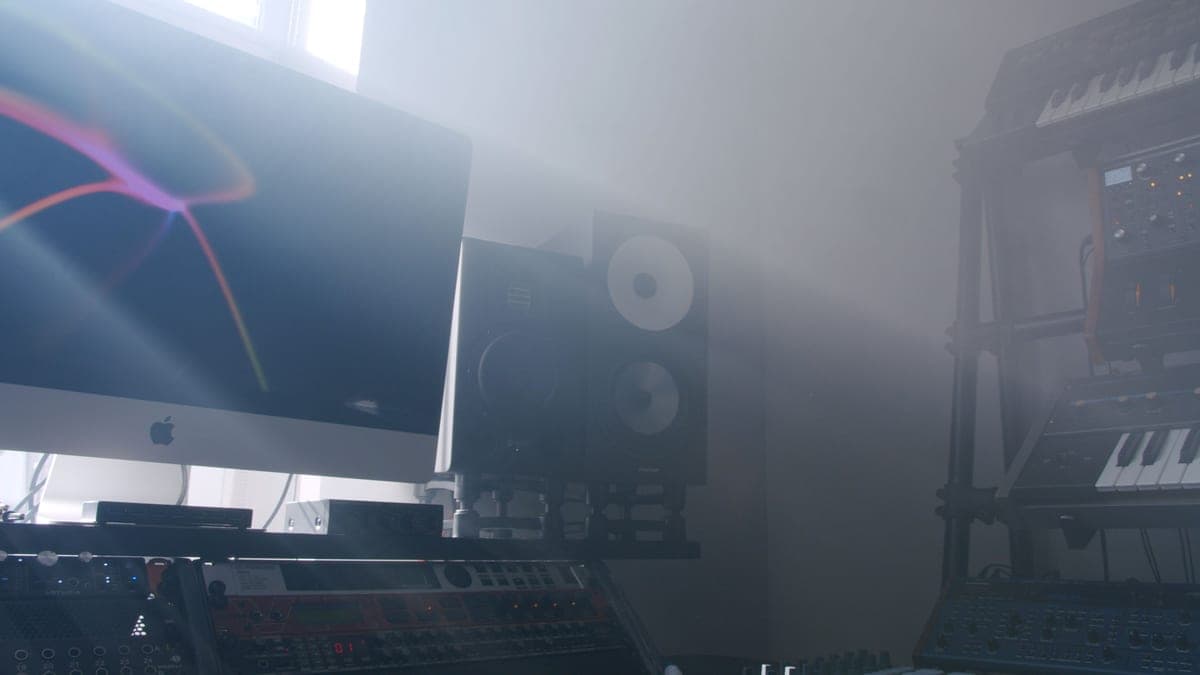
Buy the Yamaha HS5 if your room has no corner treatment — its 74 Hz limit at +/-3 dB keeps a 5 inch woofer out of the region a small bare room gets most wrong. Buy the Yamaha HS7 once bass traps are in: 43 Hz at +/-10 dB from a 6.5 inch driver and 95 W of amplification is a real extension of what you can hear.
Same voicing, different exposure to your room
These are not two different speakers in the way the HS5 and a Kali LP-6 are two different speakers. The HS family voicing is the same: flat, unflattering through the midrange, deliberately unglamorous. A rough mix sounds rough on both, which is the entire point.
What changes is how much of your room you are inviting into the mix. A 6.5 inch woofer with 60 W behind it puts real energy into the region where a small room's standing waves live. In a treated room that energy is information. In a bare bedroom it is a 10 dB peak at one frequency and a null at another, and you will equalise against both.
Choose the HS5 if
- Your corners have no bass traps in them, which describes most home studios.
- Your work is voice-led — podcast, voice-over, dialogue — where nothing depends on hearing 43 Hz accurately.
- Your desk is shallow and the cabinets will sit close to a wall.
- You want the cheaper and lighter pair, and the extra money to go on acoustic treatment instead. That is the better-value version of this decision.
Choose the HS7 if
- Corner traps are already in, so 43 Hz is information rather than interference.
- You mix music with real low-frequency content and need to hear the bottom of it.
- You mix at a level where 70 W starts to feel strained — 95 W is the meaningful headroom difference.
- You can give the cabinets distance from the wall behind and from your ears. A 6.5 inch two-way wants more room than most desks allow.
The crossover point nobody mentions
Yamaha publishes a 2 kHz crossover for the HS7, which keeps the whole vocal fundamental range and most of its first harmonics on one driver. That is a genuine advantage for voice work, and it is the one argument for the HS7 that does not depend on your room being treated.
It is still not enough to overturn the recommendation. A 2 kHz crossover in a room with an untamed 50 Hz peak is solving the smaller problem — and at that point the money belongs in the corners, not in the cabinet.
What you need to buy either way
- Stands or isolation. Tweeter at ear height, cabinet off the desk. Best studio monitor stands.
- Balanced cables from an interface with balanced outputs. Best audio interfaces for a home studio.
- HS7 especially: corner bass traps, or you have bought bandwidth you cannot trust. Best bass traps.
- A headphone cross-check for the bottom octave, whichever you buy. Best open-back headphones for mixing.
Both monitors in detail
Yamaha HS5
Top pickYamaha · The flat midrange reference for a small room
The right monitor for an untreated or lightly treated small room, precisely because it does not pretend to have low end your room could not reproduce honestly anyway. If you need to hear below 74 Hz, add a treated room before you add a bigger speaker.
Why it is here
- The honest -3 dB figure of 74 Hz tells you what it will not do, which is rarer than it should be
- Midrange is flat and unflattering, which is the entire job of a monitor
- Small enough to sit at ear height on a desk without dominating the room
What it costs you
- Nothing below about 74 Hz, so you mix low end by trust rather than by ear
- Unforgiving — a rough mix sounds rough, which some people hate
- Rear port needs clearance from the wall
Yamaha HS7
Yamaha · The HS voicing with usable low end
The upgrade once the room has bass traps in the corners. Bought before the treatment, it will simply show you your room's problems louder — which is why the HS5 is the better first monitor in a bare room.
Why it is here
- The same flat voicing as the HS5 with meaningfully more low-frequency reach
- 95 W means it stays clean at the level you actually mix at
- 2 kHz crossover keeps the vocal range on one driver
What it costs you
- A 6.5-inch woofer in an untreated bedroom excites room modes the HS5 never touches
- Needs more distance from the wall and from you than most desks allow
- Costs and weighs noticeably more than the HS5
If neither: the third option
If you want more low end than the HS5 for less than the HS7, the Kali LP-6 V2 reaches 47 Hz at +/-3 dB and has proper boundary EQ for a speaker near a wall — with the same treated-room caveat attached. The room-first version of this whole question is in best studio monitors for an untreated room.