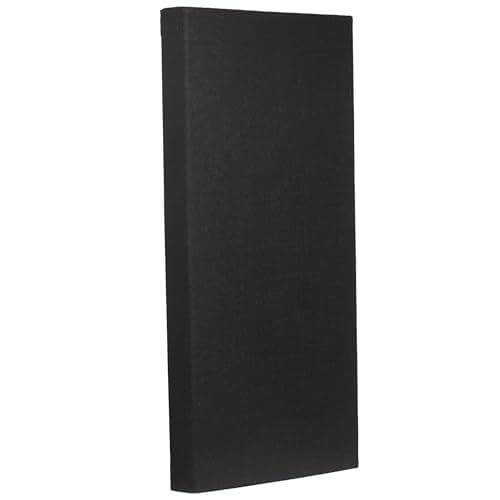
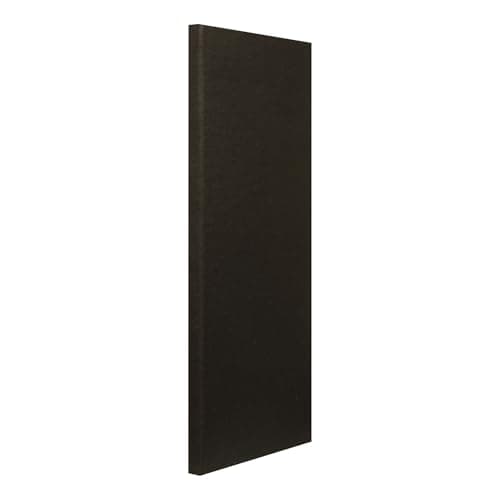
The ATS Acoustics 4-inch panel is the ceiling pick: 0.65 absorption at 125 Hz on an NRC 1.15 mineral-wool core, and at 16 lb it is still light enough to hang from two ceiling hooks. The budget pick is the ATS Acoustics 2-inch panel at 12 lb and NRC 0.95 - the cheapest product here that is a real absorber rather than a flutter treatment.
A ceiling cloud is the most efficient absorber in a home studio, and almost nobody installs one. The reason it matters is that the first reflection off a flat ceiling arrives at your ears within a couple of milliseconds of the direct sound, from a surface that neither a microphone's rejection pattern nor a monitor's directivity does anything about. It is also the only boundary in the room you can mount a panel away from, because gravity gives you the air gap for free.
Two things in that table matter more for a ceiling than they do for a wall. The first is the 125 Hz column: a flat ceiling and a flat floor form the most rigid parallel pair of boundaries in the room, so part of the low-mid buildup you hear is a vertical problem, and only the 4 inch panel publishes a figure that addresses it. The second is weight. A 16 lb panel is a two-anchor job into joists or proper drywall fixings; a 12 lb panel is easier; the foam weighs nothing and absorbs almost nothing below 250 Hz. Choose in that order.
The four ceiling panels, ranked
Each card carries the published absorption figure with its source, the hanging weight where the manufacturer publishes one, and what the panel will not do overhead.
ATS Acoustics Panel (4-inch)
Top pickATS Acoustics · The deepest panel that still publishes a 125 Hz figure
The pick if you only treat two positions and want them to reach low-mid frequencies: at `0.65` against the two-inch panel's `0.12` at `125 Hz`, the extra two inches buy more than a second pair of thin panels would. Choose the two-inch version instead if you are covering a lot of wall and the room's problem is flutter echo rather than boxiness.
Why it is here
- Publishes `0.65` at `125 Hz` — the band that decides whether a small room sounds boxy, and the one almost no panel maker quotes
- Four inches of mineral wool does the work that no amount of NRC marketing on a two-inch panel can
- Arrives finished and fabric-wrapped, so there is no frame to build
What it costs you
- Four inches is a visible object on a wall, not a discreet tile
- Costs more than the two-inch version of the same panel for the same wall area
- Not fire rated, which rules it out of some rented or commercial rooms
ATS Acoustics Panel (2-inch)
ATS Acoustics · The value finished panel
The best value in a finished panel for flutter echo and first reflections, and the money saved buys the depth that actually changes the room. Read its own `125 Hz` figure before you buy four of them to fix boxiness: at `0.12` it will not, and the 4-inch version of the same panel reaches `0.65`.
Why it is here
- Mineral-wool core at a price close to foam kits
- NRC 0.95 is within a rounding error of panels costing twice as much
- Publishes its figure at `125 Hz` as well as its NRC, which is the honest way to describe a thin panel
What it costs you
- `0.12` at `125 Hz` is the 2-inch depth limitation stated plainly — this is a high-frequency device
- Edges are softer than Primacoustic's resin-hardened ones
- Not fire rated, which rules it out of some rented rooms
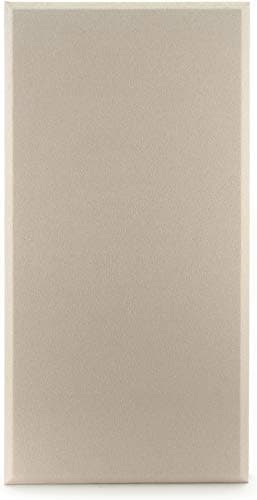
Auralex ProPanel (2-inch)
Auralex · A finished panel from the best-known brand
A sound choice for first reflection points where appearance matters. Do not expect a 2-inch panel to fix corner bass, whatever its NRC says — that is a measurement of the 250 Hz to 2 kHz band only.
Why it is here
- NRC 1.05 is the highest mid-band figure of any 2-inch panel here
- Beveled fabric-wrapped edges look finished on a visible wall
- Widely stocked, so it arrives quickly
What it costs you
- Two inches of depth will not reach the low-mid buildup that makes small rooms sound bad
- Auralex is best known for foam, and buyers routinely confuse the two product lines
- No independent lab named on the published data
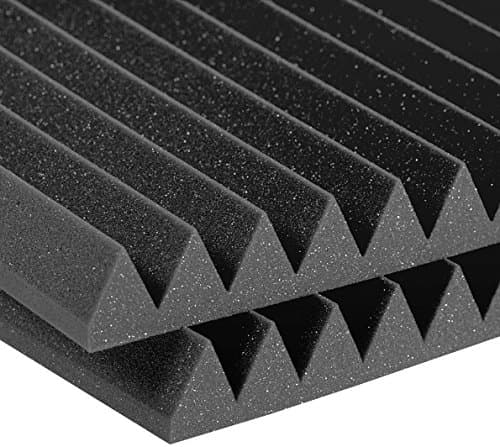
Auralex Studiofoam Wedges
Auralex · Killing flutter echo, and nothing more
Buy it only if your specific complaint is a hard, flappy echo in a tiled or bare room. If your complaint is that your voice sounds boxy or your mixes have too much bass, this is the wrong product and mineral wool is the right one.
Why it is here
- Genuinely effective above roughly 1 kHz, which does tame slap echo in a hard room
- Light, so it mounts with adhesive rather than fixings
- The real Auralex product, with published performance data, unlike the unbranded kits
What it costs you
- 0.23 at 125 Hz is less than half what mineral wool of the same depth achieves
- The low-mid buildup that makes a bedroom sound boxy is exactly what it does not touch
- Foam yellows and crumbles over years
Where a cloud goes
- Directly over the mix position, or over the microphone. Not centred in the room - centred on your head. The reflection you are killing travels speaker to ceiling to ears, or mouth to ceiling to capsule.
- Use the mirror trick upwards. Sit in your chair and have someone slide a mirror along the ceiling. Anywhere you can see a tweeter from the listening position is a first reflection point and wants panel over it.
- Hang it with a gap, not flush. Two eye hooks and a short length of chain at each end. 2 to 4 inches of air behind the panel is the cheapest performance you will ever buy.
- Two panels beats one big one in a long room. One over the desk, one over the listening position, rather than a single oversized cloud between them.
- Leave the rest of the ceiling alone. A fully clad ceiling above bare parallel walls sounds unnatural - dead overhead and live at ear level. Treat the first reflection points, then stop and listen.
What we did not pick, and why
- Suspended acoustic ceiling tiles. Mineral-fibre drop tiles in a T-grid do work, and they need a grid, several inches of head height and a landlord who does not mind. That is construction, not a purchase.
- Spray-on acoustic coatings. Thin coatings act above 2 kHz at best, and they are permanent. A hung panel comes down when you move out.
- Hexagonal felt tiles glued flat. Felt tiles are decoration with an absorption coefficient attached, and glued flush they throw away the air gap that is the ceiling's only structural advantage.
- A fully foam-clad ceiling. The Studiofoam row is in the table honestly: 0.23 at 125 Hz for the 3 inch wedges against 0.53 for mineral fibre at the same depth. Foam overhead will stop a flutter echo and will not stop a room sounding boxy.
- Anything sold as soundproofing the floor above. Absorption and transmission loss need opposite material properties, so a cloud does not quiet footsteps. Soundproofing vs acoustic treatment has the mass-law figures.

How these are ranked
- Published absorption at `125 Hz`, where it exists. NRC under ASTM C423 is computed from 250 Hz to 2 kHz and excludes 125 Hz entirely, so an NRC figure alone cannot tell you whether a cloud reaches the vertical problem.
- Thickness, then core material. Depth is what buys low-frequency reach; a mineral-wool core at a given depth outperforms open-cell foam at the same depth by a wide margin.
- Hanging weight. Overhead mounting is the constraint that makes a ceiling different from a wall. A panel you cannot safely fix to your ceiling is not a candidate at any absorption figure.
- Finish durability. A cloud is seen from below at a shallow angle in every shot you film, and it collects dust on its top face. Resin-hardened or fabric-wrapped edges last; bare foam does not.
- Buyable now, with a live listing and a price from the daily price check when this page was written.
Pair it with
- Panels at ear level, which are still the first purchase. Best acoustic panels ranks the same cores for wall mounting.
- Corner traps, because a cloud does not reach the modal region. Best bass traps.
- The full plan, if the ceiling is one of several problems. Acoustic treatment for a ceiling covers height, joists and rented rooms.
- Monitors that will now tell you the truth. Best studio monitors under $300.
If the ceiling is low as well as flat - under about 8 feet - read treating a bedroom studio before you hang anything. At that height a thick cloud directly over the desk puts absorption close enough to your head to dull the room in a way that is tiring to work in. A 2 inch panel with a 4 inch gap is often the better answer in a low room than a 4 inch panel hung flush.