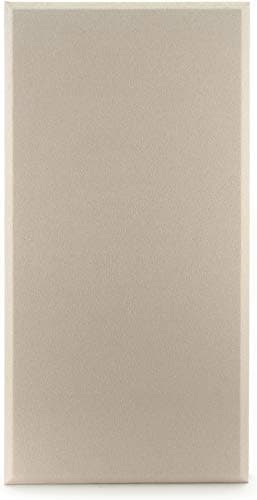
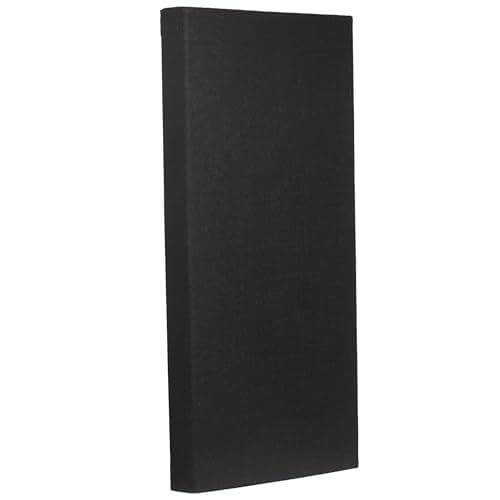
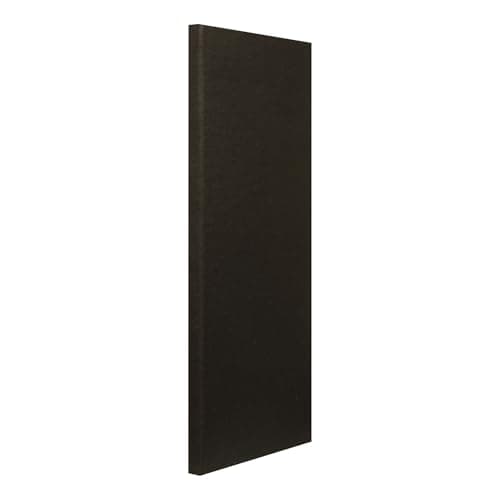
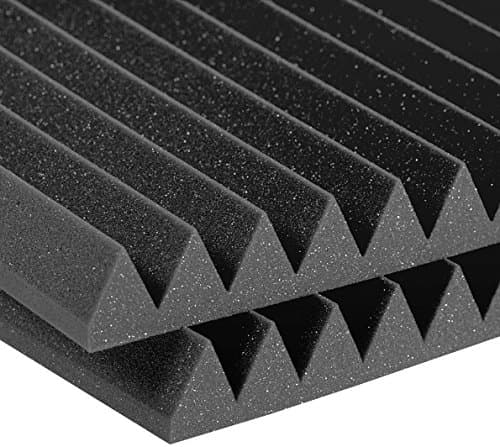
The Auralex ProPanel is the home theater pick: NRC 1.05 with a Class A fire rating per ASTM-E84 and a finished fabric face, which is what a room with furniture and a screen in it actually needs. The budget pick is the ATS Acoustics 2-inch panel at NRC 0.95 - the cheapest finished mineral-wool panel here, and the one to buy more of if you are covering four walls rather than two.
Treating a theater is a different job from treating a studio, and the difference is not subtle. A mix room is treated so that one seat hears a flat response. A theater is treated so that every seat hears intelligible dialogue and a surround image that does not collapse toward the nearest wall. That means more absorption at the side walls and first reflection points, less obsession with the 125 Hz band, and a hard requirement that the panels look like they belong in the room.
The 4 inch ATS panel outperforms the ProPanel on raw absorption - NRC 1.15 and a published 0.65 at 125 Hz against the ProPanel's 1.05 - and it is ranked second here anyway. In a theater, a 4 inch deep panel protruding from a side wall at seated ear height is furniture you will walk into, and the band it wins in is the band your subwoofer and your room correction are already arguing over. Depth wins in a mix room. Finish, rating and a flush profile win in a theater.
The four panels, ranked for a theater
Each card carries the published absorption data with its source and says what the panel does to the look of the room as well as the sound of it.
Auralex ProPanel (2-inch)
Top pickAuralex · A finished panel from the best-known brand
A sound choice for first reflection points where appearance matters. Do not expect a 2-inch panel to fix corner bass, whatever its NRC says — that is a measurement of the 250 Hz to 2 kHz band only.
Why it is here
- NRC 1.05 is the highest mid-band figure of any 2-inch panel here
- Beveled fabric-wrapped edges look finished on a visible wall
- Widely stocked, so it arrives quickly
What it costs you
- Two inches of depth will not reach the low-mid buildup that makes small rooms sound bad
- Auralex is best known for foam, and buyers routinely confuse the two product lines
- No independent lab named on the published data
ATS Acoustics Panel (4-inch)
ATS Acoustics · The deepest panel that still publishes a 125 Hz figure
The pick if you only treat two positions and want them to reach low-mid frequencies: at `0.65` against the two-inch panel's `0.12` at `125 Hz`, the extra two inches buy more than a second pair of thin panels would. Choose the two-inch version instead if you are covering a lot of wall and the room's problem is flutter echo rather than boxiness.
Why it is here
- Publishes `0.65` at `125 Hz` — the band that decides whether a small room sounds boxy, and the one almost no panel maker quotes
- Four inches of mineral wool does the work that no amount of NRC marketing on a two-inch panel can
- Arrives finished and fabric-wrapped, so there is no frame to build
What it costs you
- Four inches is a visible object on a wall, not a discreet tile
- Costs more than the two-inch version of the same panel for the same wall area
- Not fire rated, which rules it out of some rented or commercial rooms
ATS Acoustics Panel (2-inch)
ATS Acoustics · The value finished panel
The best value in a finished panel for flutter echo and first reflections, and the money saved buys the depth that actually changes the room. Read its own `125 Hz` figure before you buy four of them to fix boxiness: at `0.12` it will not, and the 4-inch version of the same panel reaches `0.65`.
Why it is here
- Mineral-wool core at a price close to foam kits
- NRC 0.95 is within a rounding error of panels costing twice as much
- Publishes its figure at `125 Hz` as well as its NRC, which is the honest way to describe a thin panel
What it costs you
- `0.12` at `125 Hz` is the 2-inch depth limitation stated plainly — this is a high-frequency device
- Edges are softer than Primacoustic's resin-hardened ones
- Not fire rated, which rules it out of some rented rooms
Auralex Studiofoam Wedges
Auralex · Killing flutter echo, and nothing more
Buy it only if your specific complaint is a hard, flappy echo in a tiled or bare room. If your complaint is that your voice sounds boxy or your mixes have too much bass, this is the wrong product and mineral wool is the right one.
Why it is here
- Genuinely effective above roughly 1 kHz, which does tame slap echo in a hard room
- Light, so it mounts with adhesive rather than fixings
- The real Auralex product, with published performance data, unlike the unbranded kits
What it costs you
- 0.23 at 125 Hz is less than half what mineral wool of the same depth achieves
- The low-mid buildup that makes a bedroom sound boxy is exactly what it does not touch
- Foam yellows and crumbles over years
Where the panels go in a theater
- The side walls level with the front speakers, first. This is the reflection that smears dialogue and pulls the centre image sideways. Two panels per side wall, from roughly speaker height to a foot above seated ear height.
- Behind the seating, second. The rear wall sends a delayed copy of everything straight back at the listeners. If there is a bare wall 3 feet behind the back row, it is doing more damage than anything at the front.
- The front wall around the screen, third. Only if the screen is acoustically transparent or the speakers are in-wall. A panel behind a projector screen that blocks sound does nothing.
- The ceiling at the first reflection point, fourth. Best acoustic panels for a ceiling covers the mounting side, which overhead is the hard part.
- Corners last, and only with real depth. Thin panels in corners are decoration. Best bass traps is the honest version of that purchase.
What we did not pick, and why
- Diffusers behind the seating. Genuinely useful in a large dedicated theater with distance behind the back row, and the wrong first purchase in a room under about 16 feet deep - a diffuser needs listening distance that a converted bedroom or lounge does not have.
- Acoustic curtains over the whole side wall. Heavy velour does absorb, and it absorbs almost entirely above 1 kHz, which makes dialogue duller without fixing the reflection pattern. Useful over a window, not as the plan.
- Foam tiles behind the screen. The Studiofoam row is in the table honestly, and 0.23 at 125 Hz for 3 inch wedges is a flutter treatment. In a theater its legitimate job is a hard, slapback-prone rear wall in a small room.
- Bass traps as the first purchase. A theater usually has a subwoofer and some form of room correction already working on the modal region. Dialogue clarity comes from the side walls, and that is where the money goes first.
- Panels marketed as soundproofing the room next door. Different physics entirely. Soundproofing vs acoustic treatment.
How these are ranked
- Published NRC. The band NRC covers - 250 Hz to 2 kHz - is almost exactly the dialogue band, which makes it a more useful single number in a theater than it is in a mix room.
- A published fire rating. Class A per ASTM E84, stated by the manufacturer. Not a tiebreaker in a habitable room with an AV rack in it.
- Finish and edge. A resin-hardened or fabric-wrapped edge survives being mounted, moved and dusted in a room people live in.
- Profile. How far the panel stands off a wall at seated ear height, because a theater is a room people walk through in the dark.
- Buyable now, with a live listing and a price from the daily price check when this page was written.
Pair it with
- A ceiling cloud at the front reflection point. Best acoustic panels for a ceiling.
- The panel-versus-trap decision, if the budget is fixed. Acoustic panels vs bass traps.
- The cheap version, if this is a shared living room. Acoustic treatment on a budget.
- The same cores ranked for a working studio. Best acoustic panels and best acoustic panels for a home office.
One honest caveat before you buy anything. A theater that sounds boomy rather than unclear has a modal problem, not a reflection problem, and no number of 2 inch wall panels will fix it - how to treat a room for recording explains how to tell the two apart by ear in about five minutes. Spend on side-wall absorption when dialogue is hard to follow, and on depth in the corners when the low end is uneven from seat to seat.