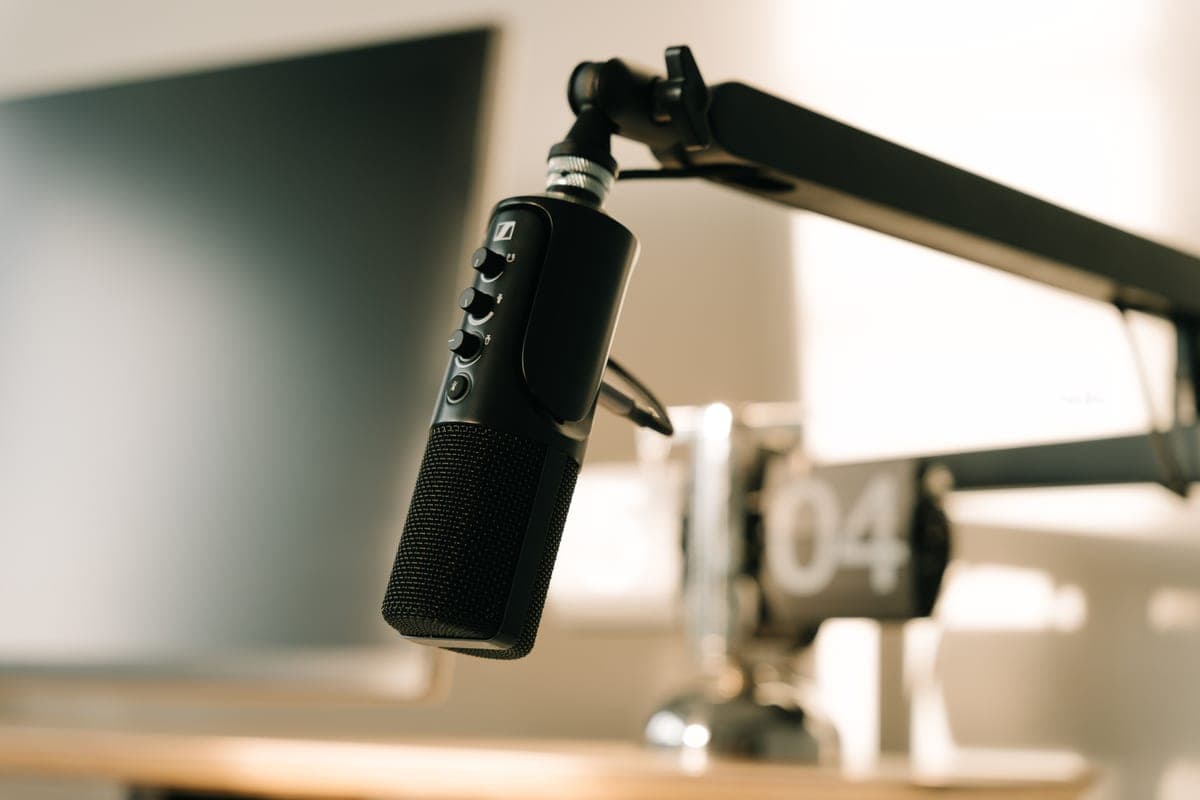
The SM7B is worth it if your room is untreated, your voice needs on-mic tone control, and your interface supplies about 60 dB of clean gain. It is not worth it if your interface tops out near 55 dB and you are unwilling to add hardware — at -59.0 dBV/Pa it is one of the quietest microphones sold, and a Rode PodMic gets you most of the way for far less.
This question gets asked constantly and answered badly, usually as a referendum on whether the microphone is overrated. It is not overrated and it is not a scam. It is a broadcast dynamic with a long production history that does two things better than almost anything at any price, and it has one requirement that trips up most of the people who buy it.
What you are actually buying
- Room rejection. This is the headline. A cardioid dynamic with an internal shockmount in a bare spare bedroom produces a usable recording where a condenser produces a recording of the bedroom. No plugin undoes that difference.
- Two voicing switches. A bass rolloff and a presence boost, on the microphone, fixing the recording rather than the file. One SM7B covers a thin voice and a boomy one, which is why it survives in shared studios.
- Mechanical quality. The internal shockmount handles desk thumps, and the yoke actually holds its angle on a boom arm instead of creeping downward through a session.
- Resale and support. It has been in production for decades, parts exist, and it holds value on the used market better than anything comparable.
The requirement nobody mentions at the till
At -59.0 dBV/Pa the SM7B is roughly 26 dB quieter than a typical condenser. That means your preamp has to do 26 dB more work, and on a cheap preamp that work arrives as hiss. The spread between interfaces is large, and it is published:
Pair an SM7B with the 58 dB box and you are at the edge; pair it with a 54 dB box and you are over it. That is the entire reason this microphone has a reputation for hissing, and it is a pairing fault rather than a microphone fault. How much gain does the SM7B need has the full arithmetic, and how much clean gain do you need lists the figure for every interface on this site.
Three cases where it is worth it
- Your room is untreated and will stay that way for a while. This is the strongest case. The SM7B's rejection is the cheapest acoustic treatment you can buy, because it is not acoustic treatment at all.
- Your voice needs tone control at the source. If you are bass-heavy, the rolloff switch is a daily tool. If you are thin, the presence switch is. A microphone without switches hands both jobs to a plugin.
- You already own an interface with `60 dB` or more. Then the SM7B costs exactly its sticker price, which is the only situation in which it is good value rather than merely good.
Three cases where it is not
- Your interface tops out near `55 dB` and you will not add hardware. Buy the SM7dB instead — the same capsule with a switchable +18 dB or +28 dB preamp built in — or buy a hotter microphone.
- Your room is properly treated. Then you have paid for rejection you no longer need, and a condenser will capture more detail. Best condenser microphones for a home studio is the better page for you.
- You move around while you talk. The SM7B's proximity effect is pronounced. If you gesture, lean or stand, the Electro-Voice RE20 and its Variable-D design holds tone far better.
What to buy
The SM7B and the three microphones that answer the question differently
The SM7B itself, the version with the preamp already inside it, the value alternative most people should buy instead, and the one that beats it if you move while you read.
Shure SM7B
Top pickShure · The default upgrade, if your preamp can feed it
Buy it if your interface supplies 60 dB or more of clean gain, or if you are budgeting for a booster alongside it. Buy something else if your only interface is a Scarlett Solo and you are not prepared to add hardware.
Why it is here
- Rejects room and computer-fan noise better than any condenser at any price
- Two voicing switches let one mic cover a thin voice and a boomy one
- Internal shockmount and a yoke that actually holds position on a boom arm
What it costs you
- At -59.0 dBV/Pa it is one of the quietest mics sold, so it demands a loud preamp
- Total cost is the mic plus, very often, a booster
- Heavy enough that a cheap desk arm will droop under it
Shure SM7dB
Shure · An SM7B with the booster problem already solved
The right SM7 for anyone whose interface tops out near 55 dB and who wants one purchase instead of two. Skip it if you already own a Cloudlifter or a 69 dB-gain interface, because you are paying twice for the same 25 dB.
Why it is here
- The +28 dB setting turns a 55 dB-gain interface into enough headroom for this capsule
- One XLR cable, no inline box, no second phantom-power dependency to reason about
- Bypassable, so it behaves as a plain SM7B when you move it to a big preamp
What it costs you
- You pay for the preamp whether your interface needed it or not
- A separate booster can be reused with other low-output mics; this one cannot
- No gain setting between +18 dB and +28 dB
Rode PodMic
Rode · The best value in a broadcast dynamic
The pick for most people upgrading from a USB mic: it gets you 90 percent of the broadcast-dynamic sound without the booster arithmetic. Choose the SM7B instead if your voice is already bass-heavy and you want the bass-rolloff switch.
Why it is here
- At -57 dBV/Pa it needs about 2 dB less gain than an SM7B, which is enough to matter on a 58 dB interface
- Internal pop filter means one less thing clamped to your arm
- All-metal body at a fraction of the SM7B's price
What it costs you
- Voiced with more low-mid weight than the SM7B, so a boomy voice can get boomier
- No voicing switches, so you fix tone in the DAW rather than on the mic
- Still low enough output that a 55 dB interface will be working hard
Electro-Voice RE20
Electro-Voice · Movers, leaners and anyone who cannot hold mic distance
Worth the premium if you move while you talk, gesture, or share a mic with someone whose technique you cannot control. If you sit still at a fixed distance, the SM7B's proximity effect is a feature you will use, not a problem you need engineered away.
Why it is here
- Variable-D means the tone barely changes as you drift closer to or further from the grille
- Integral blast filter handles close talking without a separate pop screen
- The bass tilt-down switch is a genuinely useful second voicing, not a gimmick
What it costs you
- Costs more than an SM7B while sounding less immediately flattering on most voices
- Same low-output problem as every broadcast dynamic
- Large and beige, which some people mind
The total-cost test
Add up the microphone, plus a booster if your interface needs one, plus a stand or arm rated for its weight. Compare that total against a PodMic on the same arm with no booster. In a lot of real setups the SM7B total is close to double, and the recording is better by a margin that is audible but not doubled.
That is the honest shape of the answer. The SM7B is the better microphone and frequently not the better purchase — which is the same trade that runs through best SM7B alternatives.