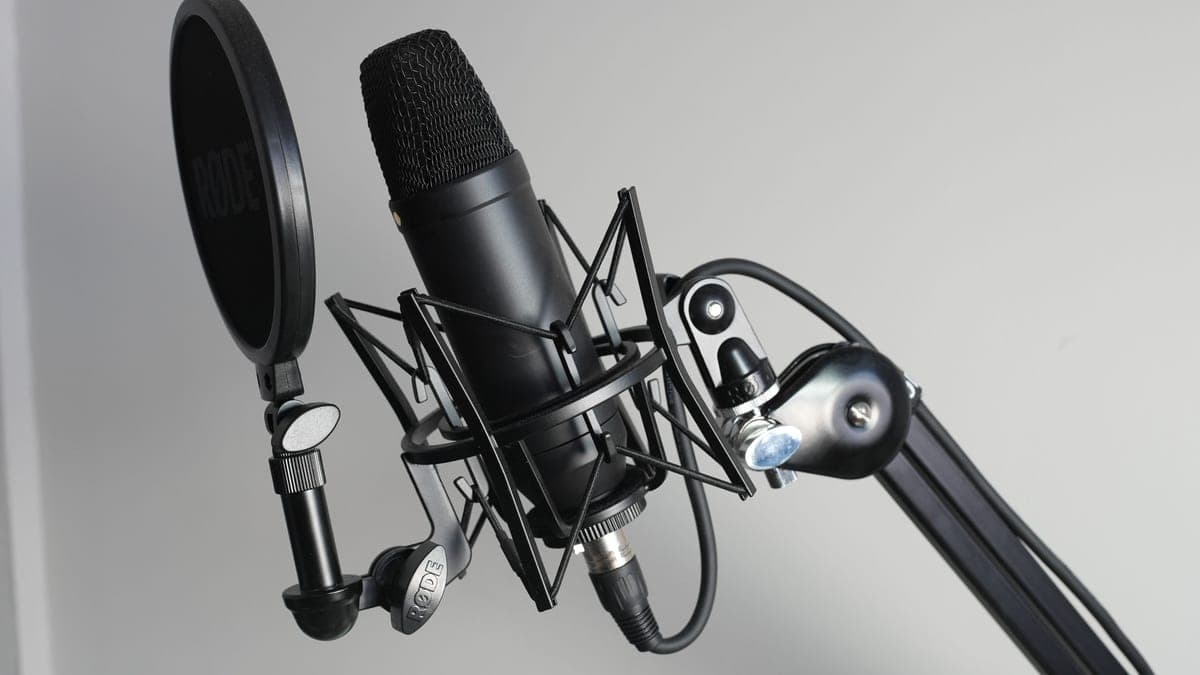
The Audio-Technica AT2035 is the right condenser for most home studios, and not because it measures best. Its switchable 80 Hz high-pass removes desk rumble and footfall before they reach the capsule, which is a problem you have every session — where the 8 dB of extra capsule quiet on a pricier microphone is a problem you have almost never.
A home studio is a desk in a room with a floor you walk on, a computer that runs a fan, and walls you may not be allowed to drill. That is a different environment from the one microphone specifications are measured in, and it changes which specification matters.
So this page ranks differently from best condensers for vocals, which ranks on how a microphone treats a voice, and from best budget condensers, which ranks within a price tier. Here, on-mic filtering comes first and noise floor second — because in a real room the noise floor is the room, not the capsule.
Why the filter outranks the noise figure here
Run this test before you buy anything. Sit in your recording position, stay silent, record thirty seconds and normalize it. Almost every home studio hears the same thing: a low rumble from the building, traffic or the desk, plus broadband noise from a computer. Almost none hears capsule hiss, because the room is louder than every microphone on this page.
A high-pass filter at the microphone removes the rumble before it consumes gain headroom or modulates a compressor. You can filter in the DAW too, and you should — but filtering at the capsule means the energy never entered the chain and you cannot forget to do it.
The AT2020 sits last for a reason worth stating plainly: no filter, no pad, 20 dB SPL self-noise, and a stand clip rather than a shockmount, so desk vibration goes straight into the capsule. It is the cheapest credible XLR condenser and it is the one that fights your room hardest.
The five condensers, ranked for a real room
Audio-Technica AT2035
Top pickAudio-Technica · The value condenser with the switches you actually need
The condenser to buy if you are choosing on value: the high-pass filter and the 8 dB quieter noise floor are worth more in a real room than anything else in this price band. Skip it if you have not treated the room, in which case a dynamic is the better purchase.
Why it is here
- 12 dB self-noise against the AT2020's 20 dB is an audible 8 dB of quiet for a small price step
- The 80 Hz high-pass is the single most useful switch on a desk-mounted condenser
- Ships with a real shockmount, not a plastic clip
What it costs you
- Still a condenser, so the room rules apply
- Slightly forward upper midrange that some voices find harsh
- The 10 dB pad is mostly irrelevant for voice work
sE Electronics X1 S
sE Electronics · The most on-mic control of any condenser here
The best-specified condenser on this site for a real home studio: quieter than the Audio-Technicas and the only one with a choice of low-cut frequencies. Choose the AT4040 instead if you want a flatter, more forgiving top end.
Why it is here
- `9 dB(A)` self-noise undercuts the AT2035 and AT4040 while costing less than the latter
- **Two** low-cut frequencies rather than one — `160 Hz` is genuinely useful on a boomy voice in a small room
- Two pad settings take it to `160 dB`, so it doubles as an instrument microphone
What it costs you
- Brighter than the AT4040, which suits some voices and not others
- Smaller dealer network than Audio-Technica or Rode
- The switch count makes it easy to leave a filter engaged by accident
Rode NT1 5th Generation
Rode · The quietest capsule most home studios can justify
The right condenser if you have treated the room, or are about to. If your room is bare drywall, the 4 dBA noise floor is irrelevant because the loudest thing on the recording will be the room.
Why it is here
- 4 dBA self-noise is quieter than the room you are recording in, which is the whole point of a condenser
- -32 dB sensitivity means no interface on this site struggles to drive it
- 32-bit float over USB makes clipping a non-event on the digital path
What it costs you
- A condenser hears your room, your keyboard and your fridge — treatment is not optional
- The USB path duplicates an interface you probably also want
- Bright enough that a sibilant voice needs a de-esser
Audio-Technica AT4040
Audio-Technica · The step up from the budget condensers
The right condenser once your room is genuinely treated and the AT2035 has become the limiting factor. In an untreated room it will faithfully reproduce your walls and you will have spent the money for nothing.
Why it is here
- The same `12 dB(A)` self-noise as the AT2035 but with a noticeably more even midrange and a `133 dB` dynamic range
- Keeps the `80 Hz` high-pass filter, which is the control that matters on a desk
- A 2-micron diaphragm and transformerless output at a price well below the boutique tier
What it costs you
- Several times the price of the AT2035 for a difference you only hear in a treated room
- No shockmount in some bundles — check before ordering
- Still a condenser, so the room rules apply unchanged
Audio-Technica AT2020
Audio-Technica · The entry condenser, if the budget is truly fixed
Buy it only if the AT2035 is genuinely out of reach — the step up buys a high-pass filter and a quieter capsule, which are the two things that matter in an untreated room. On a fixed budget the money is better spent on a dynamic and a panel.
Why it is here
- Cheapest credible XLR condenser, and it has been in production long enough to be a known quantity
- -37 dB sensitivity drives easily from any interface
- Light, so it works on a modest stand
What it costs you
- 20 dB self-noise is 8 dB noisier than the AT2035 and audible on a quiet voice-over
- No high-pass filter, so desk rumble goes straight into the take
- Plastic stand mount rather than a shockmount
What we did not pick, and why
- The Neumann TLM 102 and its tier. It is in our vocal roundup because it is a genuinely superb capsule. It has no pad and no high-pass filter, which in a home studio is the wrong trade at any price.
- The Lewitt LCT 440 Pure. A flatter, quieter capsule than the AT2035 with deliberately no switches at all. Excellent in a treated room, which is not what this page is about.
- Anything without a shockmount option. A condenser bolted rigidly to a desk stand is a desk-vibration microphone with a capsule attached.
- Foam-ball mic covers sold as room treatment. They dull the microphone's own top end and do almost nothing to the reflection arriving from behind you. Best reflection filters covers what actually helps.
The honest alternative
If your answer to the silence test was "I hear my room, loudly", the best microphone for your home studio may not be a condenser at all. A dynamic rejects what a condenser captures, and in a bare room it produces a closer, drier, more finished recording. That is the opposite of what the spec sheets suggest and it is the single most useful thing on this page.
Pair it with
- Two panels at the first reflection points. How to treat a room for recording — this is what upgrades every microphone here at once.
- A shockmount if the bundle does not include one.
- An interface with phantom power. Best audio interfaces for a home studio — no condenser here needs a booster.
- A reflection filter if you cannot fix anything to the walls. Best reflection filters.