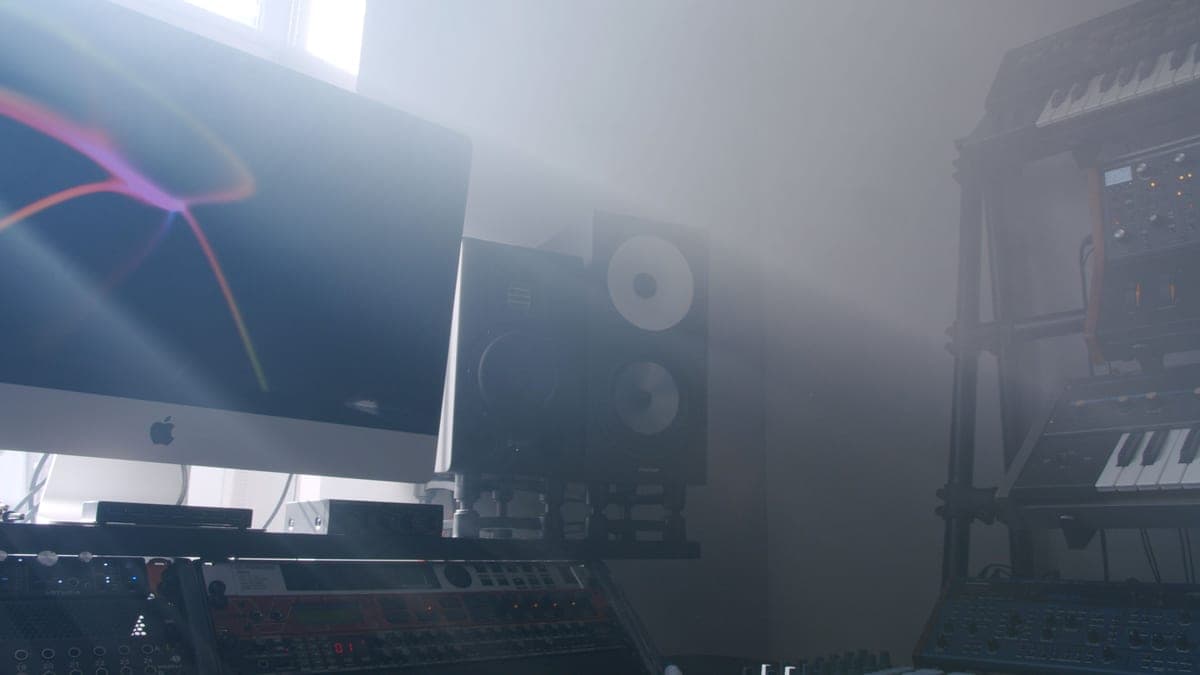
Buy the Adam T5V if your work is voice or acoustic material where sibilance and reverb decisions matter, and you listen at moderate levels — the U-ART ribbon tweeter resolves detail a dome cannot. Buy the Yamaha HS5 if you want the flattest midrange at the price, or if bright speakers tire you over a long session.
What a ribbon tweeter actually changes
A ribbon driver has far less moving mass than a dome, so it starts and stops faster. In practice that shows up as detail in the decay of things: reverb tails, the trailing edge of a consonant, room ambience in an acoustic recording. If you make decisions about reverb amount or de-essing, that is genuinely useful resolution.
The cost is fatigue. A more resolving top end is more tiring to listen to for hours until you adapt to it, and adaptation takes weeks not days. It is also less robust — a clipped ribbon is a more expensive mistake than a clipped dome. And with only 20 W on the tweeter, the T5V is not the monitor to mix loud on.
Choose the T5V if
- You work on voice or acoustic material where sibilance and reverb decisions are the work.
- You listen at moderate, sensible levels — which you should anyway.
- You want more low-frequency reach than the HS5 offers, at 45 Hz against 74 Hz at the honest tolerance.
- You have some treatment in place, so the detail you are paying for is the recording rather than the room.
Choose the HS5 if
- You want the flattest, most unflattering midrange at this price. This remains the HS5's genuine claim.
- You mix long sessions and find bright speakers tiring.
- Your room is untreated — the HS5's earlier rolloff is an advantage there, as covered in HS5 vs LP-6.
- You want Yamaha publishing both tolerance figures, so you know exactly what you are getting.
Small-room tolerance
The HS5 wins here, and not by accident. Its 74 Hz at +/-3 dB means it produces little in the modal region a small bare room handles worst. The T5V's 45 Hz figure is not published at a stated tolerance, which makes it harder to compare — and in an untreated room, more low-frequency output means more room, not more music.
What else you need to buy
- Both: stands, to get the tweeter on axis — this matters more with a ribbon, whose off-axis behavior differs more from on-axis.
- T5V especially: panels at the first reflection points, because the detail you paid for includes your side walls.
Both monitors in detail
Adam Audio T5V
Top pickAdam Audio · Detail at the top, from a ribbon tweeter
Buy it if your work is voice and acoustic material where sibilance and reverb decisions matter, and you will listen at moderate levels. If you mix loud, or find bright speakers tiring, the HS5 is the safer reference.
Why it is here
- The ribbon tweeter resolves reverb tails and sibilance detail a dome cannot
- 45 Hz from a 5-inch cabinet is excellent
- Response to 25 kHz means no audible top-end rolloff at all
What it costs you
- That top-end detail is fatiguing over a long session until you adapt to it
- 20 W on the tweeter is modest if you mix loud
- Ribbon tweeters are less robust than domes if you clip them
Yamaha HS5
Yamaha · The flat midrange reference for a small room
The right monitor for an untreated or lightly treated small room, precisely because it does not pretend to have low end your room could not reproduce honestly anyway. If you need to hear below 74 Hz, add a treated room before you add a bigger speaker.
Why it is here
- The honest -3 dB figure of 74 Hz tells you what it will not do, which is rarer than it should be
- Midrange is flat and unflattering, which is the entire job of a monitor
- Small enough to sit at ear height on a desk without dominating the room
What it costs you
- Nothing below about 74 Hz, so you mix low end by trust rather than by ear
- Unforgiving — a rough mix sounds rough, which some people hate
- Rear port needs clearance from the wall
If neither: the third option
If what appeals about the T5V is resolution and imaging rather than the tweeter specifically, the Kali IN-5's coincident three-way design gives a more stable stereo image with a conventional dome, and publishes 47 Hz at +/-3 dB. The full field is in best 5-inch studio monitors.