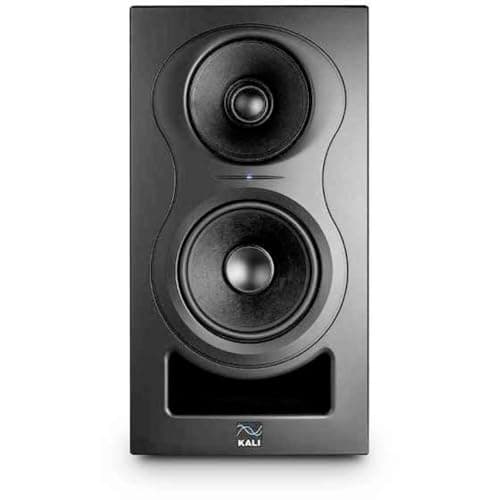
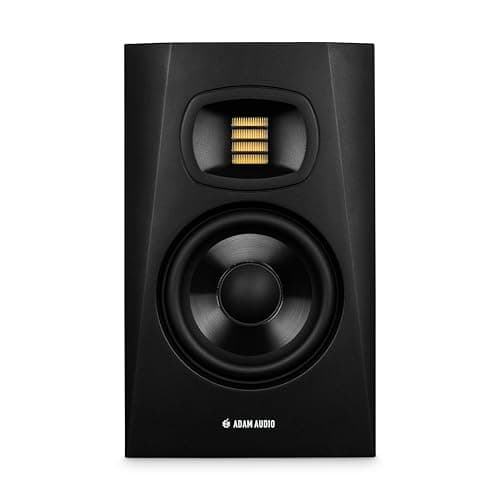
Buy the Adam Audio T5V unless you have a specific reason not to: a 1.9-inch U-ART ribbon tweeter and a 5-inch woofer in 45 Hz to 25 kHz territory, at a price a tier below the Kali. Buy the Kali Audio IN-5 if you sit close, move around while you work, and want the stereo image to hold still — its 4-inch midrange and 1-inch tweeter share an acoustic center, and crossing the woofer out at 280 Hz keeps it entirely clear of the vocal range.
This is not a like-for-like comparison and it should not be read as one. The IN-5 is a three-way coincident design sold at a three-way price. The T5V is the cheapest serious monitor Adam makes. People put them on the same shortlist because both are 5-inch monitors aimed at a small room, and the question that actually matters is whether a three-way buys you anything in a room that size.
What a coincident three-way actually buys
On a conventional two-way, the woofer and the tweeter are in different places on the baffle. Around the crossover frequency both drivers are producing the same material from two physical points, and the distance from each to your ears changes as you move. The result is a sweet spot that is narrower than it looks and an image that shifts when you lean back.
The IN-5 puts the 1-inch tweeter in the center of the 4-inch midrange so they radiate from one acoustic center. That is the same principle behind every coaxial studio monitor, and the payoff is real: the image holds together off axis, and vertical movement — standing up, slouching, turning to a second screen — stops moving the stereo picture around. On a desk where you cannot sit perfectly in the textbook triangle, this is worth more than a spec row suggests.
The second payoff is the 280 Hz crossover. The woofer never touches the fundamental range of a voice, so the driver doing the most important work on a podcast or vocal mix is a dedicated midrange with nothing else to do. A two-way asks its woofer to cover from the bass up to about 3 kHz, which includes every vowel you will ever mix.
Why the cheaper two-way is still the right buy for most rooms
Here is the uncomfortable part. Everything above is true, and in a small untreated room it is mostly inaudible, because the room is contributing errors far larger than the ones a coincident design fixes. Comb filtering from your desk surface, a 10 dB null at your listening position from a room mode, reflections off a bare side wall — those are tens of decibels of damage. Crossover lobing is a few.
So if the room is bare, the honest advice is to buy the T5V and spend the difference on bass traps and panels. Best studio monitors for an untreated room is the longer version of that argument, and it is the page most people shortlisting these two should read first.
Both monitors, and the Kali most people should buy instead
Kali Audio IN-5
Top pickKali Audio · A coincident three-way at a two-way price
The pick if you sit close, move around while working and want a stable stereo image — that is exactly what coincident drivers buy. If your room is untreated, spend the difference on panels first; the IN-5 will not out-engineer your walls.
Why it is here
- The coincident mid and tweeter share an acoustic center, so the image does not move as you do
- Crossing over at 280 Hz keeps the woofer out of the vocal range entirely
- 160 W tri-amped, with the same boundary EQ as the LP-6
What it costs you
- Three-way complexity in a small room is often solving a problem the room is causing
- Deep cabinet needs a proper stand, not a desk edge
- Meaningfully more money than the LP-6 for the same published bandwidth
Adam Audio T5V
Adam Audio · Detail at the top, from a ribbon tweeter
Buy it if your work is voice and acoustic material where sibilance and reverb decisions matter, and you will listen at moderate levels. If you mix loud, or find bright speakers tiring, the HS5 is the safer reference.
Why it is here
- The ribbon tweeter resolves reverb tails and sibilance detail a dome cannot
- 45 Hz from a 5-inch cabinet is excellent
- Response to 25 kHz means no audible top-end rolloff at all
What it costs you
- That top-end detail is fatiguing over a long session until you adapt to it
- 20 W on the tweeter is modest if you mix loud
- Ribbon tweeters are less robust than domes if you clip them
Kali Audio LP-6 V2
Kali Audio · The most low end per dollar, with boundary EQ
The best value here if you set the boundary EQ honestly and have corner traps in. In a bare bedroom with the switches left at default, the extra low end makes your mixes worse, not better, and the HS5 is the wiser buy.
Why it is here
- 47 Hz at +/-3 dB is real low end, not a marketing figure
- Boundary EQ switches on the back are the only honest answer to a speaker jammed against a wall
- 115 dB max SPL means huge headroom for a desk speaker
What it costs you
- That low-end reach is a liability in an untreated room — you will chase room modes, not mix decisions
- 6.5-inch driver in a small room needs the boundary EQ set correctly or it is worse than an HS5
- Paper cone is more fragile than the alternatives
The ribbon tweeter is the T5V's whole argument
Adam's U-ART tweeter is a folded ribbon rather than a dome, and it runs to 25 kHz. What that resolves in practice is decay: reverb tails, the shape of sibilance, where a room ambience stops. For voice-over editing, podcast cleanup and acoustic recording — work where most of your decisions are about breaths, esses and ambience — that is the single most useful kind of resolution available at this price.
It costs you fatigue. A bright, highly resolving monitor is tiring over a long session until you adapt to it, and 20 W on the tweeter is modest if you work loud. The IN-5's conventional 1-inch dome is the gentler listen across a day. Adam T5V vs Yamaha HS5 covers the same tradeoff against the flat reference.
Headroom, power and how loud you actually work
160 W tri-amped against 70 W total is a large gap, and 115 dB max SPL against at least 106 dB per pair is a real difference in headroom. On a desk at a meter, neither runs out — 106 dB at the listening position is louder than anyone should mix. The gap matters if you work in a larger room, sit further back, or use the monitors for playback at volume as well as for mixing.
Kali also publishes a distortion figure, under 2% system THD at 85 dB at one meter, and Adam does not publish one at all. A published number is not automatically a better number, but it is checkable, and on this site a checkable figure wins the tiebreak.
Boundary EQ, and why it is a bigger deal than the driver count
The IN-5 carries the same boundary EQ switches as the rest of Kali's range: settings on the back that compensate for a speaker on a desk, against a wall or in a corner. That is an acknowledgment that almost nobody has monitors on stands in free space, and a rear-ported cabinet near a wall gains a low-frequency boost that no amount of mix experience corrects for.
The T5V has no placement controls at all. In a good position that costs nothing. Jammed against a wall it costs you the bottom two octaves of honesty, and your only fix is physical — stands and distance. If your monitors cannot move, the Kali's switches are the most valuable thing in this comparison, and the cheaper LP-6 V2 has them too.
Which to buy
- Untreated room, limited budget: T5V, and spend the difference on treatment. This is the right answer for most people reading this page.
- Treated room, you sit close and move around, image stability matters: IN-5. The coincident mid and tweeter are exactly what that buys.
- Voice-led work where sibilance and reverb tails are the decisions: T5V, for the ribbon.
- Monitors stuck against a wall with no way to move them: IN-5 for the boundary EQ, or the LP-6 V2 for the same feature at a far lower price.
- You work loud, or in a larger room: IN-5, for the 115 dB headroom.
- You find bright speakers fatiguing: IN-5, or the flatter Yamaha HS5.
The Kali you probably meant to compare
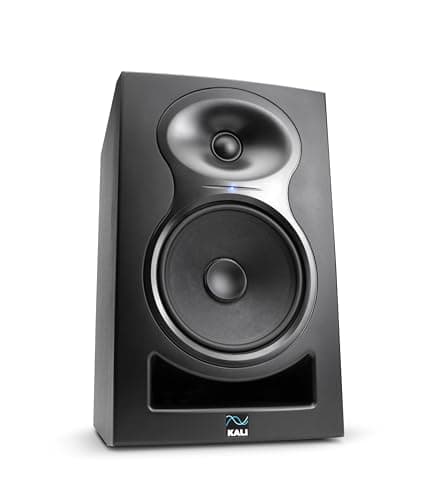
The IN-5 and the LP-6 V2 publish the same 47 Hz at +/-3 dB and the same 39 Hz at -10 dB. The IN-5 is not buying bandwidth; it is buying the coincident midrange, the 280 Hz crossover and the extra amplification, and it charges a clear tier more for them. If the three-way topology is not the thing you need, the LP-6 V2 gives you Kali's bandwidth and boundary EQ for much less, which puts it directly against the T5V on price.
Kali IN-5 vs Kali LP-6 is that comparison in full, and it is the one that decides whether you are in this market at all.
What matters more than either choice
Placement, then treatment, then the speaker. A monitor sitting on the desk surface below ear height and firing at your chest is working against itself whichever badge is on it: the desk couples to the cabinet, and the tweeter is off axis where it has the least to give. Get the tweeter to ear height, aim it at your head, pull the cabinet off the desk, and you will hear a larger change than the difference between a two-way and a three-way.
Studio monitor placement is the order of operations, and monitor isolation pads vs stands covers how to get there. After that, two corner traps do more for the low end than any upgrade in this comparison.