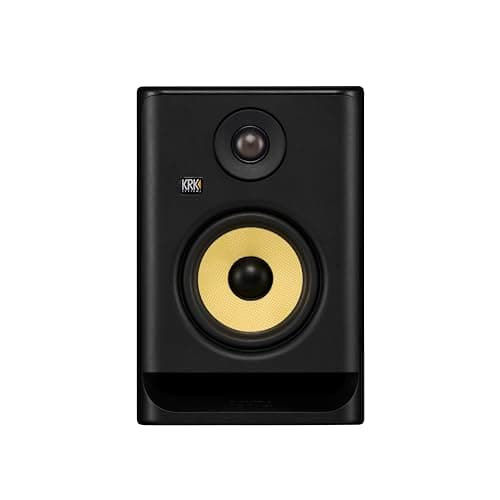
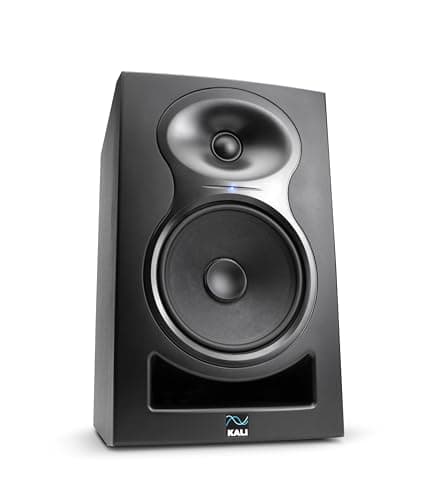
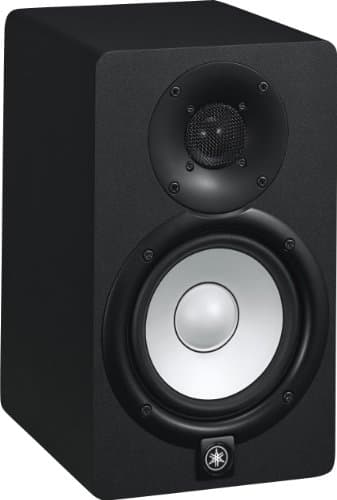
The KRK Rokit 5 G5 is the pick for a gaming desk: onboard DSP with 25 boundary and EQ combinations is the only feature here that actually corrects for a speaker jammed against a wall behind a monitor, which is where a desk pair always ends up. The budget pick is the Yamaha HS5 at 74 Hz (-3 dB) and 70 W - the cheapest honest monitor here, and the one whose flat midrange makes dialogue and footsteps clearest. The Kali Audio LP-6 V2 is the pick if you want real low end, with boundary EQ switches you must actually set.
Studio monitors on a gaming desk are not an odd choice, but they are a different choice, and it helps to be clear about why. A studio monitor is designed to be accurate at 1 to 2 metres with nothing around it. A gaming desk puts it 60 cm from your head, against a wall, beside a display, often on a hard surface - which is three acoustic problems the designer did not plan for. The monitors that work best on a desk are the ones with a control to compensate.
Read the tolerance column before you compare the low-end figures, because they are not comparable. The HS5's 74 Hz is quoted at -3 dB - a tight, honest tolerance - while the T5V's 45 Hz is quoted at -6 dB. The HS5's own -10 dB figure is 54 Hz. The same cabinet can look 20 Hz deeper simply by changing the measurement standard, and in this category that is routine.
The five monitors, ranked for a desk
Each card carries the published response with its tolerance and source, the live price with the date it was checked, and what the monitor needs from your desk.
KRK Rokit 5 G5
Top pickKRK · Onboard DSP room correction presets
Reasonable if the DSP presets genuinely match your placement and you cross-check mixes on headphones. As a sole reference, the flatter HS5 or 305P MkII will teach you more about your own mixes.
Why it is here
- Publishes its response with a tolerance — `54 Hz to 30 kHz, +/-3 dB` — which the previous generation did not
- Onboard DSP gives three voicing modes and 25 boundary settings without external hardware
- Kevlar woofer and silk-dome tweeter are physically tough
What it costs you
- `104 dB` max SPL is the lowest headroom in the 5-inch group here
- The Rokit voicing is historically flattering rather than flat — mixes translate less predictably
- `54 Hz` qualified at `+/-3 dB` is less low-end reach than the unqualified figures rivals quote
Kali Audio LP-6 V2
Kali Audio · The most low end per dollar, with boundary EQ
The best value here if you set the boundary EQ honestly and have corner traps in. In a bare bedroom with the switches left at default, the extra low end makes your mixes worse, not better, and the HS5 is the wiser buy.
Why it is here
- 47 Hz at +/-3 dB is real low end, not a marketing figure
- Boundary EQ switches on the back are the only honest answer to a speaker jammed against a wall
- 115 dB max SPL means huge headroom for a desk speaker
What it costs you
- That low-end reach is a liability in an untreated room — you will chase room modes, not mix decisions
- 6.5-inch driver in a small room needs the boundary EQ set correctly or it is worse than an HS5
- Paper cone is more fragile than the alternatives
Yamaha HS5
Yamaha · The flat midrange reference for a small room
The right monitor for an untreated or lightly treated small room, precisely because it does not pretend to have low end your room could not reproduce honestly anyway. If you need to hear below 74 Hz, add a treated room before you add a bigger speaker.
Why it is here
- The honest -3 dB figure of 74 Hz tells you what it will not do, which is rarer than it should be
- Midrange is flat and unflattering, which is the entire job of a monitor
- Small enough to sit at ear height on a desk without dominating the room
What it costs you
- Nothing below about 74 Hz, so you mix low end by trust rather than by ear
- Unforgiving — a rough mix sounds rough, which some people hate
- Rear port needs clearance from the wall
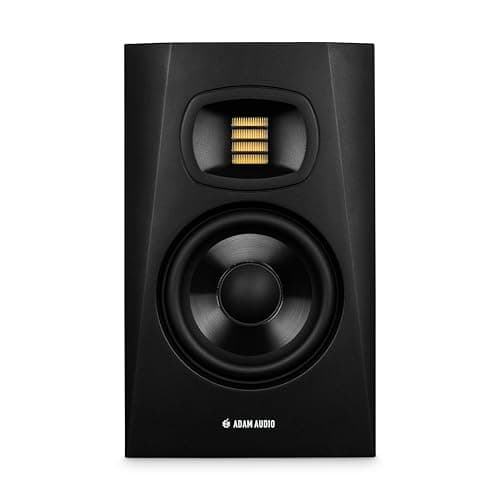
Adam Audio T5V
Adam Audio · Detail at the top, from a ribbon tweeter
Buy it if your work is voice and acoustic material where sibilance and reverb decisions matter, and you will listen at moderate levels. If you mix loud, or find bright speakers tiring, the HS5 is the safer reference.
Why it is here
- The ribbon tweeter resolves reverb tails and sibilance detail a dome cannot
- 45 Hz from a 5-inch cabinet is excellent
- Response to 25 kHz means no audible top-end rolloff at all
What it costs you
- That top-end detail is fatiguing over a long session until you adapt to it
- 20 W on the tweeter is modest if you mix loud
- Ribbon tweeters are less robust than domes if you clip them
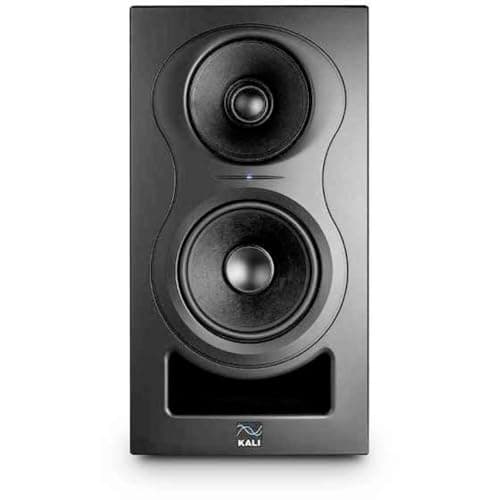
Kali Audio IN-5
Kali Audio · A coincident three-way at a two-way price
The pick if you sit close, move around while working and want a stable stereo image — that is exactly what coincident drivers buy. If your room is untreated, spend the difference on panels first; the IN-5 will not out-engineer your walls.
Why it is here
- The coincident mid and tweeter share an acoustic center, so the image does not move as you do
- Crossing over at 280 Hz keeps the woofer out of the vocal range entirely
- 160 W tri-amped, with the same boundary EQ as the LP-6
What it costs you
- Three-way complexity in a small room is often solving a problem the room is causing
- Deep cabinet needs a proper stand, not a desk edge
- Meaningfully more money than the LP-6 for the same published bandwidth
How these are ranked
- Whether the monitor can correct for boundary loading. A speaker against a wall gains several decibels of low-mid energy, and a DSP preset or an analog switch is the only thing that removes it. This is weighted first because a desk always has a wall.
- Published response with its tolerance stated. A figure without a tolerance is marketing, and no pick here is ranked above another on a looser measurement.
- Midrange flatness. Footsteps, dialogue and positional cues live between 200 Hz and 4 kHz. A flattering low end hides them; a flat midrange exposes them.
- Amplifier headroom and published max SPL, so the speaker stays clean at the level games are actually played at.
- Cabinet size against a real desk. A 5 inch two-way near a wall excites fewer room modes than a bigger cabinet, which on a desk is an advantage rather than a consolation.
What we did not pick, and why
- The JBL 305P MkII. The natural answer here - a waveguide that gives the widest usable sweet spot at the price, which on a desk is exactly what you want. It had no buyable listing when this page was written, so it is not ranked; Yamaha HS5 vs JBL 305P MkII has the comparison for when it returns.
- An `8 inch` monitor. More reach, and in a room under about 12 feet across it mostly buys room modes you then have to treat. 5-inch vs 8-inch studio monitors.
- A 2.1 gaming system. Genuinely fun, and the satellites are usually voiced for excitement rather than accuracy, which costs you the positional detail that is the actual reason to upgrade.
- A soundbar. Designed for a sofa at 3 metres, not a chair at 60 cm, and the processing works against near-field listening.
- A subwoofer, at least at first. The cheapest way to hear below 50 Hz and the fastest way to make a small untreated room uneven. Do you need a subwoofer in a home studio.
Four things to get right on a desk
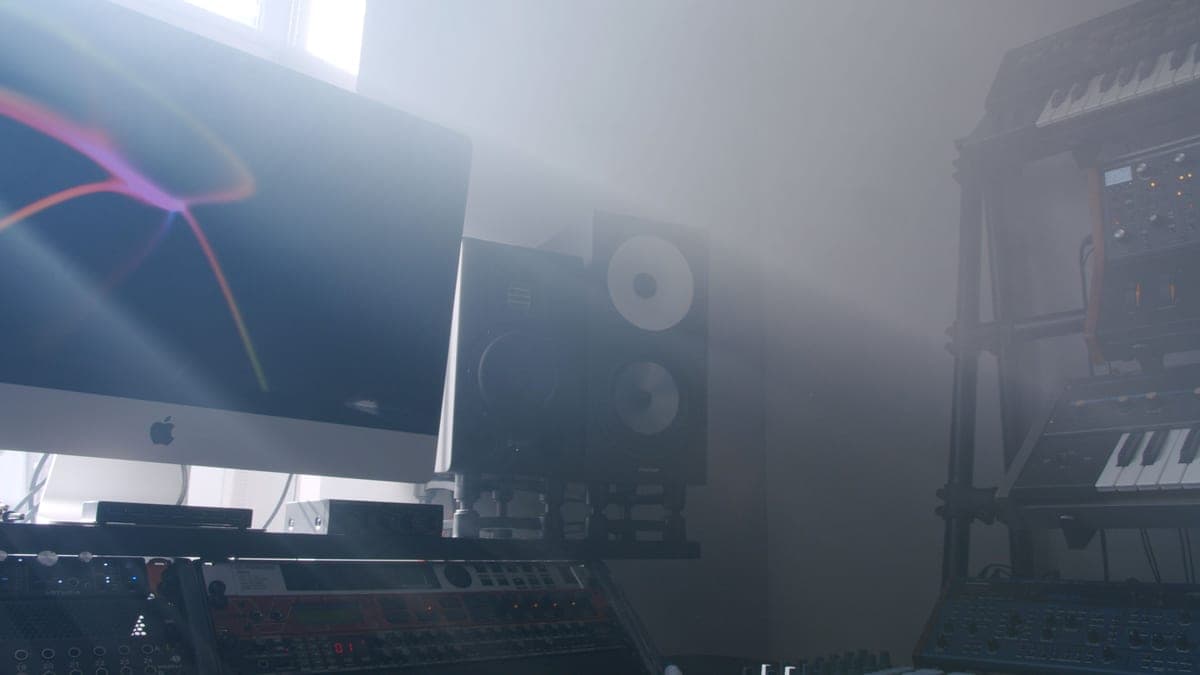
- Tweeters at ear height. This is free and it is the biggest single improvement. A monitor on the desk surface fires at your chest and the top end disappears.
- Set the boundary switches. Every monitor here has them and almost nobody uses them. Against a wall, cutting the low shelf by 2 to 4 dB is the difference between full and boomy.
- Get them off the desk surface. A hard desk reflects and resonates. Monitor isolation pads vs stands is the honest comparison of the two fixes.
- Angle them at your head, not straight ahead. An equilateral triangle between the two tweeters and your ears, with the display between rather than in front of them.
Pair it with
- Balanced outputs to feed them. Do I need an audio interface for studio monitors.
- Stands or pads, before a bigger speaker. Best studio monitor stands.
- Placement that is measured, not guessed. Studio monitor placement.
- The tier view, if the budget is the constraint. Best studio monitors under $300.
If the same pair will also be used for mixing - which is usually the real plan - read best studio monitors for music production alongside this page, because the ranking changes: there the DSP correction that wins on a desk matters less than a voicing you can trust. And are studio monitors worth it is the honest diagnosis if you are not sure the upgrade will be audible in your room.