The Kali Audio IN-5 is the best studio monitor for music production in a home room: a coincident three-way design with a dedicated 4-inch midrange driver, published 39 Hz to 25 kHz at -10 dB and 47 Hz to 21 kHz at +/-3 dB, tri-amped at 160 W. If the budget is tighter, the Kali LP-6 V2 publishes the same extension figures from a two-way cabinet, and the Yamaha HS7 is the pick if you want the HS midrange with usable low end.
Producing music is a harder job for a monitor than mixing a podcast, and the reason is the bottom two octaves. A voice lives between roughly 100 Hz and 8 kHz, which any competent 5-inch monitor reproduces honestly. A kick drum, a sub bass and a 808 live between 30 and 120 Hz, and that is precisely where small cabinets stop and small rooms misbehave.
So this page ranks on published low-frequency extension first and midrange honesty second, and it is explicit about the two different numbers manufacturers quote. A -10 dB figure tells you where output has fallen to a tenth of reference — the marketing number. A +/-3 dB figure tells you where the response is still genuinely flat — the useful one. Where both are published, read the second.
The HS5 row is the most instructive on this page. Its -3 dB point is 74 Hz, which means it is already rolling off through the whole bottom octave of a bass line. That does not make it a bad monitor — its midrange is the reference most people on this site learn to trust — but it does mean producing bass-heavy music on it alone is working blind below 74 Hz. Yamaha HS5 vs HS7 is the direct version of that trade.
The five monitors, ranked for music production
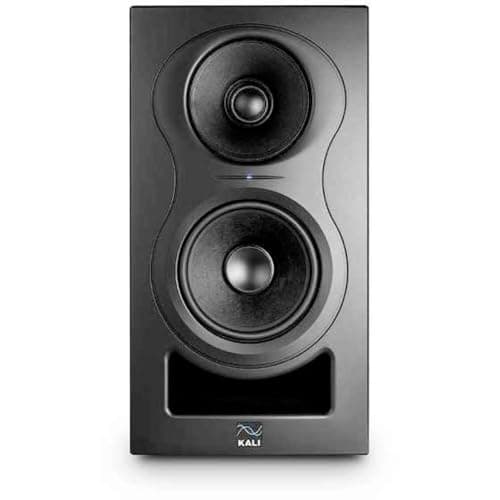
Kali Audio IN-5
Top pickKali Audio · A coincident three-way at a two-way price
The pick if you sit close, move around while working and want a stable stereo image — that is exactly what coincident drivers buy. If your room is untreated, spend the difference on panels first; the IN-5 will not out-engineer your walls.
Why it is here
- The coincident mid and tweeter share an acoustic center, so the image does not move as you do
- Crossing over at 280 Hz keeps the woofer out of the vocal range entirely
- 160 W tri-amped, with the same boundary EQ as the LP-6
What it costs you
- Three-way complexity in a small room is often solving a problem the room is causing
- Deep cabinet needs a proper stand, not a desk edge
- Meaningfully more money than the LP-6 for the same published bandwidth
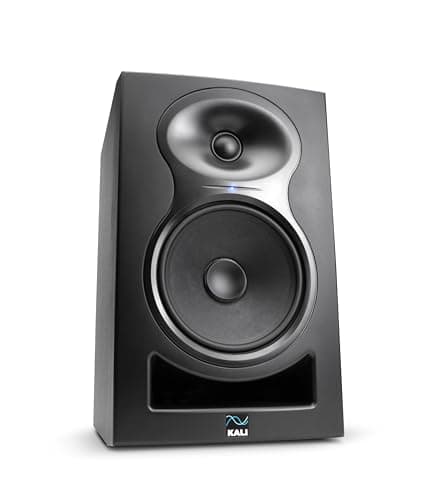
Kali Audio LP-6 V2
Kali Audio · The most low end per dollar, with boundary EQ
The best value here if you set the boundary EQ honestly and have corner traps in. In a bare bedroom with the switches left at default, the extra low end makes your mixes worse, not better, and the HS5 is the wiser buy.
Why it is here
- 47 Hz at +/-3 dB is real low end, not a marketing figure
- Boundary EQ switches on the back are the only honest answer to a speaker jammed against a wall
- 115 dB max SPL means huge headroom for a desk speaker
What it costs you
- That low-end reach is a liability in an untreated room — you will chase room modes, not mix decisions
- 6.5-inch driver in a small room needs the boundary EQ set correctly or it is worse than an HS5
- Paper cone is more fragile than the alternatives
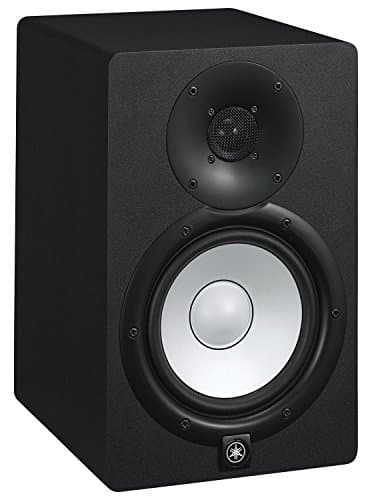
Yamaha HS7
Yamaha · The HS voicing with usable low end
The upgrade once the room has bass traps in the corners. Bought before the treatment, it will simply show you your room's problems louder — which is why the HS5 is the better first monitor in a bare room.
Why it is here
- The same flat voicing as the HS5 with meaningfully more low-frequency reach
- 95 W means it stays clean at the level you actually mix at
- 2 kHz crossover keeps the vocal range on one driver
What it costs you
- A 6.5-inch woofer in an untreated bedroom excites room modes the HS5 never touches
- Needs more distance from the wall and from you than most desks allow
- Costs and weighs noticeably more than the HS5
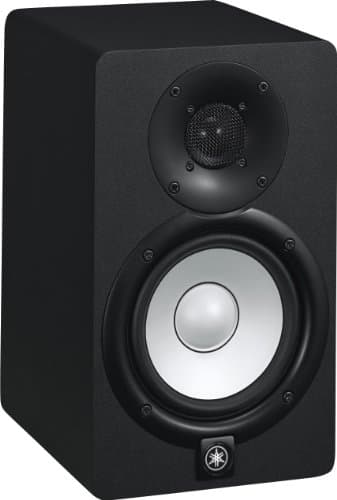
Yamaha HS5
Yamaha · The flat midrange reference for a small room
The right monitor for an untreated or lightly treated small room, precisely because it does not pretend to have low end your room could not reproduce honestly anyway. If you need to hear below 74 Hz, add a treated room before you add a bigger speaker.
Why it is here
- The honest -3 dB figure of 74 Hz tells you what it will not do, which is rarer than it should be
- Midrange is flat and unflattering, which is the entire job of a monitor
- Small enough to sit at ear height on a desk without dominating the room
What it costs you
- Nothing below about 74 Hz, so you mix low end by trust rather than by ear
- Unforgiving — a rough mix sounds rough, which some people hate
- Rear port needs clearance from the wall
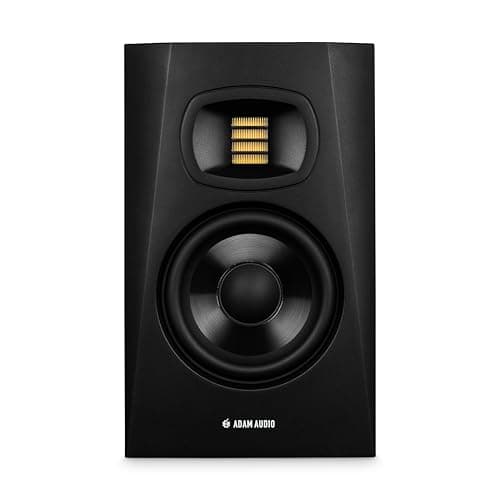
Adam Audio T5V
Adam Audio · Detail at the top, from a ribbon tweeter
Buy it if your work is voice and acoustic material where sibilance and reverb decisions matter, and you will listen at moderate levels. If you mix loud, or find bright speakers tiring, the HS5 is the safer reference.
Why it is here
- The ribbon tweeter resolves reverb tails and sibilance detail a dome cannot
- 45 Hz from a 5-inch cabinet is excellent
- Response to 25 kHz means no audible top-end rolloff at all
What it costs you
- That top-end detail is fatiguing over a long session until you adapt to it
- 20 W on the tweeter is modest if you mix loud
- Ribbon tweeters are less robust than domes if you clip them
Why the IN-5's three-way layout wins here
In a two-way cabinet, one driver covers the bass and the entire midrange up to the crossover, usually somewhere around 2 kHz. That driver is asked to move several millimetres to make a kick drum and a few microns to make a vocal consonant, at the same time, and the interaction between those two jobs is intermodulation distortion — a smearing of the midrange that gets worse as the bass gets louder.
The IN-5 splits the work three ways, with crossovers at 280 Hz and 2,800 Hz, so the 5-inch woofer handles only the bottom and the 4-inch midrange driver handles the band where vocals, snares and guitars live. The tweeter sits coaxially inside the midrange driver, which also means the vertical sweet spot does not shift with your chair height the way it does on a stacked two-way.
At 160 W tri-amped — 80 W to the woofer, 40 W each to the mid and tweeter — it also has considerably more headroom than anything else on this list. Kali IN-5 vs Kali LP-6 is the head-to-head if the two Kalis are your shortlist.
The room will undo most of this if you let it
Here is the uncomfortable part of any monitor roundup for producers: in an untreated room, low-frequency room modes cause 10 dB or more of variation between one seating position and another below 200 Hz. That is larger than the entire published difference between the five monitors in the table.
Which means buying a monitor that reaches 39 Hz and putting it in a bare bedroom gets you an accurate measurement of a room you cannot hear accurately. The sequence that actually works is: honest monitor, correct placement, bass trapping in the corners, then more monitor. Studio monitor placement is free, best bass traps is the cheapest real fix, and best studio monitors for an untreated room is the page to read if treatment is genuinely impossible.
What we did not pick, and why
- 8-inch monitors. More extension, far more room excitation, and in a bedroom-sized space usually a net loss. 5-inch vs 8-inch studio monitors covers the trade properly.
- Monitors with DSP room correction as the headline. Useful, and it corrects for the speaker in the room at one measured point rather than fixing the room. The KRK Rokit 5 G5 has it if you want it.
- Anything publishing only a `-10 dB` figure with no `+/-3 dB` number. You cannot compare extension honestly against a number chosen for the brochure.
- Multimedia desk speakers. Voiced to flatter rather than to inform, which is the opposite of the job.
Pair it with
- An interface with balanced outputs. Do I need an audio interface for studio monitors explains why that matters more than the monitor spec.
- Stands or isolation, to get the tweeter to ear height. Monitor isolation pads vs stands.
- Bass traps in the corners behind you. The only treatment that touches the band this page is about. Best bass traps.
- One pair of headphones to cross-check the low end. How to mix low end on headphones.
How to choose
- Treated room, bass-heavy material, you want the most honest midrange: Kali Audio IN-5. The three-way layout is the reason.
- Same extension figures, two-way cabinet, less money: Kali LP-6 V2.
- You want the Yamaha midrange and real low end: Yamaha HS7. 43 Hz published, 95 W bi-amped.
- Small untreated room, midrange accuracy above all: Yamaha HS5. Accept that below 74 Hz you are working blind.
- You want top-end detail and air: Adam Audio T5V. The U-ART ribbon tweeter is genuinely different.
If you are not yet sure monitors are the right purchase at all, studio monitors vs headphones for mixing is the honest comparison — in a bad room, headphones win more often than monitor manufacturers would like, and are expensive studio monitors worth it covers where the diminishing returns start.