Buy the Audio-Technica AT4040 if this microphone will sit on a desk, because its switchable 80 Hz high-pass filter removes rumble before it is ever recorded and the Lewitt LCT 440 Pure has no filter at all — by design. Buy the LCT 440 Pure if your source is quiet and your room is treated, where its 7 dB(A) self-noise is a genuine 5 dB advantage over the AT4040's 12 dB(A).
Two large-diaphragm condensers at a similar price, built on opposite philosophies. Lewitt stripped the LCT 440 Pure of every switch deliberately, on the argument that the simplest signal path is the best one. Audio-Technica fitted the AT4040 with the two switches that a condenser in a domestic room actually uses. Which philosophy is right depends entirely on the room you are putting it in.
5 dB of self-noise is real — and it is not the deciding factor
7 dB(A) against 12 dB(A) is a meaningful gap, not a rounding error. It is the difference between a capsule competing with microphones costing several times more and one sitting mid-field. On a quiet source in a quiet room — fingerstyle guitar, soft narration, anything with real silence in it — the Lewitt is the better-specified microphone and it is not close.
The reason that does not settle the comparison is that in most home studios, 12 dB(A) is already below the room. A domestic room with a computer in it, a street outside and HVAC somewhere has an ambient noise floor well above either figure. You cannot hear a 5 dB capsule advantage underneath 30 dB of room. How to treat a room for recording is what changes that equation.
The missing high-pass filter is the Lewitt's real cost
Lewitt's argument for no switches is coherent: every switch is a component in the signal path and a thing to leave set wrong. For a studio recording a controlled source at distance, that is a defensible choice.
For a condenser clamped over a desk it is a problem. A desk-mounted microphone sits on top of continuous low-frequency energy — traffic, HVAC, the building, your chair, footsteps upstairs, and every keystroke traveling up the stand. None of it is content and all of it consumes headroom. The AT4040's 80 Hz switch stops it reaching the converter at all, which is categorically better than filtering it later. With the LCT 440 Pure, all of it gets recorded and all of it has to come out in the DAW.
You can mitigate it — a high-pass as the first plug-in in the chain, a shockmounted boom arm rather than a desk stand, a stand on the floor rather than the desk — but it is work you are choosing to do every session.
Both condensers, and the one with both advantages
Ranked for a desk in a real room: the AT4040 first for its filter, the LCT 440 Pure where the room is quiet and treated, and the X1 S because it is the only one here that is both quiet and controllable.
Audio-Technica AT4040
Top pickAudio-Technica · The step up from the budget condensers
The right condenser once your room is genuinely treated and the AT2035 has become the limiting factor. In an untreated room it will faithfully reproduce your walls and you will have spent the money for nothing.
Why it is here
- The same `12 dB(A)` self-noise as the AT2035 but with a noticeably more even midrange and a `133 dB` dynamic range
- Keeps the `80 Hz` high-pass filter, which is the control that matters on a desk
- A 2-micron diaphragm and transformerless output at a price well below the boutique tier
What it costs you
- Several times the price of the AT2035 for a difference you only hear in a treated room
- No shockmount in some bundles — check before ordering
- Still a condenser, so the room rules apply unchanged
Lewitt LCT 440 Pure
Lewitt · A flatter alternative to the bright budget condensers
Worth the step up if the budget condensers have sounded harsh to you and you want flat rather than flattering. If you want on-mic filtering, the AT2035 gives you more control for less.
Why it is here
- 7 dB(A) is competitive with mics costing considerably more
- Voiced flatter than the NT1-A, so less de-essing on a sibilant voice
- Deliberately stripped of switches, which keeps the signal path simple
What it costs you
- No high-pass filter or pad at all, by design
- Costs more than the AT2035 without adding features
- Smaller dealer network than Rode or Audio-Technica
sE Electronics X1 S
sE Electronics · The most on-mic control of any condenser here
The best-specified condenser on this site for a real home studio: quieter than the Audio-Technicas and the only one with a choice of low-cut frequencies. Choose the AT4040 instead if you want a flatter, more forgiving top end.
Why it is here
- `9 dB(A)` self-noise undercuts the AT2035 and AT4040 while costing less than the latter
- **Two** low-cut frequencies rather than one — `160 Hz` is genuinely useful on a boomy voice in a small room
- Two pad settings take it to `160 dB`, so it doubles as an instrument microphone
What it costs you
- Brighter than the AT4040, which suits some voices and not others
- Smaller dealer network than Audio-Technica or Rode
- The switch count makes it easy to leave a filter engaged by accident
Voicing: flat against even
The LCT 440 Pure is voiced flatter than the bright budget condensers, which is its other selling point and a real one — less de-essing on a sibilant voice than a Rode NT1-A will give you, for instance.
The AT4040's large active diaphragm and transformerless circuit produce a notably even midrange and 133 dB of dynamic range. In practice both are honest, neutral microphones and neither will embarrass you. This is not a comparison where voicing separates them the way it separates the budget tier; the controls and the noise floor are the real variables.
The microphone that wins on both axes
If the choice above feels like a false one, it partly is. The sE Electronics X1 S publishes 9 dB(A) self-noise — between the two — and carries two low-cut frequencies (80 Hz and 160 Hz) plus two pad settings. It is quieter than the AT4040, more controllable than either, and the 160 Hz option is genuinely useful on a boomy voice in a small room where 80 Hz does not go high enough.
It is brighter than the AT4040, which is the honest trade. Best condenser microphones for home studio ranks all three together, and AT2035 vs AT4040 is worth reading first if the AT4040 is the microphone you are drawn to — the cheaper Audio-Technica publishes the same noise figure.
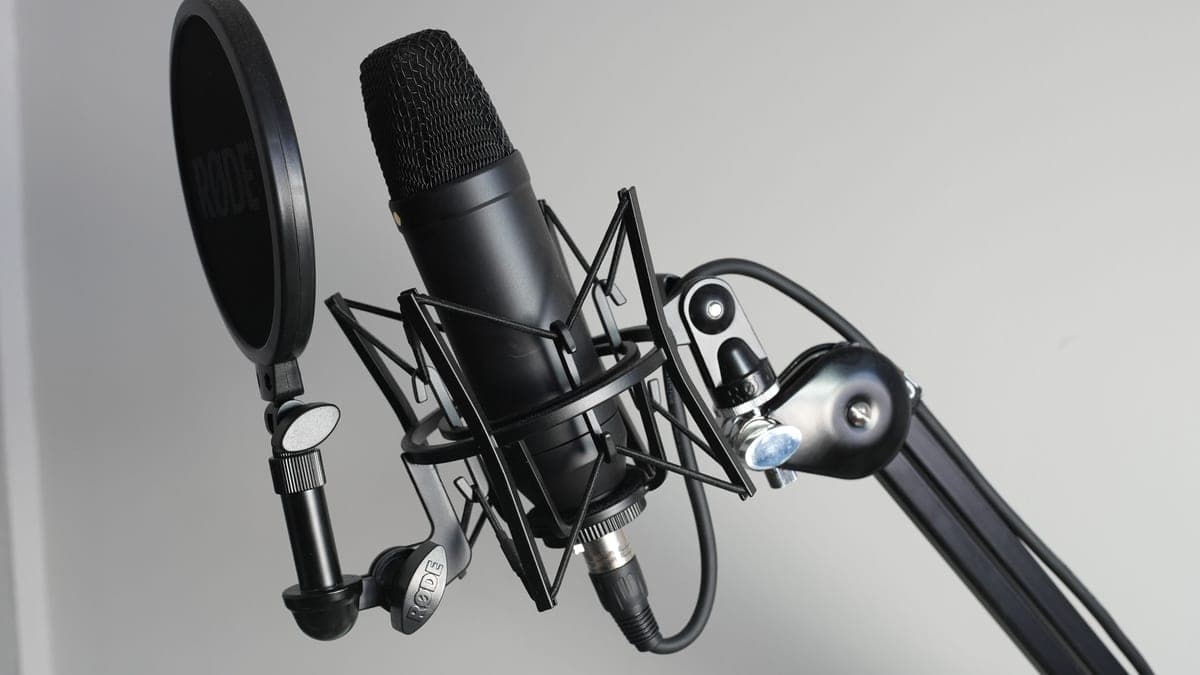
What both of these need from the rest of the chain
- Phantom power. Both are condensers and both need 48 V from an interface or preamp. XLR to USB adapters explained covers what does not supply it.
- Not much gain. Condensers are easy loads; every interface on this site has enough. Gain budgets are for low-output dynamics, not these.
- A treated first reflection point. This is the purchase that makes either microphone worth owning. Best acoustic panels.
- A pop filter. Neither has one built in, and a condenser at close range is unforgiving of plosives. Best pop filters.