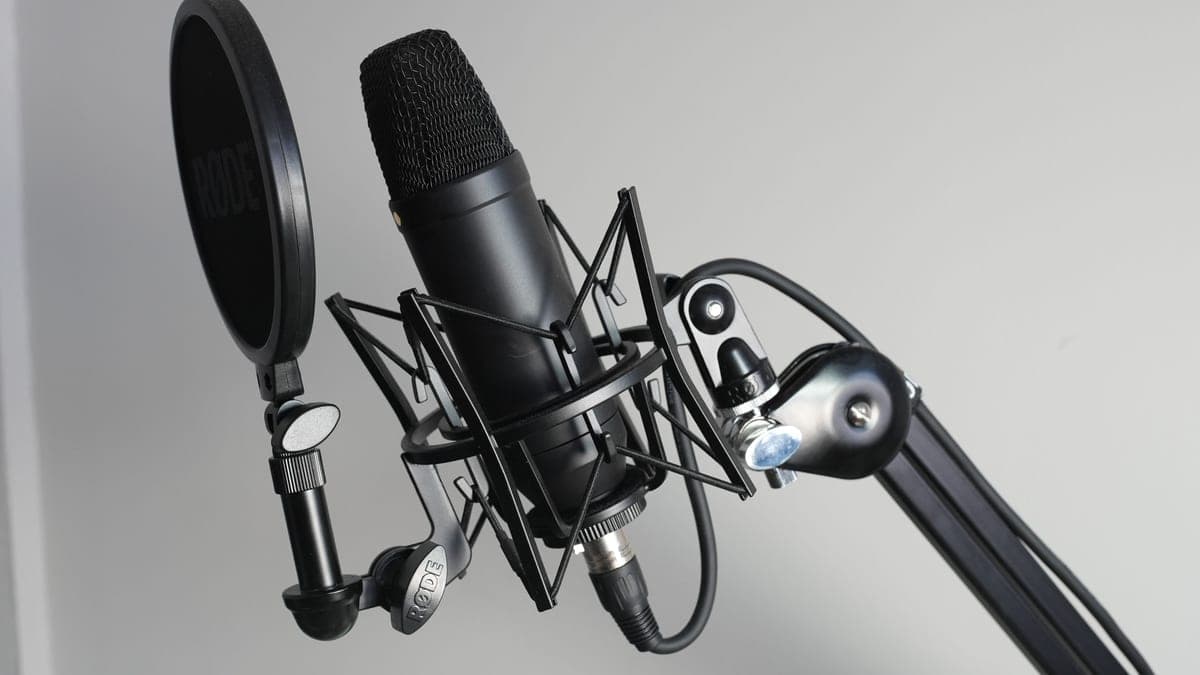
The sE Electronics X1 S is the best single microphone for acoustic guitar: 9 dB(A) self-noise keeps a quiet fingerpicked passage clean, and it is the only microphone here with a choice of two low-cut frequencies — 80 Hz and 160 Hz — which is exactly the band a close-miked guitar body overloads.
Every other microphone page on this site ranks on sensitivity and room rejection, because those decide whether a spoken-word setup works at all. This page ranks on two different specs, because an acoustic guitar is a different problem from a voice: it is quieter than you think, it is recorded closer than you think, and almost all of its character lives in a transient you either capture or smear.
The specs that decide it, and the one that does not
- Self-noise, in dB(A). A fingerpicked passage at a conversational level puts far less energy into a capsule than a voice at four inches does. Whatever the microphone's own noise floor is, you hear it between the notes. This is the primary ranking criterion on this page.
- On-mic low-cut, and at what frequency. Point any cardioid microphone at a guitar from a foot away and proximity effect plus the body resonance pile up energy in the low-mids. A switch that removes it before your converter sees it is worth more than a plug-in that removes it afterwards.
- Diaphragm size, because it sets transient behavior. A smaller, lighter diaphragm starts and stops faster. On a source whose identity is the pick hitting the string, that is audible.
- Max SPL, which does not decide anything here. Every microphone on this page is rated to at least 140 dB SPL. A strummed acoustic guitar at close range is nowhere near that. We publish the figures in the table for completeness and then ignore them, because ranking on a specification nothing on the page is ever asked to meet is how roundups end up recommending the most expensive item.
Why self-noise is the number to rank on
Self-noise is the hiss the microphone makes with nothing in front of it. On a loud source you never notice it, because the signal buries it. An acoustic guitar is not a loud source, and the moments that matter most on an acoustic recording are the quiet ones: the decay of an open chord, the space between a fingerpicked pattern, the breath before the first strum.
The spread here is bigger than the price spread. The Rode NT1 5th Generation publishes 4 dBA. The Rode M5 pair publishes 19 dBA SPL. That is a fifteen-decibel difference in the noise floor of the recording, from two microphones made by the same company. Fifteen decibels is not a subtlety — it is the difference between a usable quiet take and one you have to gate.
So why is the NT1 5th Generation not the top pick, given it publishes the lowest figure on the site? Because it has no filter of any kind. Close-mike a dreadnought with it and the low-mid buildup goes into the recording at full strength, and you fix it later with EQ on a signal that has already been through your converter. The X1 S gives up five decibels of noise floor and hands you the 160 Hz low-cut instead. In a real home studio that trade is worth making.
The Lewitt LCT 440 Pure is the interesting outlier: 7 dB(A) puts it second-quietest on the page and it is voiced deliberately flat rather than bright, which suits a guitar that is already brilliant in the top end. It is stripped of switches on purpose. If you have treated your room and you mix with EQ anyway, that simplicity is a feature rather than a cost.
The six microphones, ranked for acoustic guitar
sE Electronics X1 S
Top picksE Electronics · The most on-mic control of any condenser here
The best-specified condenser on this site for a real home studio: quieter than the Audio-Technicas and the only one with a choice of low-cut frequencies. Choose the AT4040 instead if you want a flatter, more forgiving top end.
Why it is here
- `9 dB(A)` self-noise undercuts the AT2035 and AT4040 while costing less than the latter
- **Two** low-cut frequencies rather than one — `160 Hz` is genuinely useful on a boomy voice in a small room
- Two pad settings take it to `160 dB`, so it doubles as an instrument microphone
What it costs you
- Brighter than the AT4040, which suits some voices and not others
- Smaller dealer network than Audio-Technica or Rode
- The switch count makes it easy to leave a filter engaged by accident
Rode NT1 5th Generation
Rode · The quietest capsule most home studios can justify
The right condenser if you have treated the room, or are about to. If your room is bare drywall, the 4 dBA noise floor is irrelevant because the loudest thing on the recording will be the room.
Why it is here
- 4 dBA self-noise is quieter than the room you are recording in, which is the whole point of a condenser
- -32 dB sensitivity means no interface on this site struggles to drive it
- 32-bit float over USB makes clipping a non-event on the digital path
What it costs you
- A condenser hears your room, your keyboard and your fridge — treatment is not optional
- The USB path duplicates an interface you probably also want
- Bright enough that a sibilant voice needs a de-esser
Rode M5 Matched Pair
Rode · Recording an acoustic instrument in stereo
Buy the pair if you want a genuine stereo image of an acoustic instrument and you can give it two inputs and two stands. Buy a single large-diaphragm condenser instead if your room is untreated or your takes are quiet, because `19 dBA` of self-noise and a bare room are a worse combination than a slightly slower transient.
Why it is here
- A small diaphragm on an `80 g` body follows a pick attack more cleanly than any large-diaphragm condenser here, and that attack is most of what an acoustic guitar sounds like
- Matched within `1 dB`, which is the whole point — an unmatched pair puts a tonal difference in your stereo image that no panning fixes
- Two microphones, two mounts and two windshields for less than one mid-tier large-diaphragm condenser
What it costs you
- `19 dBA` self-noise is the highest of any condenser on this site — fifteen decibels noisier than the NT1 5th Generation, and audible behind a quiet fingerpicked passage
- No pad and no high-pass filter on either microphone, so every correction happens in the mix
- Two inputs and two stands needed, which is a real cost if you own a two-channel interface and one stand
Audio-Technica AT4040
Audio-Technica · The step up from the budget condensers
The right condenser once your room is genuinely treated and the AT2035 has become the limiting factor. In an untreated room it will faithfully reproduce your walls and you will have spent the money for nothing.
Why it is here
- The same `12 dB(A)` self-noise as the AT2035 but with a noticeably more even midrange and a `133 dB` dynamic range
- Keeps the `80 Hz` high-pass filter, which is the control that matters on a desk
- A 2-micron diaphragm and transformerless output at a price well below the boutique tier
What it costs you
- Several times the price of the AT2035 for a difference you only hear in a treated room
- No shockmount in some bundles — check before ordering
- Still a condenser, so the room rules apply unchanged
Audio-Technica AT2035
Audio-Technica · The value condenser with the switches you actually need
The condenser to buy if you are choosing on value: the high-pass filter and the 8 dB quieter noise floor are worth more in a real room than anything else in this price band. Skip it if you have not treated the room, in which case a dynamic is the better purchase.
Why it is here
- 12 dB self-noise against the AT2020's 20 dB is an audible 8 dB of quiet for a small price step
- The 80 Hz high-pass is the single most useful switch on a desk-mounted condenser
- Ships with a real shockmount, not a plastic clip
What it costs you
- Still a condenser, so the room rules apply
- Slightly forward upper midrange that some voices find harsh
- The 10 dB pad is mostly irrelevant for voice work
Lewitt LCT 440 Pure
Lewitt · A flatter alternative to the bright budget condensers
Worth the step up if the budget condensers have sounded harsh to you and you want flat rather than flattering. If you want on-mic filtering, the AT2035 gives you more control for less.
Why it is here
- 7 dB(A) is competitive with mics costing considerably more
- Voiced flatter than the NT1-A, so less de-essing on a sibilant voice
- Deliberately stripped of switches, which keeps the signal path simple
What it costs you
- No high-pass filter or pad at all, by design
- Costs more than the AT2035 without adding features
- Smaller dealer network than Rode or Audio-Technica
Placement does more than the microphone choice
This is the uncomfortable part of any microphone roundup for an instrument: moving the microphone six inches changes the recording more than swapping any two microphones on this page. If your acoustic guitar recordings sound boomy and indistinct, the microphone is probably not the reason.
- Start at the twelfth fret, not the soundhole. The soundhole is a port — it radiates the instrument's low-frequency resonance, so pointing a cardioid straight into it from close range gives you the boomiest possible version of the guitar. Aiming at the neck around the twelfth fret gives a more even balance of body and string.
- Back off to roughly a foot before you judge anything. Closer is not more detailed, it is more proximity effect and more of whichever four square inches of the instrument you happen to be pointing at.
- Then use the low-cut. With the microphone placed sensibly, engage 80 Hz to remove floor rumble, or 160 Hz on the X1 S if the body resonance is still dominating. Doing this before the converter rather than after it is free headroom.
- Fix the chair and the floor before you buy anything. A hard floor under the guitar is a reflection arriving a few milliseconds after the direct sound, and it comb-filters the top end. A rug is the cheapest improvement on this list.
If the room itself is the problem rather than the placement, how to treat a room for recording is the fix, and it is a better use of the money than any upgrade on this page.
One microphone or two?
A matched pair is how acoustic instruments are recorded when the recording is the product — one microphone at the twelfth fret, one over the shoulder or at the bridge, and a stereo image you can place a vocal inside. The Rode M5 pair is the cheapest honest way to try it, and the matching spec is the part that matters: Rode selects each pair to within 1 dB of sensitivity variation, because an unmatched pair puts a tonal difference between your left and right channels that no amount of panning repairs.
Two caveats, both real. The pair's 19 dBA self-noise is the highest figure on this page, and with two microphones open you have two noise floors summing. And you need two inputs — which, if you own a one-input interface, makes the real cost of this pick higher than its price tag. Best 2-channel audio interfaces covers that side of it.
For most people reading this, a single good microphone placed well beats a cheap pair placed badly. Buy the pair when stereo is the point, not as a general upgrade.
What we did not pick, and why
- Broadcast dynamics. The SM7B and the PodMic are superb at the job they are built for and the wrong tool here — a rolled-off top end and a sensitivity figure that needs 60 dB of clean gain is a poor combination on a quiet, bright, broadband source.
- Ribbon microphones. Genuinely lovely on acoustic guitar, and a different purchase: most need far more gain than the interfaces on this site supply, and the ones that do not cost more than everything on this page combined.
- Large-diaphragm condensers with no published self-noise figure. If a manufacturer will not state the number, we cannot rank on it, and the number is the whole basis of this page.
- Stereo microphones with the pair built into one body. A reasonable product, but you are buying a fixed technique. Two separate capsules let you move each one, which is where the result actually comes from.
- USB-only microphones. No path to a second channel and no on-mic filtering. USB vs XLR microphones makes the full case.
Pair it with
- An interface with headroom, not just gain. Condensers at these sensitivities are easy to drive; best audio interfaces for a home studio covers the field.
- A stand that holds position. A guitar microphone sits a foot away at an angle, which is the hardest thing to ask of a cheap stand. Best mic stands ranks the ones that do not creep.
- Panels at the first reflection points. A condenser on an instrument hears the room more than a dynamic on a voice does: best acoustic panels.
- Closed-back headphones, if you track with a click. Best closed-back headphones for recording — leakage into an open condenser a foot away is worse than leakage into a dynamic at two inches.
How to choose
- If you want one microphone and one answer, take the X1 S. 9 dB(A) plus a choice of 80 Hz or 160 Hz low-cut is the most useful combination here for close-miking an instrument.
- If your takes are very quiet and your room is treated, take the NT1 5th Generation for its 4 dBA noise floor, and accept that every correction happens in the mix.
- If you want flat rather than bright, take the LCT 440 Pure. 7 dB(A), no switches, and a voicing that does not add brilliance to an instrument that has plenty.
- If stereo is the point, take the M5 pair — and budget for a second input and a second stand.
- If you also record voice on the same microphone, take the AT4040 for its even midrange, or the AT2035 if you are choosing on value.