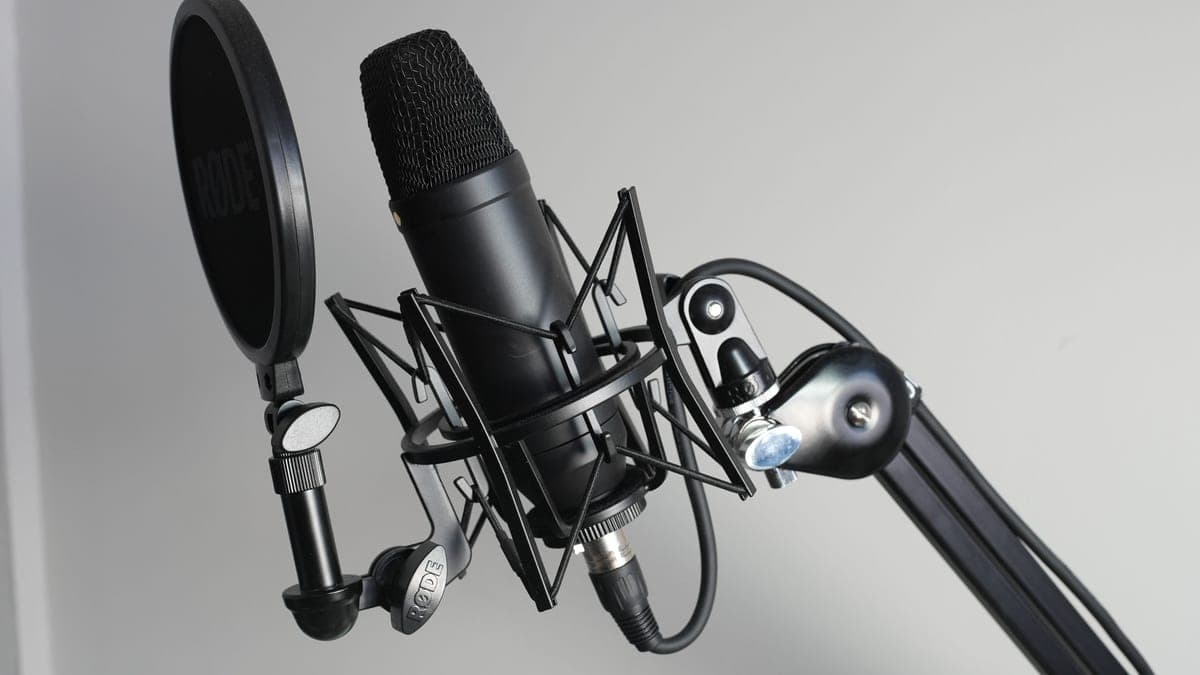
The sE Electronics X1 S is the best condenser for vocals at a sensible price: 9 dB(A) self-noise undercuts everything near it, and it is the only microphone here with a choice of low-cut frequencies — 80 Hz or 160 Hz — which is the control a boomy voice in a small room actually needs.
This page differs from our two other condenser roundups on purpose, because three pages about condensers would otherwise be three pages about the same thing. Best budget condensers is the sub-$200 answer. Best condensers for a home studio ranks on surviving a real, imperfect room. This page spans every tier and ranks on how the microphone treats a voice — noise floor, voicing through the presence region, and the filters you will reach for on a vocal take.
Self-noise is the number, and the filter is the tiebreak
A vocal take is usually the quietest thing you will record, and it is usually the thing you compress hardest. Both of those amplify the capsule's own hiss, which is why published self-noise matters more on a vocal microphone than on anything else. Under 10 dB(A) is genuinely quiet; over 18 dB SPL and you will hear it on a normalized voice-over.
Notice that the two quietest capsules on that table — the NT1 at 4 dBA and the LCT 440 Pure at 7 dB(A) — have no filters at all, and the most expensive microphone here has neither a filter nor a pad. On a desk, in a room with a floor you walk on, an 80 Hz high-pass is worth more than 3 dB of capsule quiet you will never isolate. That is why the X1 S wins and the NT1 does not.
The six vocal condensers, ranked
Each card carries the published specs with a source link for every figure, plus what the microphone costs you in practical terms.
sE Electronics X1 S
Top picksE Electronics · The most on-mic control of any condenser here
The best-specified condenser on this site for a real home studio: quieter than the Audio-Technicas and the only one with a choice of low-cut frequencies. Choose the AT4040 instead if you want a flatter, more forgiving top end.
Why it is here
- `9 dB(A)` self-noise undercuts the AT2035 and AT4040 while costing less than the latter
- **Two** low-cut frequencies rather than one — `160 Hz` is genuinely useful on a boomy voice in a small room
- Two pad settings take it to `160 dB`, so it doubles as an instrument microphone
What it costs you
- Brighter than the AT4040, which suits some voices and not others
- Smaller dealer network than Audio-Technica or Rode
- The switch count makes it easy to leave a filter engaged by accident
Audio-Technica AT4040
Audio-Technica · The step up from the budget condensers
The right condenser once your room is genuinely treated and the AT2035 has become the limiting factor. In an untreated room it will faithfully reproduce your walls and you will have spent the money for nothing.
Why it is here
- The same `12 dB(A)` self-noise as the AT2035 but with a noticeably more even midrange and a `133 dB` dynamic range
- Keeps the `80 Hz` high-pass filter, which is the control that matters on a desk
- A 2-micron diaphragm and transformerless output at a price well below the boutique tier
What it costs you
- Several times the price of the AT2035 for a difference you only hear in a treated room
- No shockmount in some bundles — check before ordering
- Still a condenser, so the room rules apply unchanged
Rode NT1 5th Generation
Rode · The quietest capsule most home studios can justify
The right condenser if you have treated the room, or are about to. If your room is bare drywall, the 4 dBA noise floor is irrelevant because the loudest thing on the recording will be the room.
Why it is here
- 4 dBA self-noise is quieter than the room you are recording in, which is the whole point of a condenser
- -32 dB sensitivity means no interface on this site struggles to drive it
- 32-bit float over USB makes clipping a non-event on the digital path
What it costs you
- A condenser hears your room, your keyboard and your fridge — treatment is not optional
- The USB path duplicates an interface you probably also want
- Bright enough that a sibilant voice needs a de-esser
Audio-Technica AT2035
Audio-Technica · The value condenser with the switches you actually need
The condenser to buy if you are choosing on value: the high-pass filter and the 8 dB quieter noise floor are worth more in a real room than anything else in this price band. Skip it if you have not treated the room, in which case a dynamic is the better purchase.
Why it is here
- 12 dB self-noise against the AT2020's 20 dB is an audible 8 dB of quiet for a small price step
- The 80 Hz high-pass is the single most useful switch on a desk-mounted condenser
- Ships with a real shockmount, not a plastic clip
What it costs you
- Still a condenser, so the room rules apply
- Slightly forward upper midrange that some voices find harsh
- The 10 dB pad is mostly irrelevant for voice work
Lewitt LCT 440 Pure
Lewitt · A flatter alternative to the bright budget condensers
Worth the step up if the budget condensers have sounded harsh to you and you want flat rather than flattering. If you want on-mic filtering, the AT2035 gives you more control for less.
Why it is here
- 7 dB(A) is competitive with mics costing considerably more
- Voiced flatter than the NT1-A, so less de-essing on a sibilant voice
- Deliberately stripped of switches, which keeps the signal path simple
What it costs you
- No high-pass filter or pad at all, by design
- Costs more than the AT2035 without adding features
- Smaller dealer network than Rode or Audio-Technica
Neumann TLM 102
Neumann · A Neumann capsule at the bottom of the range
Worth it only in a properly treated room where you have already exhausted what the AT4040 and the NT1 can do. If your room is untreated, this is the clearest example on the site of money that belongs in acoustic panels instead.
Why it is here
- A genuinely Neumann-voiced capsule, which is a different proposition from the budget tier rather than a quieter version of it
- `144 dB` max SPL means it handles anything you will put in front of it
- Physically small, so it fits where a large-body condenser will not
What it costs you
- No pad and no high-pass filter, which on a desk is a real omission at this price
- Neumann does not publish a sensitivity figure we could verify, so it is absent from our table
- The most expensive microphone on this site by a wide margin, and the room matters more than it does
What we did not pick, and why
- Multi-pattern condensers at this price. Figure-of-eight and omni are genuinely useful, but at the budget end pattern switching is done by summing two capsules and the cardioid you will actually use for vocals is usually worse than a dedicated cardioid costing the same.
- Tube condensers. Another power supply, a warm-up ritual, and a noise floor that is higher rather than lower. For a vocal take you want the capsule to be the quiet part.
- USB condensers. If you are shopping for a vocal condenser you have already decided the converter should be separate and replaceable. USB vs XLR covers that decision.
- Small-diaphragm pencil condensers. Excellent on acoustic instruments, wrong for a close vocal — the proximity behavior and the off-axis response are not what a voice wants.
- Anything above the TLM 102's tier. At that point the room is overwhelmingly the limiting factor, and we would rather tell you to spend the difference on bass traps.
Pair it with
- Treatment, first and always. How to treat a room for recording is what makes any of these worth owning.
- Phantom power from any interface. None of these needs a booster — condensers are hot. Best audio interfaces for recording vocals.
- A shockmount, and actually use it. A condenser transmits desk vibration straight into the take.
- A pop filter. Best pop filters — plosives displace a condenser diaphragm more than a dynamic's.
How to choose
- Answer the room question honestly. Untreated and staying that way means a dynamic, not anything on this page.
- If your voice is bass-heavy or your floor transmits footfall, take the X1 S for the 160 Hz low-cut. Nothing else here gives you that option.
- If you want the flattest, most forgiving top end, take the AT4040. It is the least fatiguing microphone on this page over a long session.
- If your room is genuinely quiet and you record softly, take the NT1 5th Generation for the 4 dBA floor, and filter in the DAW.
- If budget is the constraint, take the AT2035 — it has the same filter and pad as the AT4040 for a fraction of the money.