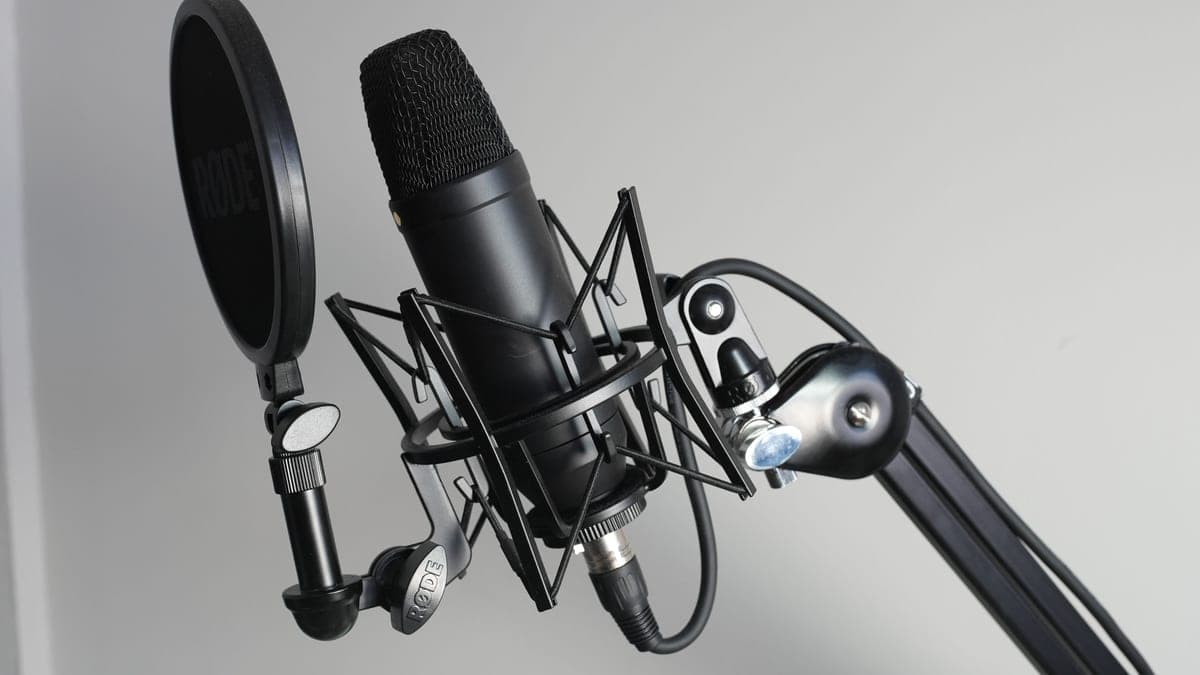
Buy the Rode NT1 5th Generation if your room is treated and quiet, where its 4 dBA self-noise against the AT2020's 20 dB SPL is an audible advantage on quiet material. In an untreated room the room noise dominates and the AT2020 is the sensible purchase — with the money saved going into panels.
Whether 16 dB matters depends entirely on your room
This is the part most comparisons skip. A microphone's self-noise only becomes the noise floor of your recording if it is louder than everything else. A quiet, treated home room might sit around 30 dB SPL. A normal room with a computer, a fridge and a street outside sits well above that. In the second room, both microphones are recording the room, and the AT2020's 20 dB SPL of hiss is inaudible beneath it.
So the honest test is: sit in your recording position, stay silent, record thirty seconds and normalize it. If what you hear is hiss, the NT1 will help. If what you hear is your room, treatment will help and a quieter capsule will not.
Choose the NT1 5th Generation if
- Your room is treated and genuinely quiet, so the capsule is your noise floor.
- You record quiet material that gets heavily compressed — intimate voice-over, soft singing, spoken meditation.
- You want the USB-C path as a travel option, with 32-bit float making clipping a non-event.
- You want a shockmount in the box rather than as another purchase.
Choose the AT2020 if
- Your room is untreated, in which case the money is better spent on panels than on 16 dB of capsule quiet you cannot hear.
- You record at normal speaking level and do not push heavy compression.
- You want the cheapest credible XLR condenser and understand what you are giving up.
Sound character
Both are cardioid condensers with a lift in the presence region, which is the budget-condenser house style. The NT1 5th Generation is the more refined of the two and the less brittle at the top, though it is still a bright microphone. The AT2020 is thinner through the low-mids and rougher in the upper midrange, which on a sibilant voice becomes work in post.
Neither has a high-pass filter, which is a real omission on a desk-mounted microphone. If desk rumble is part of your problem, the AT2035 is the more sensible purchase than either of these.
What else you need to buy
- Both: phantom power from any interface, a pop filter, and a stand or arm.
- AT2020 only: a shockmount, because the supplied clip transmits desk vibration straight into the capsule.
- Both, really: treatment. This is the category where that sentence is least optional.
Both microphones in detail
Rode NT1 5th Generation
Top pickRode · The quietest capsule most home studios can justify
The right condenser if you have treated the room, or are about to. If your room is bare drywall, the 4 dBA noise floor is irrelevant because the loudest thing on the recording will be the room.
Why it is here
- 4 dBA self-noise is quieter than the room you are recording in, which is the whole point of a condenser
- -32 dB sensitivity means no interface on this site struggles to drive it
- 32-bit float over USB makes clipping a non-event on the digital path
What it costs you
- A condenser hears your room, your keyboard and your fridge — treatment is not optional
- The USB path duplicates an interface you probably also want
- Bright enough that a sibilant voice needs a de-esser
Audio-Technica AT2020
Audio-Technica · The entry condenser, if the budget is truly fixed
Buy it only if the AT2035 is genuinely out of reach — the step up buys a high-pass filter and a quieter capsule, which are the two things that matter in an untreated room. On a fixed budget the money is better spent on a dynamic and a panel.
Why it is here
- Cheapest credible XLR condenser, and it has been in production long enough to be a known quantity
- -37 dB sensitivity drives easily from any interface
- Light, so it works on a modest stand
What it costs you
- 20 dB self-noise is 8 dB noisier than the AT2035 and audible on a quiet voice-over
- No high-pass filter, so desk rumble goes straight into the take
- Plastic stand mount rather than a shockmount
If neither: the third option
The AT2035 sits between these two on noise at 12 dB SPL and beats both on features, because it has the 80 Hz high-pass filter that neither of these offers. It is our pick of the whole category for exactly that reason.