Buy the Rode NT1 5th Generation unless the bundle price of the NT1-A is the only way you get a condenser at all. The decisive difference is not self-noise — 4 dBA against 5 dB(A) is inaudible — it is voicing and connectivity. The NT1 is voiced flat and carries XLR plus USB-C in one connector; the NT1-A is voiced bright enough to have built a reputation for sibilance, and ships with a shockmount, pop filter and cable that are worth real money.
This comparison gets written badly almost everywhere, because the two microphones share a name, a capsule size and a published noise figure within 1 dB of each other — so the spec table says they are the same microphone. They are not. One was designed in the 1990s and voiced for a market that wanted air and sparkle; the other was designed for a market that wanted to stop fighting the recording afterwards.
1 dB of self-noise is a tiebreaker, not a reason
Self-noise is the hiss a condenser generates on its own, and it is normally the first number to check because it sets the floor under a quiet take. Both of these microphones are already below the noise floor of any domestic room: 4 dBA and 5 dB(A) are quieter than your own breathing, quieter than the building, and far quieter than whatever your computer fan is doing three feet away.
So if you are choosing between them on the noise spec, stop. Neither will ever be the noisiest thing on your recording. For context, the AT2035 sits at 12 dB SPL and is still quiet enough for most voice work — the Rode pair are both in a different class, and in the same class as each other.
The real difference is the top end
The NT1-A is voiced bright. That is not a defect and it was not an accident: a lifted upper midrange and treble makes a voice sound detailed and present the instant you hear it, which sells microphones and flatters acoustic guitar. What it also does is exaggerate sibilance — every ess, every tee, every sharp consonant arrives harder than it went in. On a voice that is already sibilant, you will be reaching for a de-esser on every take for the life of the microphone.
The 5th Generation NT1 is the opposite philosophy. It is voiced far closer to flat, which sounds less impressive in a shop and considerably better three weeks into a project, because what you record is what you have to mix. If you have a bright or sibilant voice, that single difference is worth more than every other line in the table combined.
USB-C in the same connector, and whether you care
The current NT1 puts XLR and USB-C in one physical connector, so the same microphone works on an interface today and straight into a laptop on a trip. Over USB it records in 32-bit float, which in practice means clipping stops being something you can do — the take survives a level that would have ruined a 24-bit path.
Be honest about whether that matters to you. If you already own an interface and never record away from your desk, you are part-paying for a converter you will not use, and the NT1-A's bundle is the better value. If you travel, or you are still building the chain and want one purchase that works before the interface arrives, it is the deciding feature. Upgrading from USB to XLR covers the transition either way.
Both Rode condensers, and the one that undercuts them
Rode NT1 5th Generation
Top pickRode · The quietest capsule most home studios can justify
The right condenser if you have treated the room, or are about to. If your room is bare drywall, the 4 dBA noise floor is irrelevant because the loudest thing on the recording will be the room.
Why it is here
- 4 dBA self-noise is quieter than the room you are recording in, which is the whole point of a condenser
- -32 dB sensitivity means no interface on this site struggles to drive it
- 32-bit float over USB makes clipping a non-event on the digital path
What it costs you
- A condenser hears your room, your keyboard and your fridge — treatment is not optional
- The USB path duplicates an interface you probably also want
- Bright enough that a sibilant voice needs a de-esser
Rode NT1-A
Rode · A very quiet capsule for very little money
The pick when you need a genuinely quiet condenser on a hard budget and can tame brightness in the mix. If your voice is already sibilant, spend the difference on the AT2035 or the current NT1 instead.
Why it is here
- 5 dB(A) self-noise at this price is the best noise-per-dollar figure in the category
- Usually bundled with a shockmount, pop filter and cable, which is real money
- Long production run means plenty of used stock
What it costs you
- Voiced notably bright — the reason it has a reputation for sibilance
- No high-pass or pad switches
- Older design than the 5th Gen NT1 and does not share its connectivity
Audio-Technica AT2035
Audio-Technica · The value condenser with the switches you actually need
The condenser to buy if you are choosing on value: the high-pass filter and the 8 dB quieter noise floor are worth more in a real room than anything else in this price band. Skip it if you have not treated the room, in which case a dynamic is the better purchase.
Why it is here
- 12 dB self-noise against the AT2020's 20 dB is an audible 8 dB of quiet for a small price step
- The 80 Hz high-pass is the single most useful switch on a desk-mounted condenser
- Ships with a real shockmount, not a plastic clip
What it costs you
- Still a condenser, so the room rules apply
- Slightly forward upper midrange that some voices find harsh
- The 10 dB pad is mostly irrelevant for voice work
What the NT1-A bundle is actually worth
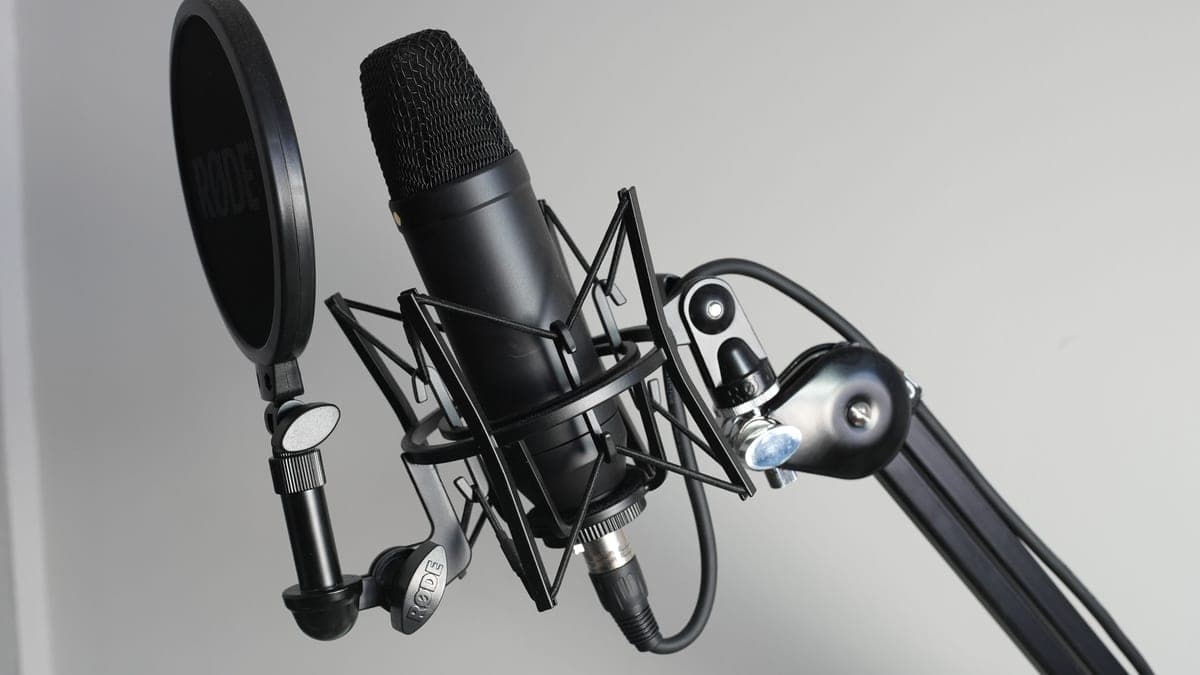
The NT1-A has been sold for most of its life as a kit: microphone, shockmount, pop filter and XLR cable in one box. Those are three things you need and would otherwise buy separately, and buying them separately is not cheap — a decent pop filter and a decent cable are a meaningful fraction of a budget microphone's price. Best pop filters and best XLR cables are what you are skipping.
That is the honest case for the older microphone, and it is a real one. If the kit price gets a working signal chain into your room this month instead of next quarter, take it and manage the brightness in the mix.
Neither of these is the right buy in an untreated room
Both are 1-inch cardioid condensers, which means both hear your room with enthusiasm. In a bedroom with bare drywall, a window and a hard floor, the loudest problem on your recording is the wall behind you arriving a couple of milliseconds after your voice does — and a 4 dBA noise floor is completely irrelevant next to that.
If the room is untreated and will stay that way, a broadcast dynamic will give you a cleaner result than either of these for the same money: dynamic vs condenser microphones explains the mechanism. If you are willing to hang two panels at the first reflection points, then the condenser conversation is worth having, and this is the right pair to be having it about.
What else the chain needs
- Phantom power. Both are condensers and both need 48 V, which means an interface or a preamp — a plain XLR-to-USB cable will not do it. XLR to USB adapters explained.
- Very little gain. At -32 dB sensitivity the NT1 is an easy load, and every interface on this site drives either of these comfortably. How much clean gain do you need has the arithmetic.
- A mount that does not transmit the desk. A condenser on a hard desk picks up every keystroke through the stand. Boom arm vs desk stand.