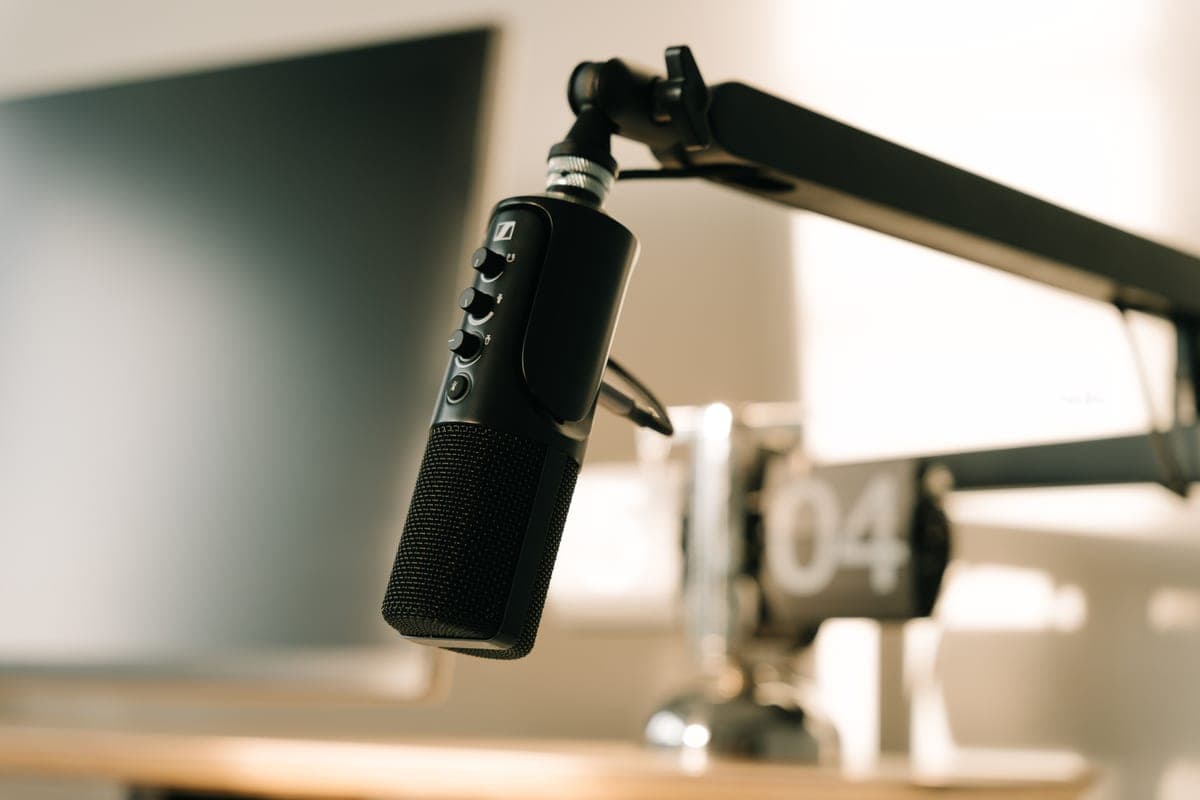
Buy the Shure MV7+ if you still record away from your interface — it is 2 dB hotter at -55 dBV/Pa, and the USB side keeps working on a laptop with nothing else plugged in. Buy the Rode PodMic if you have committed to XLR: it reaches 20 kHz against the MV7+'s 16 kHz, which is the difference between a microphone that also records music and one voiced only for speech.
The 2 dB that does not matter, and the 4 kHz that does
On gain these two are close enough to be interchangeable. -55 dBV/Pa against -57 dBV/Pa is a 2 dB difference, and both sit comfortably inside what a 69 dB interface supplies without a booster. Anyone telling you the MV7+ solves a gain problem the PodMic has is overstating a rounding error — what matters is that both are hotter than an SM7B, by roughly 4 dB and 2 dB respectively.
The bandwidth difference is the real one. The MV7+ response stops at 16,000 Hz. That is a deliberate speech voicing and it is fine — more than fine — for a podcast or a narration. It is a hard ceiling if you ever want to put the same microphone on an acoustic guitar, a cabinet or a backing vocal. The PodMic's 20 Hz to 20 kHz range makes it a general-purpose dynamic that happens to be excellent on voice.
What you are actually paying for on the MV7+
A converter and a DSP chip, both of which live on the USB path only. Plug the MV7+ into an interface over XLR and the Auto Level Mode, the digital pop filter and the touch panel all stop being part of the signal chain. You are then using a competent speech dynamic and carrying the cost of hardware you have switched off.
That is not an argument against it. It is an argument for being honest about which half of the microphone you are buying. If the laptop-only session is a real part of your week — travel, a guest's kitchen table, a recording you make before the interface arrives — the USB side is worth money. If it is hypothetical, it is not.
Choose the MV7+ if
- You record in more than one place, and one of those places has no interface.
- You are mid-transition from a USB microphone and do not want a gap. Upgrading from USB to XLR is the order to do it in.
- You host alone with no engineer, and Auto Level Mode genuinely removes a job from your week.
- Your content is speech only, now and for the foreseeable future, so 16 kHz costs you nothing.
Choose the PodMic if
- Your interface is already on the desk and will stay there.
- You want the option of recording something other than a voice with it.
- You would rather spend the difference on an interface with more gain or on room treatment.
- You want an internal acoustic pop filter rather than a digital one you lose on the XLR path.
Tone, and the boominess warning
The PodMic is voiced with more low-mid weight than most broadcast dynamics. On a light voice that reads as authority. On an already bass-heavy voice at close range it reads as mud, and the PodMic has no voicing switches to fix it — you fix it in the DAW or you back off the grille.
The MV7+ is the flatter and more neutral of the two through the midrange, which is part of why it is the safer microphone for someone not yet confident about processing their own voice. If you want on-mic control instead of either compromise, the switchable bass rolloff on an SM7B is the feature you are looking for.
Both microphones in detail
Shure MV7+
Top pickShure · Keeping a USB fallback while you move to XLR
The honest transition mic: it works on your laptop today and on your interface next month. If you know you are committing to XLR and never going back, the same money buys a better-sounding pure-XLR dynamic.
Why it is here
- -55 dBV/Pa is roughly 4 dB hotter than an SM7B, which removes the booster question entirely
- USB side keeps working when you travel without the interface
- DSP and the LED panel are genuinely useful for a solo host with no engineer
What it costs you
- Frequency response stops at 16 kHz, so it is voiced for speech rather than music
- The DSP features only exist on the USB path, not the XLR path
- You are part-paying for a converter you stop using the day the interface arrives
Rode PodMic
Rode · The best value in a broadcast dynamic
The pick for most people upgrading from a USB mic: it gets you 90 percent of the broadcast-dynamic sound without the booster arithmetic. Choose the SM7B instead if your voice is already bass-heavy and you want the bass-rolloff switch.
Why it is here
- At -57 dBV/Pa it needs about 2 dB less gain than an SM7B, which is enough to matter on a 58 dB interface
- Internal pop filter means one less thing clamped to your arm
- All-metal body at a fraction of the SM7B's price
What it costs you
- Voiced with more low-mid weight than the SM7B, so a boomy voice can get boomier
- No voicing switches, so you fix tone in the DAW rather than on the mic
- Still low enough output that a 55 dB interface will be working hard
If neither: the third option
If you want the broadcast-dynamic sound with voicing switches and your interface has the gain for it, the SM7B is the step up from both — Shure SM7B vs Rode PodMic runs that comparison directly, and is the SM7B worth it answers whether you should. The full field is in best XLR microphones for podcasting.