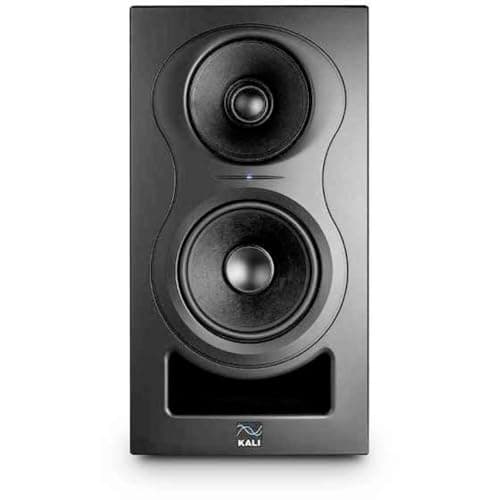
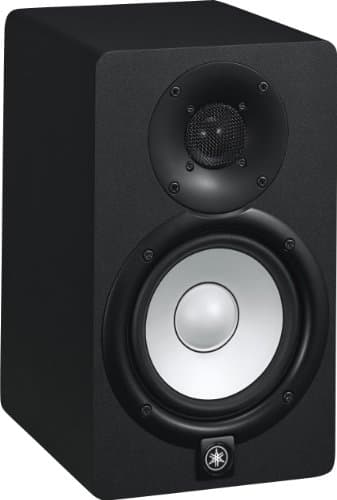
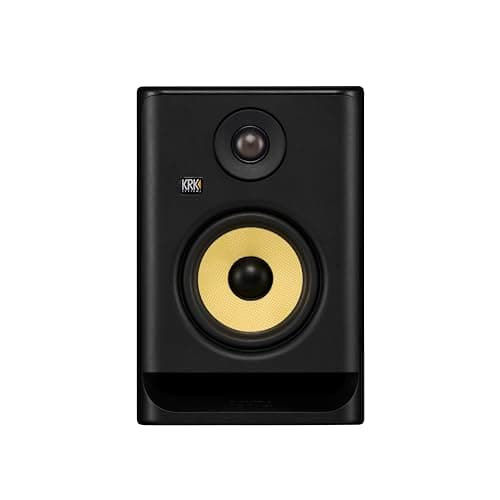
The Kali Audio IN-5 is the nearfield pick, and the reason is geometry rather than specification: its 4 inch midrange and 1 inch tweeter are coincident, so at a desk distance of three feet you hear one acoustic source instead of three drivers arriving at slightly different times. The budget pick is the Yamaha HS5, whose 74 Hz at -3 dB is the tightest-tolerance figure in this group and whose flat midrange is the most useful reference a small desk can hold. Prices come from the daily price check and each button carries its own date.
Nearfield monitoring means putting the speaker close enough that the direct sound from the driver dominates the reflected sound from the room. In a domestic room that distance is roughly 0.8 m to 1.2 m - three to four feet - and it is the single most effective thing you can do about a room you cannot treat. The trade is that at that distance the speaker's own construction stops being an abstraction. Driver spacing that is inaudible at 3 m becomes a lobing error at 1 m. A cabinet that is 12 inches deep eats a third of your desk. A monitor that needs to be 6 feet away to integrate its woofer and tweeter is, at a desk, simply the wrong speaker.
Read the tolerance column before the frequency column. The HS5's 74 Hz is measured at -3 dB and Yamaha publishes 54 Hz for the same speaker at -10 dB; the T5V's 45 Hz is a -6 dB figure. Nothing about either speaker changes - only the standard. The genuinely useful comparison in this group is between the two Kali models, which publish at the same +/-3 dB tolerance and reach the same 47 Hz: the LP-6 V2 does it with a larger woofer, the IN-5 does it with a three-way coincident arrangement that behaves better at the distance this page is about.
The five, ranked for a three-foot listening distance
Each card carries the published response with the tolerance and source, the live price with the date it was checked, and what the speaker needs from your desk and your room.
Kali Audio IN-5
Top pickKali Audio · A coincident three-way at a two-way price
The pick if you sit close, move around while working and want a stable stereo image — that is exactly what coincident drivers buy. If your room is untreated, spend the difference on panels first; the IN-5 will not out-engineer your walls.
Why it is here
- The coincident mid and tweeter share an acoustic center, so the image does not move as you do
- Crossing over at 280 Hz keeps the woofer out of the vocal range entirely
- 160 W tri-amped, with the same boundary EQ as the LP-6
What it costs you
- Three-way complexity in a small room is often solving a problem the room is causing
- Deep cabinet needs a proper stand, not a desk edge
- Meaningfully more money than the LP-6 for the same published bandwidth
Yamaha HS5
Yamaha · The flat midrange reference for a small room
The right monitor for an untreated or lightly treated small room, precisely because it does not pretend to have low end your room could not reproduce honestly anyway. If you need to hear below 74 Hz, add a treated room before you add a bigger speaker.
Why it is here
- The honest -3 dB figure of 74 Hz tells you what it will not do, which is rarer than it should be
- Midrange is flat and unflattering, which is the entire job of a monitor
- Small enough to sit at ear height on a desk without dominating the room
What it costs you
- Nothing below about 74 Hz, so you mix low end by trust rather than by ear
- Unforgiving — a rough mix sounds rough, which some people hate
- Rear port needs clearance from the wall
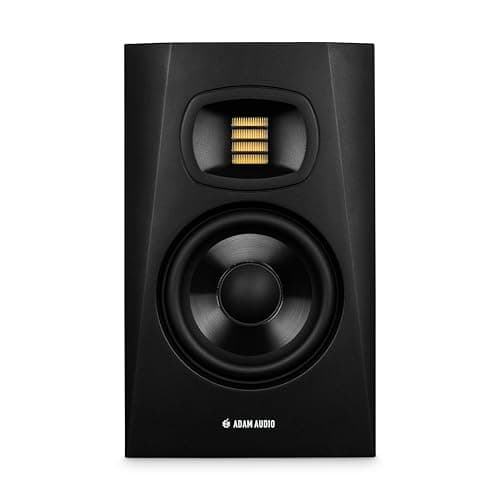
Adam Audio T5V
Adam Audio · Detail at the top, from a ribbon tweeter
Buy it if your work is voice and acoustic material where sibilance and reverb decisions matter, and you will listen at moderate levels. If you mix loud, or find bright speakers tiring, the HS5 is the safer reference.
Why it is here
- The ribbon tweeter resolves reverb tails and sibilance detail a dome cannot
- 45 Hz from a 5-inch cabinet is excellent
- Response to 25 kHz means no audible top-end rolloff at all
What it costs you
- That top-end detail is fatiguing over a long session until you adapt to it
- 20 W on the tweeter is modest if you mix loud
- Ribbon tweeters are less robust than domes if you clip them
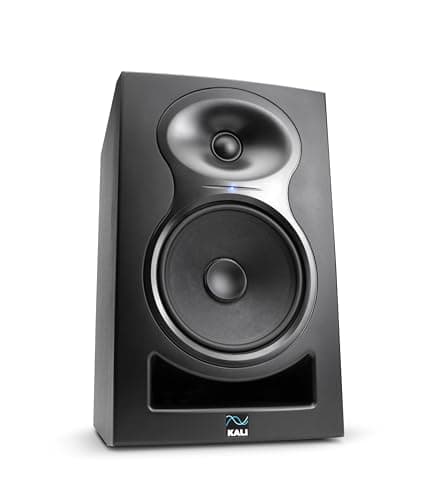
Kali Audio LP-6 V2
Kali Audio · The most low end per dollar, with boundary EQ
The best value here if you set the boundary EQ honestly and have corner traps in. In a bare bedroom with the switches left at default, the extra low end makes your mixes worse, not better, and the HS5 is the wiser buy.
Why it is here
- 47 Hz at +/-3 dB is real low end, not a marketing figure
- Boundary EQ switches on the back are the only honest answer to a speaker jammed against a wall
- 115 dB max SPL means huge headroom for a desk speaker
What it costs you
- That low-end reach is a liability in an untreated room — you will chase room modes, not mix decisions
- 6.5-inch driver in a small room needs the boundary EQ set correctly or it is worse than an HS5
- Paper cone is more fragile than the alternatives
KRK Rokit 5 G5
KRK · Onboard DSP room correction presets
Reasonable if the DSP presets genuinely match your placement and you cross-check mixes on headphones. As a sole reference, the flatter HS5 or 305P MkII will teach you more about your own mixes.
Why it is here
- Publishes its response with a tolerance — `54 Hz to 30 kHz, +/-3 dB` — which the previous generation did not
- Onboard DSP gives three voicing modes and 25 boundary settings without external hardware
- Kevlar woofer and silk-dome tweeter are physically tough
What it costs you
- `104 dB` max SPL is the lowest headroom in the 5-inch group here
- The Rokit voicing is historically flattering rather than flat — mixes translate less predictably
- `54 Hz` qualified at `+/-3 dB` is less low-end reach than the unqualified figures rivals quote
Setting up a nearfield pair properly
- Get the tweeters to ear height. This is the single largest free improvement available, and on most desks it needs a stand. Best studio monitor stands covers the options, and monitor isolation pads vs stands covers which problem each one solves.
- Make an equilateral triangle. The distance between the speakers should equal the distance from each speaker to your head. At a desk that usually means 1 m on each side, not the widest the desk allows.
- Pull them off the wall, or use the boundary switch. A speaker against a wall gains 3 dB to 6 dB of low end that is not in the recording. The LP-6 V2 and the Rokit 5 both have switches for it; the HS5 has a room-control filter.
- Toe them in to point at your head, not straight down the desk. At nearfield distances the off-axis response difference is audible.
- Then check the low end on headphones. No monitor at this distance in an untreated room is telling you the truth below 100 Hz. How to mix low end on headphones is the cross-check.
What we did not pick, and why
- The Yamaha HS7. A better speaker in a better room, and a 6.5 inch woofer with a 2 kHz crossover is not what a three-foot listening distance wants. It is ranked on best studio monitors for music production and on best studio monitors for guitar, both of which are further-field uses.
- Anything with an 8-inch woofer. 5-inch vs 8-inch studio monitors has the argument in full: an 8 inch driver needs distance to integrate and a room big enough to load.
- A subwoofer in the first purchase. At nearfield distances in a small room, a sub mostly adds a mode you cannot hear accurately. Do you need a subwoofer in a home studio is the honest version.
- Desktop multimedia speakers. They are voiced to flatter, which is the opposite of the job. If budget is the constraint, one HS5 pair beats any consumer 2.1 set for mixing.
- Monitors with no published tolerance at all. If a manufacturer prints a frequency figure without stating the dB window it was measured in, there is nothing to compare.
How these are ranked
- Driver arrangement at close range. Coincident or tightly-spaced drivers first, because vertical lobing is the dominant nearfield error.
- Published response with its tolerance. A +/-3 dB figure outranks a -10 dB figure quoting a lower number.
- Dispersion and sweet-spot width, because a desk is not a measurement chamber and you move while you work.
- Level capability. Published max SPL where it exists, since a nearfield pair is asked for less of it than a mid-field pair.
- Buyable now, with a live Amazon listing and a price from the daily price check at the time this page was written.
Pair it with
- Stands or decoupling pads, before anything else. Best studio monitor stands.
- Two panels at the first reflection points. Best acoustic panels - the desk itself is one of the reflections.
- An interface with balanced outputs. Do I need an audio interface for studio monitors answers the wiring question.
- A headphone cross-check for the low end. Best headphones for mixing.
If your desk is against a wall and you cannot move it, read best studio monitors for an untreated room before you buy from this page: in that situation the monitor that measures best is not the monitor that will serve you best, and the boundary-EQ switches matter more than the driver count. Nearfield placement is a partial escape from a bad room, not a complete one.