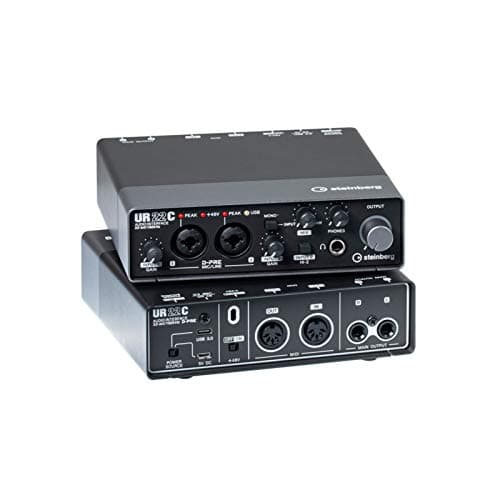
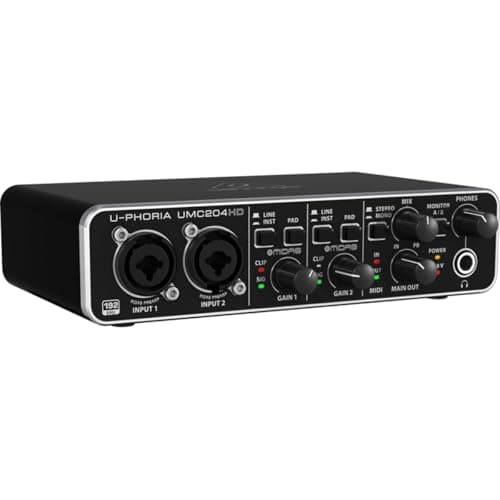
Buy the Steinberg UR22C if you record on Windows, want MIDI, or stream: 32-bit / 192 kHz conversion, Class-A D-PRE preamps, 5-pin MIDI in and out, a hardware loopback switch on the box and an onboard SSP3 DSP chip for latency-free monitoring effects. Buy the Behringer UMC204HD if the budget is the constraint — two XLR/TRS combo inputs with Midas-designed preamps and +48 V at 24-bit / 192 kHz is a complete, working interface for very little money.
This is a genuine budget-tier comparison rather than a close call. The UMC204HD is the honest floor of the category: it does the job, it publishes real numbers, and it leaves out everything that is not strictly necessary. The UR22C costs more and spends the difference on four specific things, each of which either matters a lot to you or not at all.
The four things the UR22C adds
- 32-bit conversion. Real, and the least important item on this list. Nothing in a home studio has the dynamic range to reveal the difference between 24-bit and 32-bit capture; your room's noise floor swamps it by a wide margin.
- MIDI in and out on 5-pin DIN. If you own a hardware synth, a drum machine or a controller without USB, this saves a separate interface. If you do not, it is a socket you will never use.
- A hardware loopback switch. Physically on the box, not in software. For streaming and for recording a call, this is the single most useful feature either interface has, because it routes computer audio back into the recording without a software router that can break mid-session.
- An onboard SSP3 DSP chip. Runs reverb and channel-strip processing on the interface, so a performer hears effects in the headphones with no round-trip latency. Genuinely useful for a singer; irrelevant for a podcaster.
Read that list honestly and the answer usually falls out. Two of the four — loopback and MIDI — are either essential to you or worthless. The other two are nice. If neither of the first two applies, the UMC204HD does the same core job for considerably less. Best audio interfaces with MIDI and best audio interfaces for streaming rank the wider field on each.
Drivers, which is the real argument for the Steinberg on Windows
Neither manufacturer publishes a driver-stability figure, because there is no such spec. What is true and worth saying is that the budget interface market's most common failure is not audio quality but the driver: crackling under load, a device that vanishes after a sleep cycle, a buffer setting that works until you open a browser.
Steinberg builds Cubase, so their Windows ASIO driver gets more attention than almost anyone's at this price, and the UR22C's reputation reflects that. Behringer's drivers have improved considerably over the UMC line's life and remain the weaker half of the package. If you record on Windows and your sessions matter, that is worth more than any converter spec on this page. Best audio interfaces for PC treats driver quality as the primary ranking criterion.
On macOS the argument shrinks. Core Audio handles class-compliant devices well and the gap between these two narrows to the feature list. Best audio interfaces for Mac covers that side.
Both interfaces, and the one that publishes its gain figure
Steinberg UR22C
Top pickSteinberg · Windows driver quality and a hardware loopback switch
The pick on Windows if driver stability and a physical loopback switch matter to you. The missing gain figure makes it a gamble with a low-output broadcast dynamic — pair it with a hot microphone.
Why it is here
- A hardware loopback switch rather than a software setting, which is the difference between streaming working and streaming needing a manual
- Yamaha-lineage Windows drivers, historically the most stable in this price band
- MIDI in and out plus onboard DSP monitoring FX
What it costs you
- Steinberg does not publish a maximum mic-gain figure, so you cannot plan a gain budget for a quiet dynamic
- The DSP FX are monitoring-only and add nothing to the recording
- 32-bit conversion is a headline number rather than an audible advantage
Behringer U-Phoria UMC204HD
Behringer · The floor of the category, honestly described
Buy it when the alternative is not recording at all, and plan to replace it. With no published gain figure it is a gamble with any low-output dynamic — pair it with a hot mic or not at all.
Why it is here
- Cheapest two-input interface worth plugging a real mic into
- Two combo inputs and phantom power at a price nothing else matches
- Inserts on the inputs, which is unusual this low
What it costs you
- Behringer does not publish a maximum gain figure, so you cannot plan a gain budget from the spec sheet
- Driver experience is the weakest in this group
- Build reflects the price
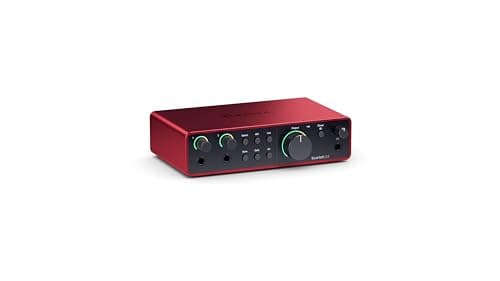
Focusrite Scarlett 2i2 (4th Gen)
Focusrite · The most gain per dollar in a two-input box
The default answer for someone buying an SM7B or PodMic: it supplies enough clean gain that you never need a booster, which makes it the cheaper total purchase even when it is not the cheaper box. Look elsewhere only if you need MIDI or four outputs.
Why it is here
- 69 dB is the most gain of any interface at this price, and enough for an SM7B with headroom to spare
- 120 dB dynamic range means the converters are not the weak link
- Two inputs, so a second person does not mean a second purchase
What it costs you
- Air mode is a fixed voicing, not an EQ you can dial
- Plastic-and-metal build feels less solid than the SSL or Audient competition
- No MIDI, which matters if you also play keys
What the UMC204HD gets right
It is easy to be snobbish about the cheapest interface in a roundup, and in this case it would be wrong. The UMC204HD gives you two XLR/TRS combo inputs — two real microphone preamps, not one preamp and one line input — with +48 V phantom power and 24-bit / 192 kHz conversion.
Two mic preamps is the specification that decides whether you can record a second person at all, and plenty of interfaces at twice the price have one. If your constraint is money and your requirement is two microphones, this is the box, and the compromise you accept is driver polish rather than audio. Are cheap audio interfaces worth it makes that case at length, and best audio interfaces under $100 is where it sits in the field.
Which to buy
- Windows, and the session matters: UR22C, for the driver.
- You stream, or record calls: UR22C, for the hardware loopback switch.
- You own `5-pin` MIDI hardware: UR22C. The Behringer has no MIDI at all.
- Two microphones, hard budget, macOS: UMC204HD. It does the core job and the money is better spent on acoustic treatment.
- Your microphone is a low-output dynamic: neither — the Scarlett 2i2's published 69 dB removes the guesswork.
The useful summary: these two are not competing on sound. They are competing on features and driver maturity, and both of those are things you can decide from your own requirements list rather than from a listening test.