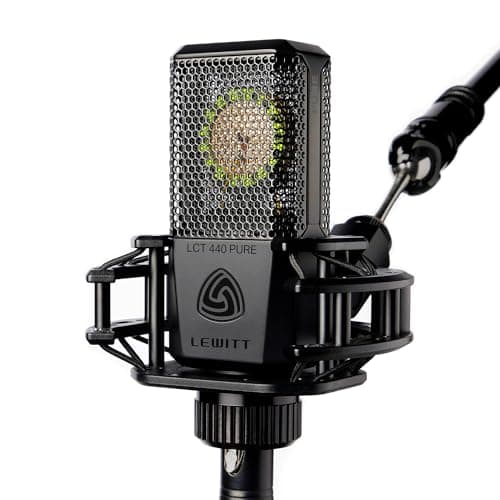
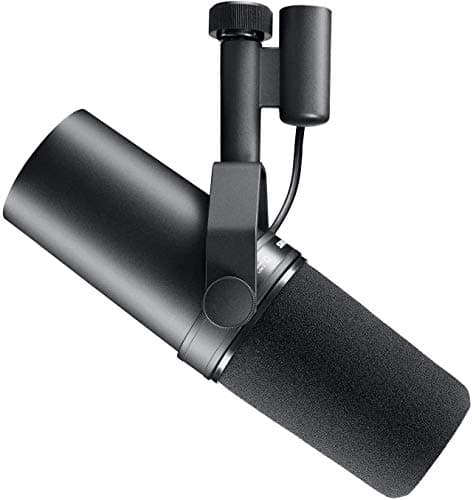
Buy the Lewitt LCT 440 Pure if your room is treated and your interface has modest gain - at 27.4 mV/Pa it needs roughly 28 dB less of it than the Shure. Buy the Shure SM7B if your room is bare or noisy, and budget for the gain it demands at -59.0 dBV/Pa.
This is a genuinely hard comparison, because the two microphones are not competing on quality. They are competing on which of your two problems is worse: a preamp that cannot deliver enough clean gain, or a room that puts itself on every recording. Pick the microphone that solves the problem you actually have and the other one will look like a mistake.
The 28 dB gap, and what it costs you
Sensitivity is how much voltage a microphone produces for a given sound pressure. The Lewitt publishes 27.4 mV/Pa. The Shure publishes -59.0 dBV/Pa, which is 1.12 mV/Pa. Convert both to the same unit and the condenser puts out about 28 dB more signal for the same voice at the same distance.
That number is not an abstraction, it is a shopping constraint. A spoken voice into the SM7B typically wants somewhere around 60 dB of gain to land at a healthy recording level, which is at or past the limit of a lot of two-input interfaces. The same voice into the LCT 440 Pure wants something in the thirties, which every interface on this site supplies with headroom to spare. How much gain does the SM7B need works through the arithmetic with real preamp figures.
Run a preamp near its ceiling and you are not just quieter - you are listening to the preamp's own noise floor, amplified along with your voice. That is why the SM7B has an entire accessory category attached to it. An inline booster adds clean gain ahead of the preamp, which fixes the problem properly and costs real money: see Cloudlifter vs FetHead for the two standard answers, or the best preamps for the Shure SM7B for the interfaces that make a booster unnecessary.
What the Shure buys you back: your room
Everything above argues for the condenser, and then you record in an untreated bedroom and the argument collapses. The same 28 dB of extra sensitivity that makes the Lewitt easy to drive also makes it hear your room, your refrigerator, your neighbor's car and the reflection off the wall behind you.
The SM7B is a dynamic with a tight cardioid pattern, a built-in windscreen and an internal shockmount, and it is quietly the best room-rejecting microphone in this price class. Put it close - a fist's width - and the direct sound dominates everything else by a comfortable margin. That is why it is the broadcast default and why it has not needed replacing in decades.
A large-diaphragm condenser in a bare room does not have that option. It will reproduce the room faithfully, because reproducing things faithfully is what it is for. You can fix that - how to treat a room for recording is the real answer and the best reflection filters is the partial, portable one - but you have to actually do it, and the cost belongs in the comparison.
Where the Lewitt is simply better
- Detail and air. 20 Hz to 20 kHz from a 25.4 mm, 3-micron diaphragm resolves breath, consonants and acoustic instruments in a way no dynamic at this price does.
- Noise floor. 7 dB(A) of self-noise is competitive with microphones costing several times more, and it is the figure that matters for quiet sources - a fingerpicked guitar, a whispered line.
- Headroom. 140 dB max SPL at 0.5% THD means it will not run out on a loud singer or a snare, which is a real limit on some budget condensers.
- Flat rather than flattering. It is voiced noticeably flatter than the bright budget condensers, so a sibilant voice needs less de-essing. Rode NT1 vs Lewitt LCT 440 is the comparison that pins that down.
- It costs less. Meaningfully less than the SM7B, before you count the booster the Shure often needs.
Where the Shure is simply better
- Room rejection. The single biggest difference in a real home studio, and it is not close.
- Voicing control on the microphone. Bass rolloff and presence boost let one SM7B flatter a thin voice and tame a boomy one. The Lewitt has no switches at all, by design.
- Plosive and handling tolerance. The internal shockmount and integral windscreen absorb desk bumps and breath that a condenser forwards straight to the file.
- Humidity and heat. A dynamic capsule does not care. A condenser capsule can, in a hot room or a garage.
- Resale and ubiquity. An SM7B holds value and every guest already knows how to talk into one.
Choose the Lewitt LCT 440 Pure if
- Your interface's gain range is modest and you do not want to buy a booster.
- You have at least some treatment up, or you record in a soft, furnished room.
- You record acoustic sources as well as voice - guitar, strings, a quiet room tone.
- You want flat rather than shaped, and you would rather do your tone-shaping in the mix.
- The budget has to cover the microphone and the stand, not the microphone and an accessory.
Choose the Shure SM7B if
- Your room is bare, shared, or near a road, and treating it is not happening this month.
- Your work is speech - podcast, voiceover, streaming - where room rejection beats air every time.
- Your interface already supplies 60 dB or more of clean gain, or you are budgeting for a booster.
- You want the two voicing switches, because your voice needs shaping at the source.
- You record with guests who will bump the desk and eat the microphone.
Both microphones in detail
Lewitt LCT 440 Pure
Top pickLewitt · A flatter alternative to the bright budget condensers
Worth the step up if the budget condensers have sounded harsh to you and you want flat rather than flattering. If you want on-mic filtering, the AT2035 gives you more control for less.
Why it is here
- 7 dB(A) is competitive with mics costing considerably more
- Voiced flatter than the NT1-A, so less de-essing on a sibilant voice
- Deliberately stripped of switches, which keeps the signal path simple
What it costs you
- No high-pass filter or pad at all, by design
- Costs more than the AT2035 without adding features
- Smaller dealer network than Rode or Audio-Technica
Shure SM7B
Shure · The default upgrade, if your preamp can feed it
Buy it if your interface supplies 60 dB or more of clean gain, or if you are budgeting for a booster alongside it. Buy something else if your only interface is a Scarlett Solo and you are not prepared to add hardware.
Why it is here
- Rejects room and computer-fan noise better than any condenser at any price
- Two voicing switches let one mic cover a thin voice and a boomy one
- Internal shockmount and a yoke that actually holds position on a boom arm
What it costs you
- At -59.0 dBV/Pa it is one of the quietest mics sold, so it demands a loud preamp
- Total cost is the mic plus, very often, a booster
- Heavy enough that a cheap desk arm will droop under it
If neither: the two obvious third options
If the SM7B's gain demand is the only thing putting you off, the Shure SM7dB is the same capsule with a switchable preamp built in - SM7B vs SM7dB is whether paying Shure for the booster beats buying one. If you want a condenser with the on-mic filtering the Lewitt deliberately omits, the Audio-Technica AT2035 has a pad and a high-pass switch for less money, and Audio-Technica AT2035 vs Rode NT1 is where that field starts.
And if what you actually want is the SM7B sound without the SM7B total, the best SM7B alternatives ranks the dynamics that get closest, including the ones that need no booster at all.