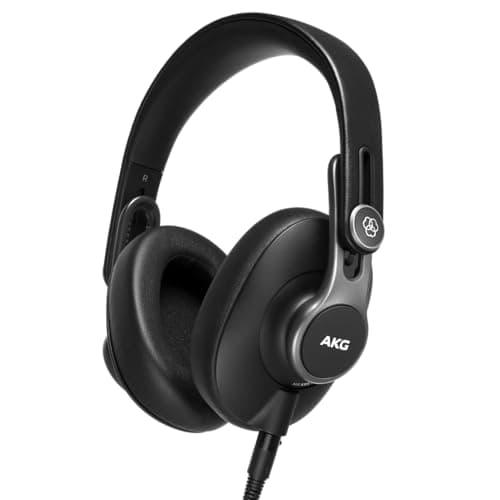
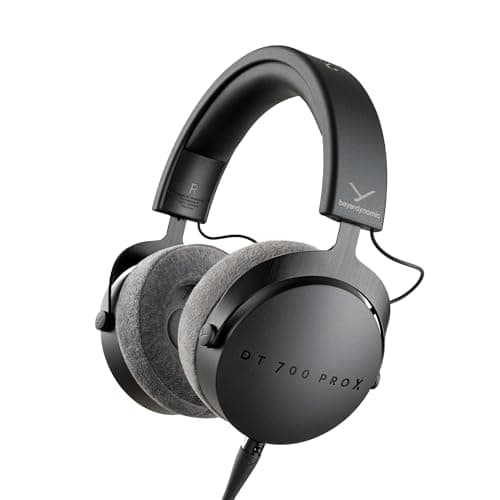
The AKG K371 is the best closed-back for mixing: independently measured at 36.2 ohms and 117.9 dB SPL, and one of the flattest closed designs measured at any price. The Beyerdynamic DT 700 Pro X at 48 ohms is the pick if you want a sturdier pair and will accept less isolation.
This page exists because the obvious closed-back advice is wrong for this job. Rank closed-backs the normal way - on how little leaks out - and you get the best closed-back headphones for recording, where the winner is the Beyerdynamic DT 770 Pro and the Sennheiser HD 280 Pro is the bargain. Rank the same seven pairs on whether you can trust what they tell you about a mix and that order very nearly reverses.
You are probably here because open-back is not available to you. A shared room, a housemate, a live microphone in front of you, a train - whatever the reason, the honest open-back recommendation on best headphones for mixing does not help. So the question becomes narrower and more useful: of the headphones that seal, which ones can you make real decisions on?
The criteria, in the order they actually matter
- Measured tonal accuracy. How closely the pair tracks a known target curve. This is the whole page, and it is the one thing manufacturers never publish - you have to go to independent measurement for it.
- Low-end honesty specifically. A sealed cup is a pressure chamber, and the bass region is where closed designs most often add energy that is not in your mix. Under-mixing low end is the most common headphone-mixing failure there is.
- Drivability. Impedance and sensitivity together decide whether your interface's headphone output can drive the pair to a usable level without strain. A pair that is flat but quiet is still the wrong pair.
- Isolation, demoted. You need enough to keep the room out and your headphone mix in. Past that point, more isolation usually means a heavier seal, more clamping force and a stronger pressure chamber - which works against criterion one.
- Comfort over hours. Mixing sessions are long in a way tracking sessions are not. A pair you take off every forty minutes costs you continuity, and continuity is most of what a mix is.
- Parts availability. The pair you keep for eight years is cheaper per year than the pair you replace twice, and pads are the part that always dies first.
What a sealed cup does to what you hear
An open-back earcup lets air move freely behind the driver. A closed one does not, and that single physical difference produces three consequences you have to mix around.
The cup becomes a pressure chamber. Trapped air behind and in front of the driver raises low-frequency output, and how much depends on how well the pad seals against your head. That is why the same closed-back can sound bass-heavy on one person and thin on another, and why wearing glasses changes the result. Open-backs are far less sensitive to seal.
The enclosure resonates. A sealed volume has modes of its own, and they land in the low and lower-mid range where a lot of mix decisions live. You hear it as a thickness that is not in the file.
Reflections inside the cup compress depth. Sound bounces off the inside of the enclosure and reaches your ear a fraction late. The result is a narrower sense of space, which is why reverb and stereo width read less honestly on any closed design than on a decent open-back. This is the one problem on the list that no amount of engineering fully solves.
None of this makes mixing on closed-backs impossible. It makes it something you do deliberately, with a cross-reference, and with the knowledge that low end and depth are the two things your headphones are least qualified to judge. How to mix with headphones only is the method, and how to mix low end on headphones is the specific workaround for the hardest part of it.
The seven closed-backs, ranked for mixing
Ranked on tonal accuracy first and drivability second. The order below is close to the reverse of the isolation ranking on the recording page, which is the whole reason both pages exist.
AKG K371
Top pickAKG · The closed-back that measures closest to a target curve
The best single-pair compromise on this site: closed enough to track with, flat enough to make real mix decisions on. Choose the DT 770 instead if durability matters more than measured flatness.
Why it is here
- Independently measured as one of the flattest closed-backs at any price
- 36 ohms and 117.9 dB SPL means anything drives it loudly
- Folds flat, with three detachable cables
What it costs you
- Plastic build that does not inspire the confidence a DT 770 does
- Clamping force is light, so it moves if you do
- Closed-back still compresses your sense of reverb depth
Beyerdynamic DT 700 Pro X
Beyerdynamic · A closed-back you can also make mix calls on
The pick if you want one closed-back that tracks honestly and can take a mix most of the way, and your interface has a modest headphone output. If budget decides, the DT 770 Pro does the tracking job for less.
Why it is here
- 48 ohms is the easiest-to-drive closed-back here — a bus-powered interface or a phone dongle manages it
- Noticeably flatter than the DT 770's lifted treble, so mix decisions survive better
- Detachable cable plus the usual Beyerdynamic replaceable-everything parts policy
What it costs you
- Costs roughly half again what the DT 770 Pro does for a smaller gain than the price implies
- Isolates less than the DT 770 Pro, which is the trade for the flatter voicing
- Beyerdynamic publishes no attenuation figure, so isolation cannot be compared on paper
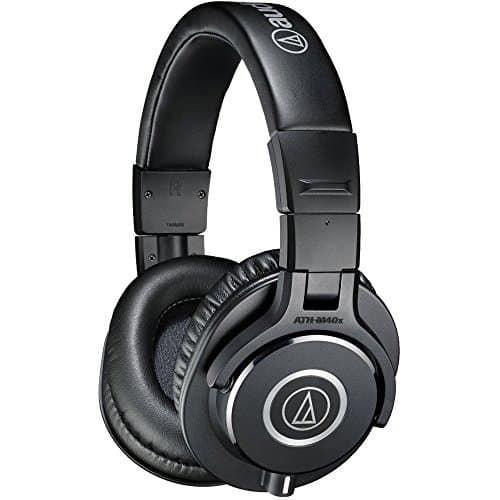
Audio-Technica ATH-M40x
Audio-Technica · The flat-voiced budget closed-back
The one to buy if money is tight and you want a closed-back that does not lie to you about low end. Step up to the DT 770 Pro when isolation or longevity starts costing you takes.
Why it is here
- Voiced far flatter than the ATH-M50x it sits below, which makes it the better monitoring choice of the two
- 35 ohms and a 1,600 mW power handling figure means nothing you own will struggle or damage it
- Two detachable cables in the box, one coiled and one straight
What it costs you
- Isolates less than the DT 770 Pro or the HD 280 Pro, so a loud headphone mix can still leak
- Pads are shallow and compress within a year of regular use
- Audio-Technica publishes no attenuation figure for it either
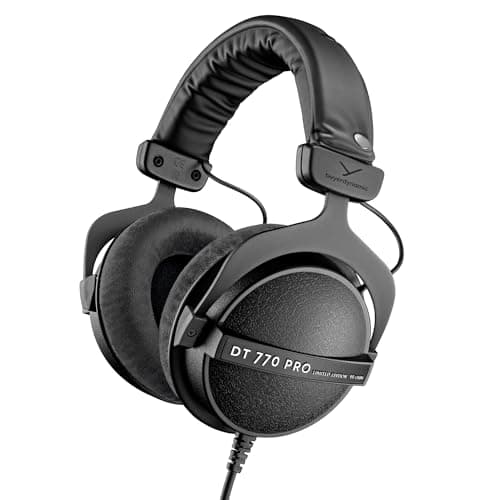
Beyerdynamic DT 770 Pro (80 ohm)
Beyerdynamic · Tracking with a live mic in the room
The right headphone for recording, where leakage is the problem you are solving. For mixing decisions, an open-back pair will tell you more truth about depth and reverb.
Why it is here
- Closed-back, so nothing leaks into an open microphone two feet away
- 80 ohms drives properly from any interface headphone output on this site
- Every wear part is a user-replaceable spare, which is why these last a decade
What it costs you
- A lifted top end that flatters detail and misleads on sibilance decisions
- Closed-back soundstage narrows your sense of reverb depth
- Velour pads get warm over a long session
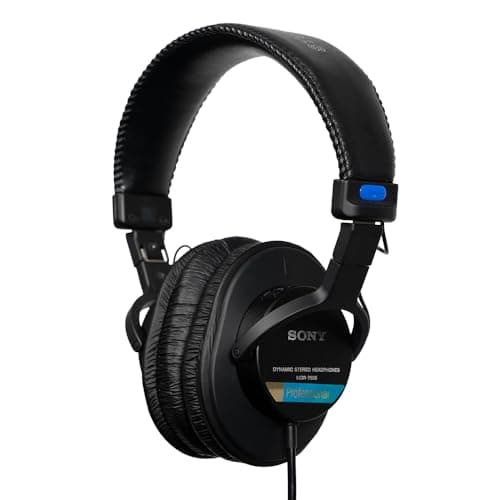
Sony MDR-7506
Sony · The broadcast standard for hearing problems
Buy them as the pair you check edits and noise on, not the pair you mix on. If you only own one set of headphones, the K371 is the better choice.
Why it is here
- Forward, slightly harsh presentation that makes clicks, hum and sibilance obvious
- 63 ohms drives from anything, including a camera
- Decades of parts availability and a price that has barely moved
What it costs you
- Not flat, and not pleasant — this is a fault-finding tool
- Coiled cable is fixed, not detachable
- Thin pads that flake with age
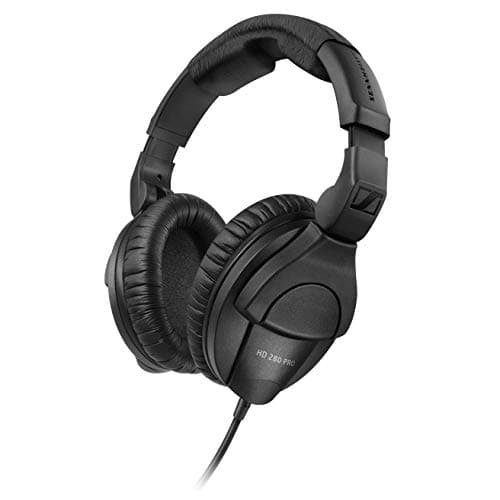
Sennheiser HD 280 Pro
Sennheiser · The only published isolation figure in the category
Buy them when leakage is the actual problem — a loud headphone mix, a noisy room, a condenser two feet away. Do not buy them as your only pair if you also mix, because the voicing will mislead you.
Why it is here
- 32 dB of attenuation is the highest published figure on this page, and almost nobody else publishes one at all
- 64 ohms with a 113 dB maximum SPL plays loud from any interface output on this site
- Costs a fraction of the Beyerdynamic picks while isolating better than either
What it costs you
- Strong clamping force that most people find uncomfortable before the second hour
- Mid-forward and bass-shy voicing — these are a tracking tool, not a mixing reference
- The coiled cable is captive, so a cable fault is a repair rather than a swap
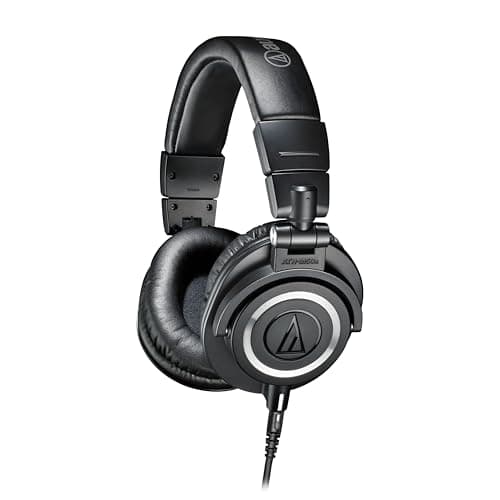
Audio-Technica ATH-M50x
Audio-Technica · A tough closed-back for tracking, not mixing
Use them for tracking and for checking a mix against a consumer-style bass lift. Do not make low-end decisions on them — the K371 costs similar money and measures far flatter.
Why it is here
- Drives easily from anything at 36.6 ohms
- Physically robust, and folds for transport
- Good isolation for tracking next to a live mic
What it costs you
- A pronounced bass lift that makes mixes translate badly
- Narrow soundstage even by closed-back standards
- Pads compress and need replacing sooner than the Beyerdynamic equivalents
Where the ranking inverts, and why
The Beyerdynamic DT 770 Pro wins the recording page and sits fourth here. Nothing about the headphone changed - the question did. Its treble lift makes a cymbal and a consonant easy to hear, which is exactly what you want when you are checking a take for a click or a plosive, and exactly what you do not want when you are deciding how much de-essing a vocal needs. Mix on a bright pair and you will consistently over-correct sibilance, then wonder why the file sounds dull everywhere else.
The Sennheiser HD 280 Pro falls further for the same kind of reason. Its 32 dB of published attenuation is the best isolation figure in the category by a distance, and that is a real achievement - it is the pair to buy if leakage into a live microphone is your problem. But the voicing that comes with that seal is mid-forward and bass-shy, so a mix made on it arrives with too much low end everywhere else. It is a tracking tool that happens to be cheap, not a mixing reference that happens to isolate.
The ATH-M50x is last, and it is the most-bought headphone on this page. Its measured bass lift is real and it is consistent, and consistent is the problem: you learn to compensate for it, and then every mix you make is thin on a flat system. The ATH-M40x sits below it in Audio-Technica's own range, costs less, and is voiced flatter. For monitoring, the cheaper one is the better one - DT 770 Pro vs ATH-M50x covers why neither of the two most obvious buys is a mixing tool.
What we did not pick, and why
- Any pair with active noise cancellation. ANC works by adding a processed correction to what reaches your ear. Judging a mix through an unknown correction curve is not monitoring.
- Wireless, including low-latency modes. Codec processing changes the signal and latency changes your timing judgment. Neither is acceptable for a mix decision.
- Closed-backs with no published or measured impedance. Drivability is criterion three and you cannot assess it without the figure.
- Consumer closed-backs with a deliberate bass shelf. They are often more comfortable and better built than the studio pairs at the same price. They also guarantee the single most common mixing error on this site.
- Planar magnetic closed-backs above this price band. Some are genuinely excellent. At that budget the money does more good in acoustic treatment plus an open-back pair, because then the closed-back only has to handle tracking.
How to choose
- Is closed-back actually a requirement, or a habit? If nothing in your room leaks and nobody minds the sound, buy open-back - the best open-back headphones for mixing will tell you more truth for the same money.
- One pair, doing both jobs? The K371. It is the only pair here that is genuinely competent at mixing and adequate at tracking.
- Two pairs, and this is the mixing one? The DT 700 Pro X, with a DT 770 Pro or an HD 280 Pro handling the tracking.
- Tight budget? The ATH-M40x. It is the cheapest pair here that does not lie to you about low end.
- Weak headphone output? The DT 700 Pro X at 48 ohms and the K371 at 36.2 ohms both play loudly from a bus-powered interface. Check your output specification against best audio interfaces for a home studio.
- Already own a bright or a bass-heavy pair? Keep it for fault-finding and buy one flat pair. Two known voicings beat one unknown one.
Pair it with
- A second reference, whatever it is. A cheap speaker, a phone, a car. Studio monitors vs headphones for mixing sets out which to buy first, and why the answer is usually headphones.
- An interface that drives them cleanly. None of these need an external amplifier, but a weak output still runs out of level. Best audio interfaces for a home studio.
- Two panels before a better pair. If you also plan to use speakers, acoustic treatment on a budget buys more reliable decisions than any headphone upgrade at this price.
- A monitor pair, when the room allows it. Best studio monitors for an untreated room is the honest version of that step.
If the budget is the real constraint, best closed-back headphones under $200 ranks that band from live listings and separates the pairs you can make decisions on from the pairs built for tracking.