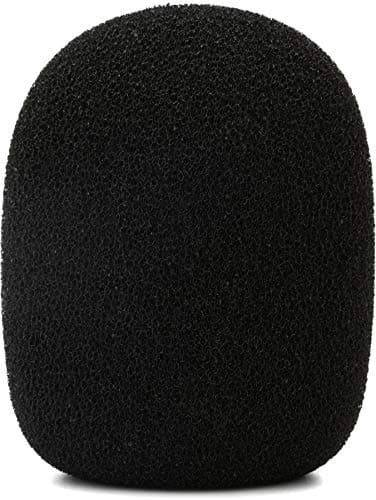
The Elgato Wave Mic Arm LP is the accessory to buy under $100: 2 kg of rated capacity and 740 mm of reach, traveling below the shoulder line so it never enters a camera frame. The budget pick is the Rode WS2 foam windshield, which costs a fraction of anything else here and solves plosives on a mount that is already at its weight limit. Prices come from the daily price check and each button carries its own date.
Accessories are where home studio money is wasted most reliably, because the category is full of products that solve nothing. The five here were chosen the other way around: each one is the answer to a specific failure you can hear on a recording. A mic that drifts or thumps is a mount problem. A buzz that changes when you move your hand is an interference problem. A take ruined by one word beginning with P is a filter problem. If you cannot name the problem, the honest advice is to buy nothing and spend the hundred dollars on absorption instead - best acoustic panels is where that money does more.
The two mounts are ranked on a trade rather than a number. The Wave Arm LP carries 2 kg - comfortably more than any microphone on this site - and its low-profile travel keeps it out of a camera frame, which is the thing most people actually complain about. The K&M floor stand carries no published load rating at all, and it is here because a clamp needs a desk edge and plenty of desks do not have one. If your floor is a suspended wooden one, note that a floor stand transmits footfall that a clamped arm does not; boom arm vs desk stand covers that decision in full.
The five, ranked under $100
Each card carries the published figure with its source, the live price with the date it was checked, and the fault the accessory exists to fix.
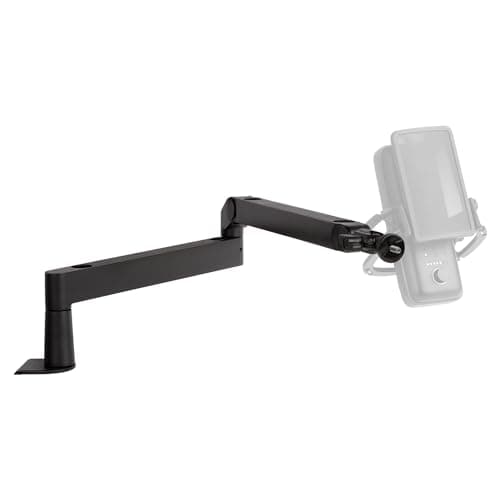
Elgato Wave Mic Arm LP
Top pickElgato · Staying out of the camera frame
The pick if you are on camera, because an arm that never enters the frame is worth more than a marginally quieter one. For audio-only work the PSA1+ is the quieter mount.
Why it is here
- 2 kg capacity is the highest here — it will hold anything on this site
- 740 mm of reach crosses a deep desk without a riser
- Travels below your shoulder, so it stays under a monitor and out of a webcam shot
What it costs you
- The low arc puts the arm where your keyboard wants to be
- Not as thoroughly damped as the PSA1+, so knocks transmit more
- Repositioning takes two hands
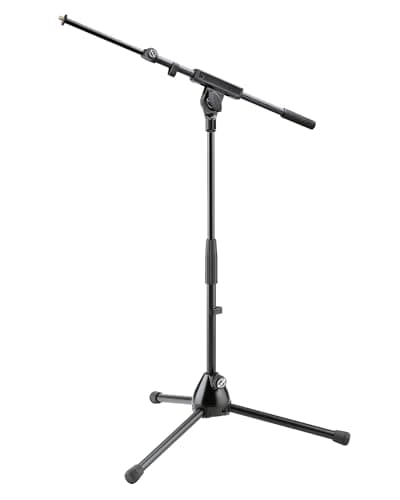
K&M 25977 (259 series)
König & Meyer · A desk-height stand when an arm will not fit
The answer when your desk has no clampable edge, or when you record standing. If you can clamp, a damped boom arm isolates footfall better and takes no floor.
Why it is here
- Low-level design reaches mic height from the floor beside the desk, so nothing clamps to the desk at all
- Zinc die-cast base and steel tube — this is a stand you buy once
- Nearly `29 inches` of boom reach, and a `5/8 in` thread that fits US shockmounts without an adapter
What it costs you
- K&M does not publish a load rating for this model, so a heavy mic plus a shield is guesswork
- Floor stands transmit footfall a clamped arm does not
- Takes floor space
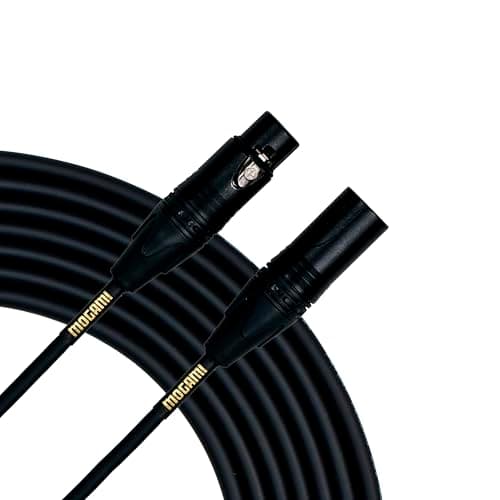
Mogami Gold Studio XLR
Mogami · A room full of electrical interference
Buy it for a specific, diagnosed hum problem, where the 30 dB rejection figure is doing measurable work. Do not buy it expecting better sound in a quiet electrical environment — that is not what a cable does.
Why it is here
- Star-quad geometry rejects up to 30 dB more induced noise than a standard two-conductor cable
- That figure is the reason to buy it: if you hear hum near a dimmer or a router, this is a real fix
- Built to be coiled and uncoiled for years without conductor failure
What it costs you
- Costs several times a competent basic cable
- If you have no interference problem, it will sound exactly like a cheap cable, because it should
- Stiffer than a thin cable, which matters on a boom arm
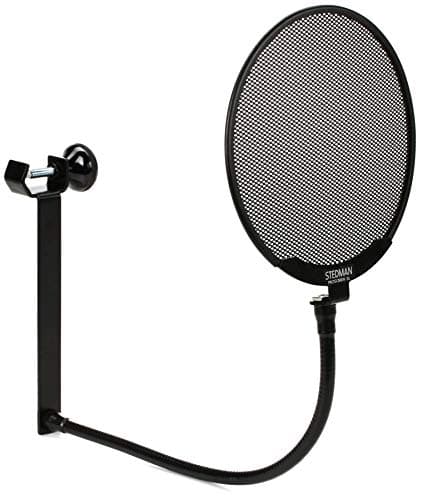
Stedman Proscreen XL
Stedman · A pop filter you can wash instead of replace
Worth it if you record daily and have replaced a fabric filter more than once. For occasional recording a nylon filter at a tenth of the price does the same acoustic job.
Why it is here
- The patented metal screen redirects plosive air downward rather than trapping it in fabric
- 6.125 inches of screen covers off-axis movement a small filter does not
- Rinse it clean; a nylon mesh filter is a consumable
What it costs you
- 10 oz on a 13-inch gooseneck is real leverage on a boom arm
- Costs many times a nylon filter
- 26.5 inches overall needs somewhere to live when you are not recording
Rode WS2
Rode · Plosive control without anything on your arm
The right choice when your arm is already at its weight limit, or when the mic has to stay portable. A mesh or metal screen keeps the top end cleaner if you have the load capacity for one.
Why it is here
- 10 g adds nothing to your arm's load, unlike a 10 oz metal filter
- Sits on the mic, so the mic can move without re-aiming a separate screen
- Cheapest effective plosive control there is
What it costs you
- Foam over a capsule takes a little top end with it
- Sized for specific Rode bodies — check the fit before ordering
- Foam degrades over a few years
Which problem are you actually solving
- The microphone moves, droops or thumps. A mount problem. Buy the Wave Arm LP if your desk has a clampable edge, the K&M stand if it does not.
- A constant hum or buzz that changes as you move. An interference problem, and the one case where a cable genuinely helps: the Mogami's quad geometry publishes up to 30 dB more rejection than a typical twisted pair.
- Occasional ruined words. A plosive problem. The Stedman is metal and washable; the WS2 is foam and weighs 10 g, which matters when the arm is already loaded.
- A hollow or boxy tone on every take. Not an accessory problem at all - that is the room. How to treat a room for recording is the diagnosis.
- A quiet, hissy recording. Not an accessory problem either - that is gain. How much clean gain do you need has the arithmetic.
What we did not pick, and why
- The Rode PSA1+. The quietest arm we rank and above this band on price. If it is within reach, buy it instead - see best boom arms for microphones.
- IsoAcoustics ISO-155 monitor stands. An excellent purchase that sits above $100 and belongs to the monitoring hub: best studio monitor stands.
- A shock mount, bought separately. Most microphones worth mounting ship with one, and a damped arm addresses the same vibration path.
- Cheap unbranded XLR cables in a multipack. They work. The reason the Mogami is here is a published rejection figure, which a multipack does not have - best XLR cables explains when that matters and when it does not.
- Desk-mounted acoustic shields under $100. The sE RF-X is the one we rank and it belongs to the treatment hub: best reflection filters.
How these are ranked
- Whether it fixes a nameable fault. Anything that does not is excluded regardless of price.
- A published figure. Load rating, reach, rejection, screen diameter - with a source for each.
- Durability per dollar, because accessories fail more often than electronics do.
- Whether it duplicates something else on the list. Two solutions to one problem is one purchase too many.
- Buyable now, with a live Amazon listing under $100 from the daily price check at the time this page was written.
Pair it with
- The full arm ranking. Best boom arms for microphones.
- The full pop filter ranking. Best pop filters, and pop filter vs foam windscreen for the choice between the two here.
- The rig these accessories hang off. Best home recording equipment.
- The cheapest full build. Home studio on a budget.
- The same shelf framed as a present. Best gifts for home recording.
One last note on spending order. If you own a microphone, an interface and headphones but nothing on the walls, none of these five accessories is your next purchase - a $60 to $80 panel is, and it will change every recording rather than one fault. Buy from this page when the recording is already clean and something mechanical is getting in the way of it.