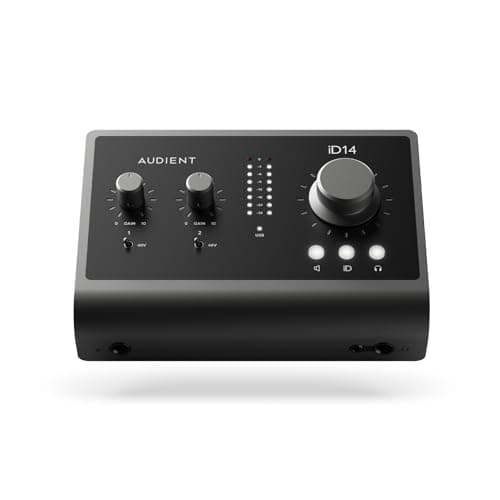
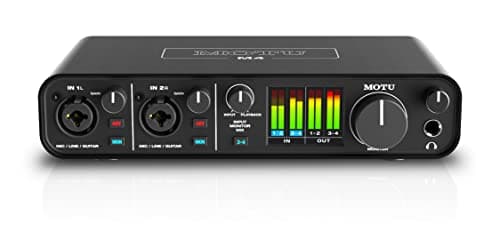
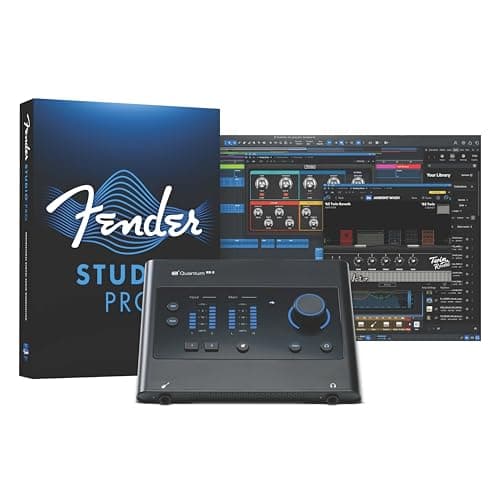
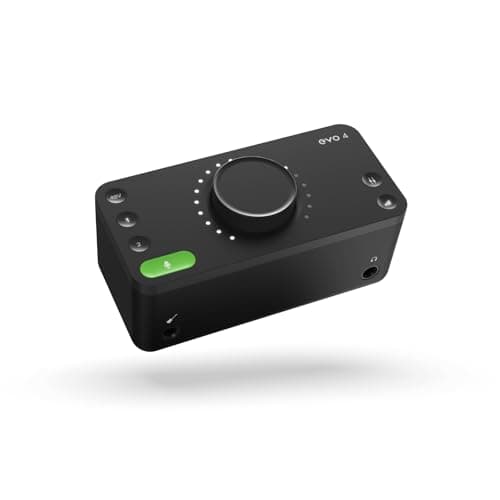
The Audient iD14 MKII is the pick under $300: two Class-A discrete preamps at -129 dB(A) equivalent input noise, converters rated 121 dB in and 126 dB out, and an ADAT input that adds eight more channels later without replacing the box. The budget pick is the Audient EVO 4, the cheapest interface here that still sets your level for you and gets it right. If you need four channels and MIDI, take the MOTU M4 instead. Prices come from the daily price check and each button carries its own date.
Under $200 an interface makes you choose. You can have the gain to drive a broadcast dynamic, or you can have the converters and the metering, and the boxes that do both at that price do not exist. By $300 that choice disappears, and the question becomes which additional thing you want alongside two clean inputs: more channels, MIDI, analog compression on the way in, or the quietest preamps you can buy at the price. All six picks below clear the gain bar for every microphone on this site except the very quietest broadcast dynamics - which is why the ranking turns on noise and features rather than on the gain figure alone.
Two columns in that table are doing different jobs, and conflating them is the most common mistake in this category. Gain is how much the preamp can amplify; EIN is how much noise it adds while doing it. The Quantum ES 2's +75 dB is the highest figure on this site and makes it the cheapest honest answer to a very quiet microphone - but the iD14 MKII's -129 dB(A) with 58 dB of range is the quieter preamp at the gain settings most people actually use. If your microphone is an SM7B at -59 dBV/Pa, read how much clean gain do you need first: the arithmetic, not the ranking, decides that purchase.
The six, ranked under $300
Each card carries the published gain and noise figures with their sources, the live price with the date it was checked, and the one thing the box does that the others do not.
Audient iD14 MKII
Top pickAudient · The quietest two-channel preamp pair here
The best-sounding two-channel box in this price band, and the right buy if your microphones are condensers or hot dynamics. With a low-output broadcast dynamic the gain ceiling still forces a booster.
Why it is here
- Two of the same Class-A console preamps as the iD4, at `-129 dB(A)` EIN
- ADAT input means it grows to ten inputs without replacing the box
- JFET instrument input that takes being driven hard
What it costs you
- 58 dB is marginal for an SM7B, exactly as on the iD4
- No MIDI, which at this price is a real omission
- ADAT expansion needs a separate preamp unit you do not own yet
MOTU M4
MOTU · Four channels, MIDI and the best converters here
The pick if you want MOTU's conversion plus MIDI and a couple of extra line inputs. If you only ever record one or two microphones and do not need MIDI, the M2 does the same job for less.
Why it is here
- 60 dB of published gain and `-129 dBu` EIN is a genuinely quiet channel, and unlike the M2 the figure is published
- MIDI in and out on a box this size saves a separate interface if you play keys
- Full-color LCD metering for all four channels, which is more useful daily than any software mixer
What it costs you
- 60 dB is enough for an SM7B but without much headroom to spare
- Two of the four inputs are line-only, so it is not a four-microphone box
- No onboard voicing or DSP at all
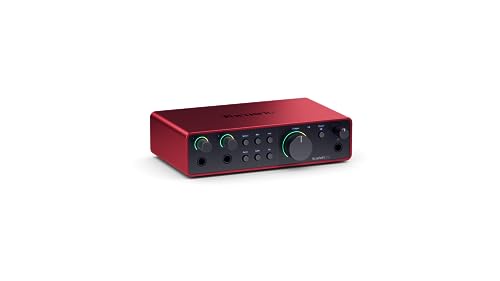
Focusrite Scarlett 2i2 (4th Gen)
Focusrite · The most gain per dollar in a two-input box
The default answer for someone buying an SM7B or PodMic: it supplies enough clean gain that you never need a booster, which makes it the cheaper total purchase even when it is not the cheaper box. Look elsewhere only if you need MIDI or four outputs.
Why it is here
- 69 dB is the most gain of any interface at this price, and enough for an SM7B with headroom to spare
- 120 dB dynamic range means the converters are not the weak link
- Two inputs, so a second person does not mean a second purchase
What it costs you
- Air mode is a fixed voicing, not an EQ you can dial
- Plastic-and-metal build feels less solid than the SSL or Audient competition
- No MIDI, which matters if you also play keys
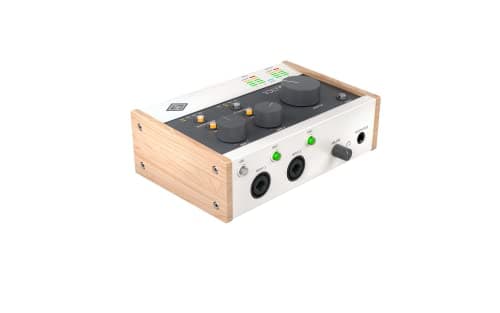
Universal Audio Volt 276
Universal Audio · Analog compression on the way in
Worth it if you record your own voice, know you want compression on the way in, and your microphone is hot enough for 55 dB. For anything else, record clean and compress in the DAW where you can change your mind.
Why it is here
- A real analog compressor on the input, which no other interface at this price includes
- Vintage preamp mode plus MIDI I/O in a bus-powered box
- The three compressor presets are genuinely usable rather than decorative
What it costs you
- `55 dB` of gain is the lowest of the interfaces we recommend and rules out an SM7B without a booster
- Analog compression is printed into the recording and cannot be undone
- You are paying for two color options a clean recording does not need
PreSonus Quantum ES 2
PreSonus · A published +75 dB of gain for the money
Buy it when the microphone is a quiet broadcast dynamic and the budget is tight: `+75 dB` with a published EIN figure is the cheapest honest answer to the gain problem on this site. Buy the Scarlett 4i4 instead if you need MIDI, or more than two inputs.
Why it is here
- `+75 dB` is more published gain than anything else near this price, and enough for an SM7B with no booster
- `-129 dBu` EIN is published too, so the noise cost of using all that gain is a known quantity rather than a guess
- Two MAX-HD preamps with independent gain and phantom
What it costs you
- No MIDI in or out, which the interface it replaces in this class did have
- Driver experience has historically trailed Focusrite and Steinberg on Windows
- 2-in / 2-out only — no room to grow
Audient EVO 4
Audient · Anyone who keeps getting gain-staging wrong
The pick for a second host on a budget, or for anyone whose recordings keep coming back too quiet. Not the pick if your mic is an SM7B, where the gain ceiling forces a booster.
Why it is here
- Smartgain removes the single most common beginner mistake in one button
- Two mic preamps at the price of most one-input boxes
- Genuinely small and bus-powered
What it costs you
- 58 dB again falls short of an SM7B's appetite
- Single encoder for everything means more button-pressing than knob-turning
- Plastic build
Which of the six is yours
- You record one or two microphones and want the best sound per dollar. The iD14 MKII. The ADAT input means a channel count problem later does not become a new interface.
- You also play keys, or need four inputs. The MOTU M4: MIDI in and out, two extra line inputs and the same converters as the M2. MOTU M2 vs MOTU M4 is the direct comparison.
- Your microphone is a quiet broadcast dynamic. The Scarlett 2i2 at 69 dB, or the Quantum ES 2 at +75 dB if the budget is tighter. Both remove the booster from the purchase - see best audio interfaces for the Shure SM7B.
- You want compression on the way in and you know you want it. The Volt 276. If you are not sure, record clean and compress in the DAW where you can change your mind.
- You keep getting levels wrong. The EVO 4's Smartgain, which is the budget pick here and the reason best audio interfaces for beginners ranks it first.
What we did not pick, and why
- The Focusrite Scarlett 4i4. The most complete box under $500 and it sits above this band on price. It wins best audio interfaces under $500.
- The SSL 2+ MKII. Two headphone outputs and a console voicing, and the daily price check did not show a live offer under $300 when this page was written. MOTU M2 vs SSL 2 MKII has the comparison.
- The MOTU M2. An excellent box that belongs to the band below, where it is one of the strongest picks: best audio interfaces under $200.
- The Zoom PodTrak P4 and RodeCaster Pro II. Recorders and consoles rather than interfaces. Best audio interfaces for multiple mics covers when that shape is right.
- Thunderbolt interfaces. Nothing in this band is Thunderbolt, and for two microphones the latency difference does not justify the price step - are Thunderbolt audio interfaces worth it.
How these are ranked
- Published equivalent input noise, where the manufacturer states it. At this price it is the figure that separates the boxes.
- Published maximum microphone gain, checked against the sensitivity of the microphones we recommend.
- Conversion figures, where published, as dynamic range in and out.
- What it adds beyond two inputs - channels, MIDI, expansion, automation - because every box here clears the basics.
- Buyable now, with a live Amazon listing under $300 from the daily price check at the time this page was written.
Pair it with
- The microphone this interface has to drive. Best XLR microphones.
- Headphones its output can actually drive. Best studio headphones under $300.
- The gain arithmetic, before you buy. How much clean gain do you need.
- Monitors, if the interface has balanced outputs. Do I need an audio interface for studio monitors.
One thing worth saying plainly about this band: the audible difference between a good $200 interface and a good $300 one is small, and smaller than the difference two acoustic panels make to the same recording. Buy from this page when you need a feature - a channel count, MIDI, ADAT, compression - or when the microphone you want is quiet enough that the gain figure decides it. Buy panels first if neither of those is true.