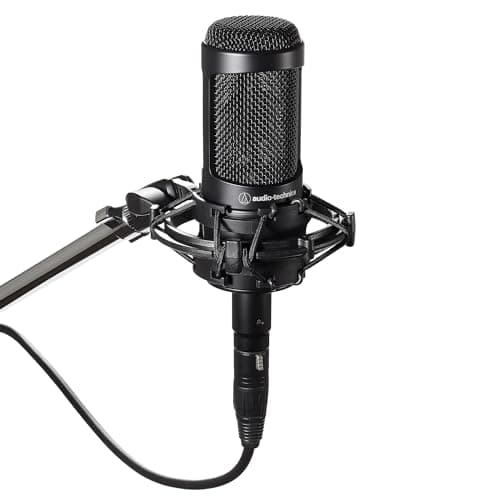
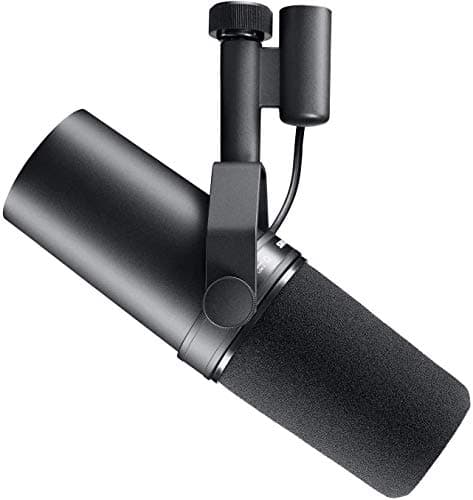
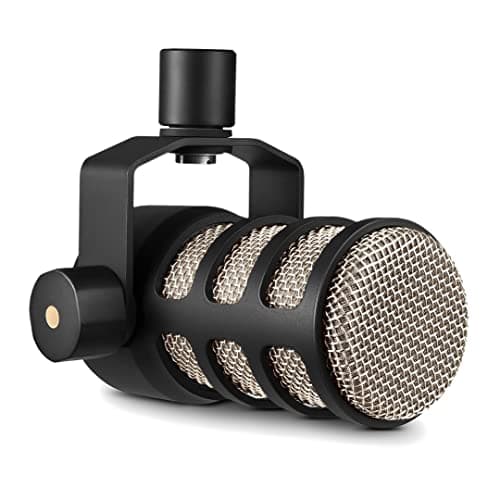
Buy the Audio-Technica AT2035 if your room is quiet and your interface is modest: at -33 dB (22.4 mV) it is roughly 26 dB hotter than the SM7B, so any interface will drive it, and it brings an 80 Hz high-pass and a 10 dB pad. Buy the Shure SM7B if your room is noisy or reflective and your interface publishes 60 dB of gain or more — nothing at this price rejects a room like it.
This pairing comes up constantly because the two microphones occupy adjacent slots in people's shortlists and almost nothing else in common. One is a value condenser with switches. The other is the broadcast dynamic every podcast studio owns. Comparing them on tone is close to meaningless; comparing them on sensitivity and room rejection settles it in about two minutes.
The 26 dB gap is the whole comparison
The AT2035 publishes -33 dB; the SM7B publishes -59.0 dBV/Pa. That is a gap of roughly 26 dB in how much signal the capsule hands your preamp for the same sound pressure at the grille, and 26 dB is an enormous amount of gain to have to find somewhere else.
In practice this means the AT2035 is comfortable on any interface sold with phantom power, including the cheapest. A 44 dB preamp is plenty. The SM7B needs roughly 60 dB of clean gain for speech at a normal working distance, and interfaces that publish less than that produce a recording with audible preamp hiss under every pause. How much gain does the SM7B need does the arithmetic with real figures, and best audio interfaces for the Shure SM7B lists the boxes that clear it.
The SM7B's answer to a low-gain interface is an inline booster: a FetHead adds 27 dB at a 3 kohm load for a fraction of the microphone's price. That works, and it is also a second purchase, a second point of failure and a dependency on phantom power that the microphone itself does not need. Budget for it honestly rather than discovering it after the microphone arrives.
Your room decides which of those two problems you would rather have
The AT2035's 26 dB advantage comes from being a condenser, and being a condenser is also its cost. A condenser generates a usable signal from very little air movement, which is why it captures detail a dynamic cannot — and why it also captures the reflection off the wall behind you, the computer fan, the fridge in the next room and the traffic outside.
The SM7B's dynamic capsule needs substantial air movement to produce anything at all, so a reflection arriving quieter and later than your voice produces almost nothing. That is not a tonal preference. In a bare bedroom it is the difference between a voice track that sounds like a recording and one that sounds like a room.
So the honest test is not which microphone is better. It is: can you hang two panels at the first reflection points? If yes, the AT2035 is excellent value and the switches are genuinely useful. If no — rented room, no wall fixings, housemates, street noise — the SM7B's rejection is worth paying for twice. How to treat a room for recording is the cheaper half of that decision.
Both microphones, and the dynamic that splits them
The Rode PodMic is on this page for a reason: at -57 dBV/Pa it is a dynamic you can drive on a modest interface, which is exactly the gap between these two.
Audio-Technica AT2035
Top pickAudio-Technica · The value condenser with the switches you actually need
The condenser to buy if you are choosing on value: the high-pass filter and the 8 dB quieter noise floor are worth more in a real room than anything else in this price band. Skip it if you have not treated the room, in which case a dynamic is the better purchase.
Why it is here
- 12 dB self-noise against the AT2020's 20 dB is an audible 8 dB of quiet for a small price step
- The 80 Hz high-pass is the single most useful switch on a desk-mounted condenser
- Ships with a real shockmount, not a plastic clip
What it costs you
- Still a condenser, so the room rules apply
- Slightly forward upper midrange that some voices find harsh
- The 10 dB pad is mostly irrelevant for voice work
Shure SM7B
Shure · The default upgrade, if your preamp can feed it
Buy it if your interface supplies 60 dB or more of clean gain, or if you are budgeting for a booster alongside it. Buy something else if your only interface is a Scarlett Solo and you are not prepared to add hardware.
Why it is here
- Rejects room and computer-fan noise better than any condenser at any price
- Two voicing switches let one mic cover a thin voice and a boomy one
- Internal shockmount and a yoke that actually holds position on a boom arm
What it costs you
- At -59.0 dBV/Pa it is one of the quietest mics sold, so it demands a loud preamp
- Total cost is the mic plus, very often, a booster
- Heavy enough that a cheap desk arm will droop under it
Rode PodMic
Rode · The best value in a broadcast dynamic
The pick for most people upgrading from a USB mic: it gets you 90 percent of the broadcast-dynamic sound without the booster arithmetic. Choose the SM7B instead if your voice is already bass-heavy and you want the bass-rolloff switch.
Why it is here
- At -57 dBV/Pa it needs about 2 dB less gain than an SM7B, which is enough to matter on a 58 dB interface
- Internal pop filter means one less thing clamped to your arm
- All-metal body at a fraction of the SM7B's price
What it costs you
- Voiced with more low-mid weight than the SM7B, so a boomy voice can get boomier
- No voicing switches, so you fix tone in the DAW rather than on the mic
- Still low enough output that a 55 dB interface will be working hard
The switches, and which ones you will actually use
Both microphones have two switches, and they do roughly opposite things. The AT2035's 80 Hz high-pass removes rumble and proximity buildup; its 10 dB pad raises max SPL from 148 dB to 158 dB, which matters for a guitar amp and never for speech.
The SM7B's switches are voicing rather than protection: a bass rolloff that does a similar job to the AT's high-pass, and a presence boost that lifts the upper midrange for a voice that reads as dull. The presence switch is the more interesting of the four, because it is the only one here that changes character rather than removing a problem.
What about tone
Having argued that tone is the wrong first question, it does matter once the practical constraints are settled. The AT2035 is the brighter, more detailed microphone, with more top-end air and a faster transient — it reads as more open on a high voice and on anything acoustic. The SM7B is darker, thicker and more forgiving, voiced for broadcast speech across decades of use.
If you record music as well as speech, that pushes toward the condenser. If you record speech only and want the sound people associate with radio, it pushes the other way. For the full condenser field see best condenser microphones for home studio; for the dynamic field, best dynamic microphones for vocals.
Which to buy
- Modest interface, quiet room, you record music too: AT2035. The 26 dB sensitivity advantage and the two switches make it the safer purchase.
- Reflective or noisy room, interface publishing `60 dB` or more: SM7B.
- Noisy room, low-gain interface: SM7B plus a booster, or the SM7dB with the +28 dB preamp built in.
- You want the SM7B's rejection without the gain problem: the Rode PodMic at -57 dBV/Pa, or the SM7B alternatives page for the full field.
Neither of these is a mistake, which is the useful summary. The AT2035 is the better instrument per dollar and the SM7B is the better tool for a compromised room. Decide the room question first and the microphone follows from it.