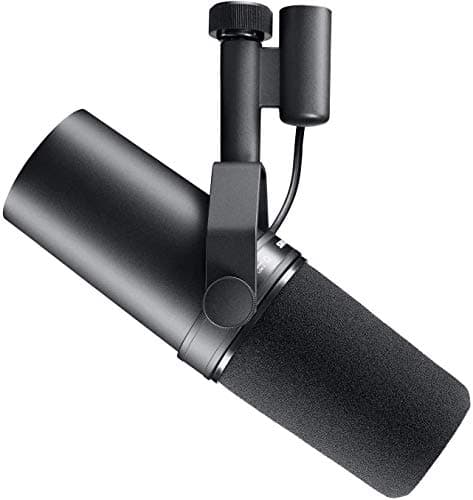
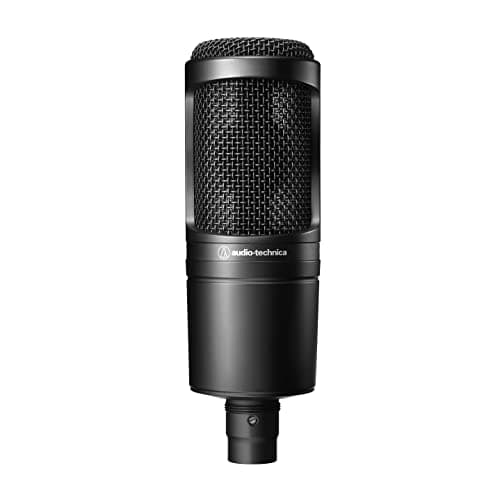
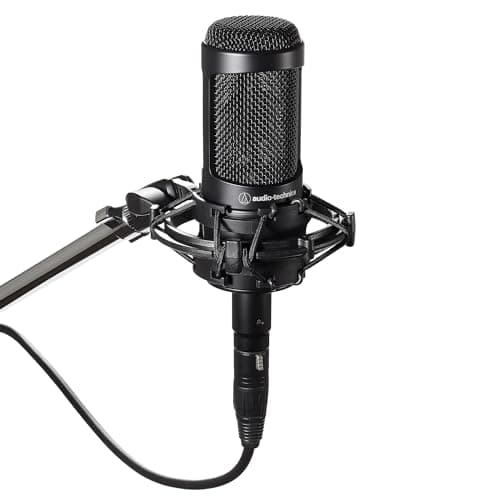
Buy the Shure SM7B if your interface publishes 60 dB of clean gain or more and your room is untreated — its dynamic capsule rejects a reflective, noisy space in a way no condenser at any price matches. Buy the Audio-Technica AT2020 only if the budget is genuinely fixed; it is hotter by roughly 22 dB so any interface drives it, but its 20 dB SPL self-noise is the highest of any condenser on this site, and the AT2035 one rung up fixes that.
This is the comparison that shows up when somebody has an SM7B on a wishlist and an AT2020 in the basket, and the honest answer involves a third microphone. The AT2020 is not a bad capsule; it is the entry point of a range, and the next rung up improves the two figures that matter most for a small fraction of the gap to the Shure.
The gain question, with numbers
The SM7B publishes -59.0 dBV/Pa. The AT2020 publishes -37 dB. The gap is roughly 22 dB, and that number is the practical difference between the two microphones for anyone buying their first interface alongside the capsule.
The AT2020 runs happily on anything with phantom power. The SM7B wants around 60 dB of clean gain for spoken word at a normal working distance; below that you are turning the preamp to its last few decibels, where its own noise floor becomes audible in every pause. A Scarlett 2i2 publishes 69 dB and clears it with room to spare; a 54 dB budget box does not clear it at all. How much clean gain do you need has the figure for every interface here.
If you already own a low-gain interface, the SM7B's real price is the microphone plus a booster — a FetHead at `27 dB`, or the SM7dB with +18 or +28 dB built into the body. That is not a reason to avoid it. It is a reason to total the bill before deciding the Shure is out of reach or the Audio-Technica is a bargain.
The AT2020's self-noise is the figure to look at twice
20 dB SPL is the highest self-noise figure of any condenser in this registry. In a loud, close application — a rap vocal, a shouted presentation — it is irrelevant, buried far under the source. On quiet material it is not: a softly delivered voice-over at a foot of distance sits close enough to it to hear a faint haze on the quiet parts.
The AT2035 publishes 12 dB SPL, an 8 dB improvement, and adds the 80 Hz high-pass and the 10 dB pad the AT2020 does not have. That is why this page carries three products rather than two: the cheaper Audio-Technica is rarely the right Audio-Technica. AT2020 vs AT2035 is the full version of that argument.
Room rejection, which the price tags hide
The specification sheets do not have a row for this and it is the most consequential difference between the two microphones. A dynamic capsule needs real air movement to generate a signal. A wall reflection arriving a few milliseconds later and several decibels down produces almost nothing from an SM7B and a clearly audible contribution from an AT2020.
In a treated room that is a feature: the condenser gives you detail and air the dynamic cannot. In a bare bedroom with a hard desk and a window, it is the reason home recordings sound like home recordings. Dynamic vs condenser microphones covers the mechanism, and treating a bedroom studio covers what it costs to change the answer.
Both microphones, and the one that usually wins instead
Shure SM7B
Top pickShure · The default upgrade, if your preamp can feed it
Buy it if your interface supplies 60 dB or more of clean gain, or if you are budgeting for a booster alongside it. Buy something else if your only interface is a Scarlett Solo and you are not prepared to add hardware.
Why it is here
- Rejects room and computer-fan noise better than any condenser at any price
- Two voicing switches let one mic cover a thin voice and a boomy one
- Internal shockmount and a yoke that actually holds position on a boom arm
What it costs you
- At -59.0 dBV/Pa it is one of the quietest mics sold, so it demands a loud preamp
- Total cost is the mic plus, very often, a booster
- Heavy enough that a cheap desk arm will droop under it
Audio-Technica AT2020
Audio-Technica · The entry condenser, if the budget is truly fixed
Buy it only if the AT2035 is genuinely out of reach — the step up buys a high-pass filter and a quieter capsule, which are the two things that matter in an untreated room. On a fixed budget the money is better spent on a dynamic and a panel.
Why it is here
- Cheapest credible XLR condenser, and it has been in production long enough to be a known quantity
- -37 dB sensitivity drives easily from any interface
- Light, so it works on a modest stand
What it costs you
- 20 dB self-noise is 8 dB noisier than the AT2035 and audible on a quiet voice-over
- No high-pass filter, so desk rumble goes straight into the take
- Plastic stand mount rather than a shockmount
Audio-Technica AT2035
Audio-Technica · The value condenser with the switches you actually need
The condenser to buy if you are choosing on value: the high-pass filter and the 8 dB quieter noise floor are worth more in a real room than anything else in this price band. Skip it if you have not treated the room, in which case a dynamic is the better purchase.
Why it is here
- 12 dB self-noise against the AT2020's 20 dB is an audible 8 dB of quiet for a small price step
- The 80 Hz high-pass is the single most useful switch on a desk-mounted condenser
- Ships with a real shockmount, not a plastic clip
What it costs you
- Still a condenser, so the room rules apply
- Slightly forward upper midrange that some voices find harsh
- The 10 dB pad is mostly irrelevant for voice work
Where each one is clearly the right purchase
- Podcast or voice work in an untreated room, interface publishing `60 dB` or more: SM7B, without hesitation.
- First condenser, hard budget, quiet treated space, loud source: AT2020 — and look at the AT2035 before you commit.
- Quiet voice-over material: neither at face value. The AT2020's 20 dB SPL floor is too high and the SM7B needs gain; see best microphones for voice over.
- You want SM7B-style rejection on a cheap interface: a Rode PodMic at -57 dBV/Pa, which is 2 dB hotter than the Shure and far cheaper.
What neither microphone will fix
If your current recordings sound boomy, hollow or distant, the problem is the room, and a different capsule reproduces a bad room more or less faithfully rather than improving it. The SM7B reproduces less of it, which is a mitigation rather than a fix. Two panels at the first reflection points and a thick rug will do more for either microphone than swapping between them. Acoustic treatment on a budget is the cheap version of that.
The short version: the SM7B is the better microphone and the harder purchase, the AT2020 is the easier purchase and the weaker microphone, and the AT2035 sitting between them is the reason this comparison rarely ends with either of the two in the title.