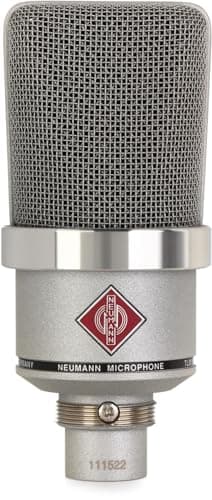
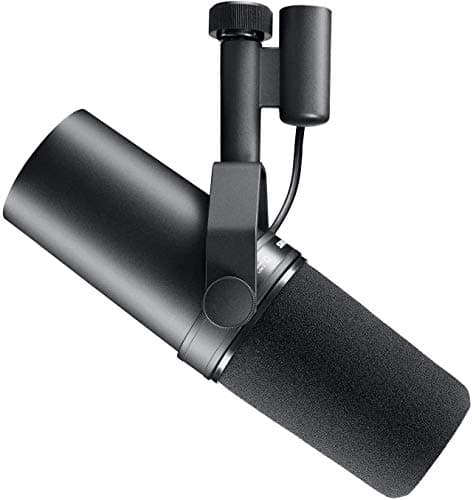
Buy the Neumann TLM 102 if your room is treated and you want detail: 11 mV/Pa sensitivity, 12 dB-A self-noise and 144 dB max SPL from a genuine Neumann capsule, hot enough that any interface with phantom power will drive it. Buy the Shure SM7B if your room is bare or noisy and your interface publishes 60 dB of gain or more — at -59.0 dBV/Pa it is roughly 20 dB quieter and it rejects a bad room in a way no condenser at any price matches.
This is the aspirational version of the decision that runs through this whole site: a condenser you buy for what it hears, against a dynamic you buy for what it refuses to hear. People arrive at it with a wishlist, a bedroom and an interface, and the specification sheets settle it faster than any listening test — because the two microphones do not actually compete on sound. They compete on what your room will let you get away with.
The 20 dB sensitivity gap, and who it matters to
Neumann publishes 11 mV/Pa. Shure publishes 1.12 mV at 94 dB SPL, which is their -59.0 dBV/Pa. Converted to the same unit, the Neumann sits near -39 dBV/Pa — so the condenser hands your preamp roughly 20 dB more signal for the same sound pressure at the grille.
Practically, that means the TLM 102 is a non-issue on any interface with 48 V phantom power, including the cheapest box on this site. The SM7B wants around 60 dB of clean gain for spoken word at a normal working distance. A Focusrite Scarlett 2i2 publishes 69 dB and clears it easily; a 55 dB interface does not, and the symptom is preamp hiss under every pause rather than a quiet recording. How much gain does the SM7B need walks the arithmetic, and what kind of microphone is the Shure SM7B explains why a passive moving-coil capsule is that quiet in the first place.
If your interface is short, the SM7B's real price is the microphone plus a booster — a FetHead at `27 dB`, or the SM7dB with +18 or +28 dB built into the body. Add that to the comparison before you decide which of these two is the expensive one.
What 12 dB-A and 82 dB signal-to-noise actually buy
The TLM 102's 12 dB-A equivalent noise level is the figure Neumann leads with, and 82 dB A-weighted signal-to-noise referenced to 94 dB SPL is the same claim stated the other way round. It means the capsule's own hiss sits far enough below a normal speaking level to be inaudible, and far enough below a quiet one to still be usable.
That matters for exactly one class of work: quiet material recorded at a distance. A softly delivered voice-over, a fingerpicked guitar, a room ambience. For a close-miced podcast at six inches it is academic — the source is tens of decibels above the noise floor either way, and nobody has ever heard an SM7B's absence of self-noise as a feature.
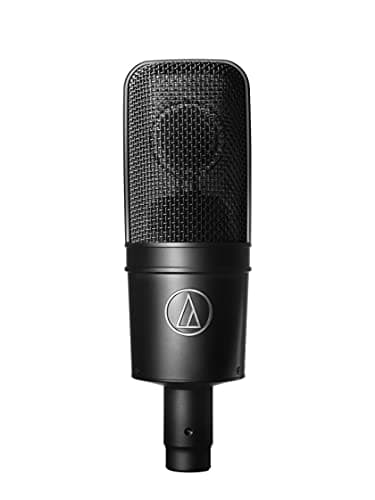
The uncomfortable part is that 12 dB-A is not a Neumann-exclusive figure. The Audio-Technica AT4040 publishes the same 12 dB(A), at 25.1 mV/Pa — hotter than the Neumann — plus a switchable -10 dB pad and an 80 Hz high-pass the TLM 102 does not have, for a fraction of the money. That is why this page carries three products rather than two, and it is the same conclusion Neumann TLM 102 vs Rode NT1 reaches from the other direction.
Room rejection is the row that is not on the spec sheet
Neither manufacturer publishes a figure for this, and it is the most consequential difference between the two microphones. A moving-coil dynamic needs real air movement to induce a voltage, so a reflection arriving off the wall behind you — several decibels down and a few milliseconds late — barely moves the SM7B's diaphragm. A condenser measures capacitance change across a tensioned membrane, needs far less energy, and reproduces that reflection clearly.
In a treated room that is the whole point of buying the Neumann: you get detail, air and a transient response the Shure cannot produce. In a bare bedroom with a hard desk, a window and a flat wall two feet away, it is the reason home recordings sound like home recordings — and a flagship capsule renders a bad room more faithfully than a budget one, not less.
So the honest test is not which microphone is better. It is whether you can hang two panels at the first reflection points and something thick in the corners. If yes, the TLM 102 is a genuine instrument and the SM7B will feel blunt beside it. If no, the Shure is the correct purchase and the difference belongs in acoustic treatment instead.
Both microphones, and the condenser that matches the Neumann's noise figure
The Neumann, the broadcast dynamic, and the Audio-Technica AT4040 — same published 12 dB(A) self-noise, hotter output, and the pad and high-pass neither of the other two has.
Neumann TLM 102
Top pickNeumann · A Neumann capsule at the bottom of the range
Worth it only in a properly treated room where you have already exhausted what the AT4040 and the NT1 can do. If your room is untreated, this is the clearest example on the site of money that belongs in acoustic panels instead.
Why it is here
- A genuinely Neumann-voiced capsule, which is a different proposition from the budget tier rather than a quieter version of it
- `144 dB` max SPL means it handles anything you will put in front of it
- Physically small, so it fits where a large-body condenser will not
What it costs you
- No pad and no high-pass filter, which on a desk is a real omission at this price
- Neumann does not publish a sensitivity figure we could verify, so it is absent from our table
- The most expensive microphone on this site by a wide margin, and the room matters more than it does
Shure SM7B
Shure · The default upgrade, if your preamp can feed it
Buy it if your interface supplies 60 dB or more of clean gain, or if you are budgeting for a booster alongside it. Buy something else if your only interface is a Scarlett Solo and you are not prepared to add hardware.
Why it is here
- Rejects room and computer-fan noise better than any condenser at any price
- Two voicing switches let one mic cover a thin voice and a boomy one
- Internal shockmount and a yoke that actually holds position on a boom arm
What it costs you
- At -59.0 dBV/Pa it is one of the quietest mics sold, so it demands a loud preamp
- Total cost is the mic plus, very often, a booster
- Heavy enough that a cheap desk arm will droop under it
Audio-Technica AT4040
Audio-Technica · The step up from the budget condensers
The right condenser once your room is genuinely treated and the AT2035 has become the limiting factor. In an untreated room it will faithfully reproduce your walls and you will have spent the money for nothing.
Why it is here
- The same `12 dB(A)` self-noise as the AT2035 but with a noticeably more even midrange and a `133 dB` dynamic range
- Keeps the `80 Hz` high-pass filter, which is the control that matters on a desk
- A 2-micron diaphragm and transformerless output at a price well below the boutique tier
What it costs you
- Several times the price of the AT2035 for a difference you only hear in a treated room
- No shockmount in some bundles — check before ordering
- Still a condenser, so the room rules apply unchanged
No switches on the Neumann, two on the Shure
The TLM 102 has nothing on the body: no pad, no high-pass, no pattern selection. Neumann's position is that the capsule should be transparent and the decisions should happen later, and at 144 dB max SPL a pad is rarely the thing you are missing. What you do miss is a high-pass, because close-micing any directional capsule produces a proximity hump in the low end that moves with your head, and a static EQ in the DAW cannot track it.
The SM7B has two switches, and the bass rolloff is the more useful of them precisely for that reason — it trades an unpredictable proximity buildup for a known, fixed curve, in analog, before anything is recorded. Its presence boost lifts the upper midrange for a voice that reads as dull, which is the only character control on either microphone.
Both of the Shure's switches print permanently into the file, so they are decisions you cannot revisit. For spoken word the usual sensible default is bass rolloff in, presence out.
The practical costs nobody lists
- The Neumann needs phantom power, so a preamp without 48 V rules it out entirely. The Shure works on anything with an XLR socket.
- The Neumann needs a quiet room, which is a purchase, not a preference. Budget it or buy the Shure.
- The Shure may need a booster, which is a second box, a second failure point and a phantom-power dependency the microphone itself does not have.
- The Shure is heavy. A cheap spring arm droops under it by the second session. Best boom arms for microphones covers load ratings.
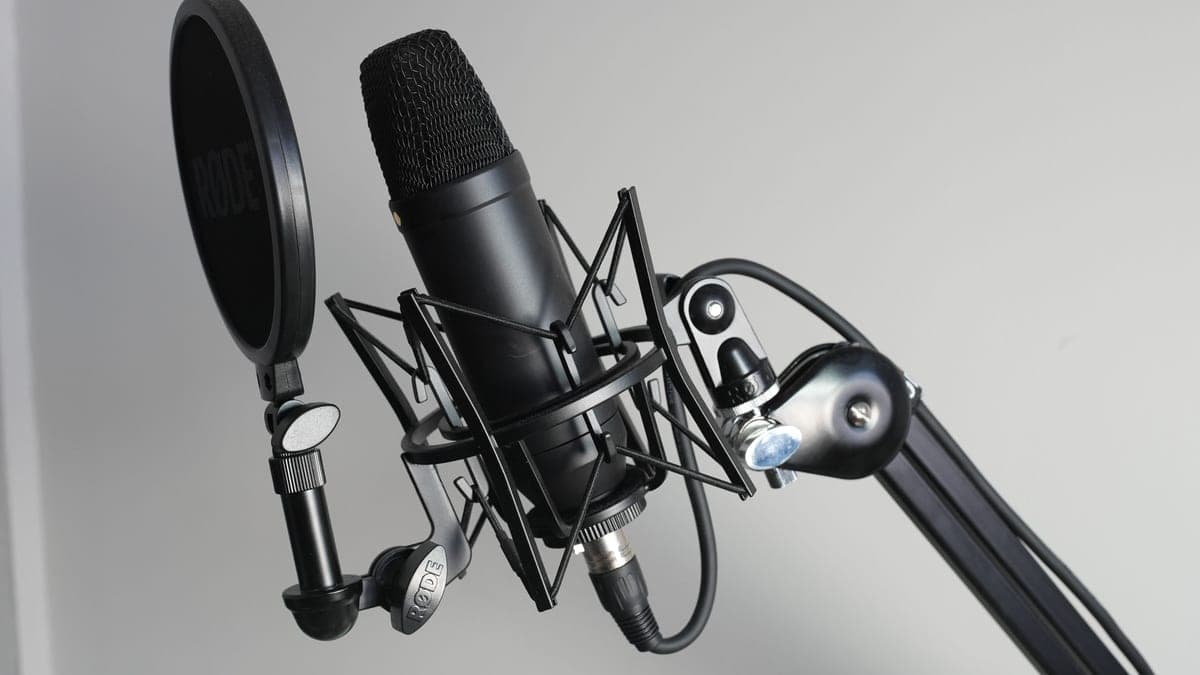
- The Neumann needs a pop filter. 144 dB of headroom does nothing about a plosive blast hitting the diaphragm, and there is no windscreen in the box. Best pop filters.
Which to buy
- Treated room, quiet material, you want the best capsule here: TLM 102. Any interface will drive it.
- Untreated or noisy room, interface publishing `60 dB` or more: SM7B, without hesitation.
- Untreated room, low-gain interface: SM7B plus a booster, or the SM7dB with the preamp built in.
- You want the Neumann's noise figure for a quarter of the money: the AT4040 at 12 dB(A) and 25.1 mV/Pa, with a pad and a high-pass.
- You are not sure the Shure is worth it at all: is the Shure SM7B worth it runs the total-cost version of that question.
The summary worth keeping: the TLM 102 is the better microphone and the SM7B is the better tool for most of the rooms this site's readers actually record in. Fix the room and the Neumann becomes the obvious answer; leave the room alone and it becomes an expensive way to hear it.