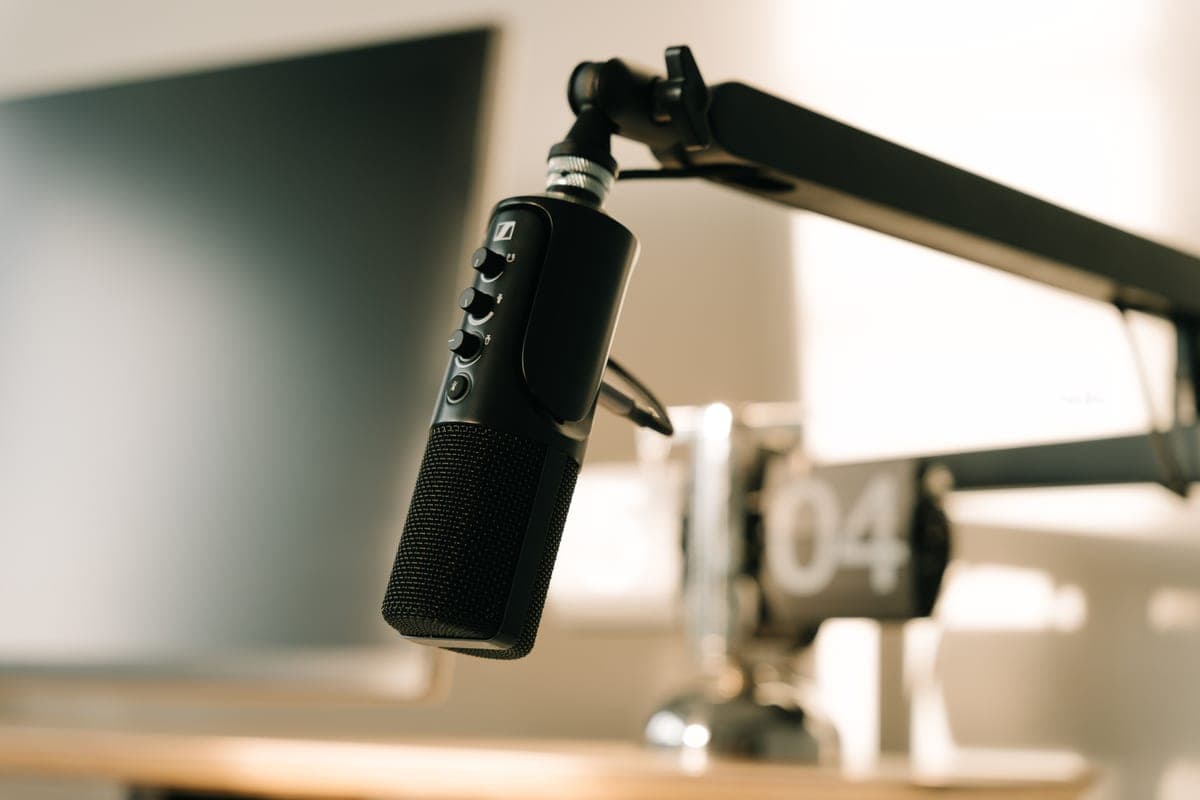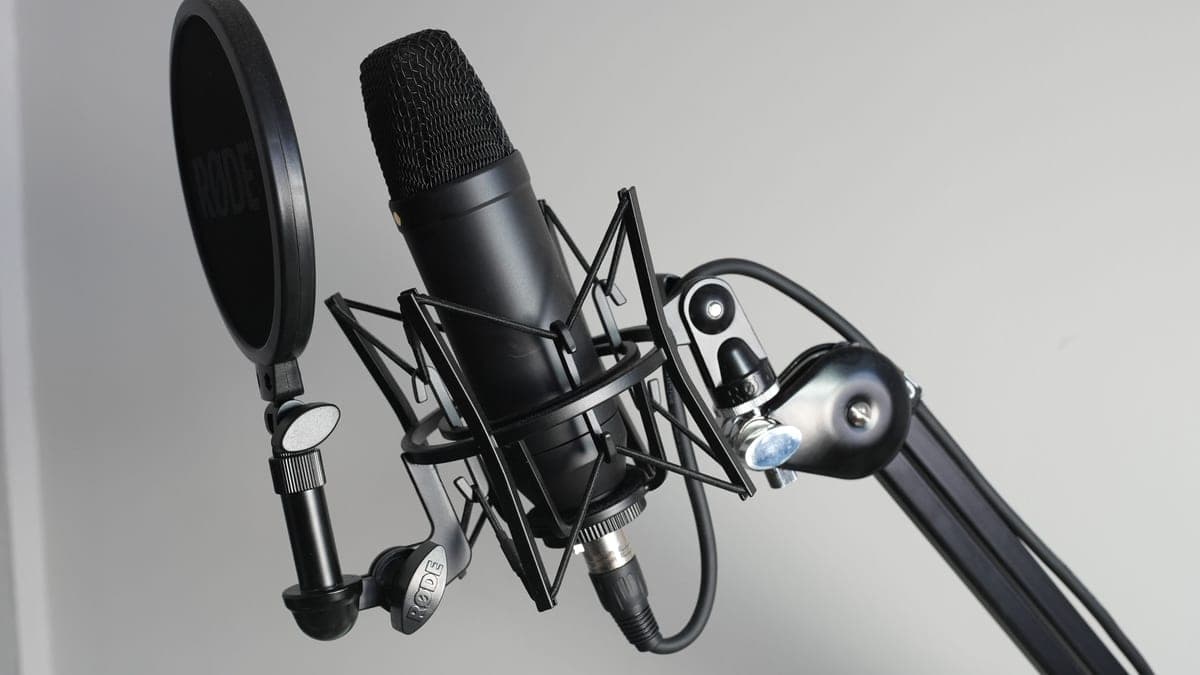
The Shure SM7B is the best microphone for voice-over work in an untreated room: at -59.0 dBV/Pa it is a cardioid dynamic that hears your voice and very little of your walls, and its bass-rolloff and presence switches cover a thin voice and a boomy one. If your room is genuinely treated, the Audio-Technica AT4040 and its 12 dB(A) self-noise capture more detail than any dynamic here.
Voice-over is not podcasting and it is not music, and the difference changes the answer. A podcast tolerates room sound because listeners expect a conversation in a space. A commercial read, an audiobook chapter or an e-learning module is held to a different standard: the client hears every reflection, every chair creak and every hour-four change in your tone. That pushes the decision toward room rejection and consistency, which is why this page is ordered the way it is.
What actually matters for a voice-over microphone
- Room rejection. A cardioid dynamic hears far less of a reflection arriving from behind it than a large-diaphragm condenser does of the same reflection. In a bare room that single property outweighs every spec below it.
- Tonal consistency over distance. A long read means you drift. A microphone whose low end changes by several decibels as you move a hand's width is a microphone that produces unusable pickups.
- A noise floor below your room's. This only becomes the limiting factor once the room is quiet. 12 dB(A) and 9 dB(A) are both far below the noise floor of a domestic room, which is why self-noise is a treated-room specification.
- On-mic voicing controls. A bass rolloff you can switch is worth more over a career than any plugin, because it fixes the recording rather than the file.
- The gain it demands. Every dynamic here needs a preamp that can supply it. How much clean gain do you need carries the published figure for every interface we cover.
Note what is not on that list: frequency response charts, diaphragm size and brand tier. For a spoken read in a domestic room none of them is the limiting factor, and all three are what marketing leads with.
The five microphones, ranked for voice-over
Three dynamics and two condensers. Read the dynamics if your room is bare and the condensers if it is not — the ranking is not a straight line down the page.
Shure SM7B
Top pickShure · The default upgrade, if your preamp can feed it
Buy it if your interface supplies 60 dB or more of clean gain, or if you are budgeting for a booster alongside it. Buy something else if your only interface is a Scarlett Solo and you are not prepared to add hardware.
Why it is here
- Rejects room and computer-fan noise better than any condenser at any price
- Two voicing switches let one mic cover a thin voice and a boomy one
- Internal shockmount and a yoke that actually holds position on a boom arm
What it costs you
- At -59.0 dBV/Pa it is one of the quietest mics sold, so it demands a loud preamp
- Total cost is the mic plus, very often, a booster
- Heavy enough that a cheap desk arm will droop under it
Electro-Voice RE20
Electro-Voice · Movers, leaners and anyone who cannot hold mic distance
Worth the premium if you move while you talk, gesture, or share a mic with someone whose technique you cannot control. If you sit still at a fixed distance, the SM7B's proximity effect is a feature you will use, not a problem you need engineered away.
Why it is here
- Variable-D means the tone barely changes as you drift closer to or further from the grille
- Integral blast filter handles close talking without a separate pop screen
- The bass tilt-down switch is a genuinely useful second voicing, not a gimmick
What it costs you
- Costs more than an SM7B while sounding less immediately flattering on most voices
- Same low-output problem as every broadcast dynamic
- Large and beige, which some people mind
Audio-Technica AT4040
Audio-Technica · The step up from the budget condensers
The right condenser once your room is genuinely treated and the AT2035 has become the limiting factor. In an untreated room it will faithfully reproduce your walls and you will have spent the money for nothing.
Why it is here
- The same `12 dB(A)` self-noise as the AT2035 but with a noticeably more even midrange and a `133 dB` dynamic range
- Keeps the `80 Hz` high-pass filter, which is the control that matters on a desk
- A 2-micron diaphragm and transformerless output at a price well below the boutique tier
What it costs you
- Several times the price of the AT2035 for a difference you only hear in a treated room
- No shockmount in some bundles — check before ordering
- Still a condenser, so the room rules apply unchanged
sE Electronics X1 S
sE Electronics · The most on-mic control of any condenser here
The best-specified condenser on this site for a real home studio: quieter than the Audio-Technicas and the only one with a choice of low-cut frequencies. Choose the AT4040 instead if you want a flatter, more forgiving top end.
Why it is here
- `9 dB(A)` self-noise undercuts the AT2035 and AT4040 while costing less than the latter
- **Two** low-cut frequencies rather than one — `160 Hz` is genuinely useful on a boomy voice in a small room
- Two pad settings take it to `160 dB`, so it doubles as an instrument microphone
What it costs you
- Brighter than the AT4040, which suits some voices and not others
- Smaller dealer network than Audio-Technica or Rode
- The switch count makes it easy to leave a filter engaged by accident
Rode PodMic
Rode · The best value in a broadcast dynamic
The pick for most people upgrading from a USB mic: it gets you 90 percent of the broadcast-dynamic sound without the booster arithmetic. Choose the SM7B instead if your voice is already bass-heavy and you want the bass-rolloff switch.
Why it is here
- At -57 dBV/Pa it needs about 2 dB less gain than an SM7B, which is enough to matter on a 58 dB interface
- Internal pop filter means one less thing clamped to your arm
- All-metal body at a fraction of the SM7B's price
What it costs you
- Voiced with more low-mid weight than the SM7B, so a boomy voice can get boomier
- No voicing switches, so you fix tone in the DAW rather than on the mic
- Still low enough output that a 55 dB interface will be working hard
Why the SM7B wins and the RE20 is often the better buy
The SM7B tops this list because it is the most forgiving microphone here in the condition most voice-over work actually happens in — a spare room with a desk in it. The two voicing switches matter more for voice-over than for any other use on this site, because a single read can need a bass rolloff on Monday and a presence lift on Thursday.
The RE20 wins on one property the SM7B does not have: Variable-D, which keeps the tone nearly constant as your distance from the grille changes. If you gesture, lean, or record standing up, that is not a nicety — it is the difference between a consistent four-hour session and a day of matching levels in the edit. It costs more than an SM7B and sounds less immediately flattering, which is why it sits second rather than first.
The condensers, and the condition attached to them
The AT4040 at 12 dB(A) and the X1 S at 9 dB(A) are both quieter than any dynamic here, and both resolve consonant detail a dynamic rounds off. In a treated room recording a soft, intimate read, that is audible and worth paying for.
The X1 S earns its place over the AT4040 on controls rather than noise: two low-cut frequencies rather than one, and 160 Hz is the setting that rescues a bass-heavy voice at a desk. The AT4040 is the flatter, more forgiving top end of the two. Neither belongs in a bare room — see dynamic vs condenser microphones for why that is a physics problem rather than a preference.
What we did not pick, and why
- The Neumann TLM 102. A better capsule than anything here, and the clearest example on this site of money that belongs in acoustic panels first. It also has no pad and no high-pass filter, which at a desk is a real omission.
- USB microphones. Not because they sound bad, but because voice-over clients ask for revisions years later and a chain you can upgrade one link at a time is worth more than a sealed box. USB vs XLR is the honest version of that argument.
- The Rode NT1 5th Generation. An excellent, very quiet condenser — and the same room condition applies. It is covered in best condenser microphones for vocals.
- Shotgun and lavalier microphones. A different job entirely. They exist to solve distance and mobility problems a voice-over desk does not have.
What to buy alongside it
- An interface with the published gain to match. All three dynamics here want 60 dB or more. Best audio interfaces for vocals has the field.
- A boom arm rated for the weight. An SM7B on an underrated arm droops over a long session. Best boom arms.
- Absorption behind you before anything else. Acoustic treatment on a budget is the highest-return purchase on this page.
- Closed-back headphones, so your monitoring never leaks into the take. Best closed-back headphones for recording.