The Shure SM7B is a passive, cardioid, moving-coil dynamic microphone with a sensitivity of -59.0 dBV/Pa, a 150 ohm output impedance, and two voicing switches for bass rolloff and presence boost. It needs no phantom power and no batteries, and because it is one of the quietest microphones sold it needs roughly 60 dB of clean preamp gain to reach a working level for speech.
That one sentence contains every practical consequence of owning one, and each word is worth unpacking — because the most common SM7B disappointment is not tonal, it is somebody buying the microphone without realising what the category commits them to.
Dynamic: a coil and a magnet, nothing powered
A dynamic microphone works by moving a coil of wire through a magnetic field. Sound pressure moves a thin diaphragm, the diaphragm moves the attached coil, and the motion induces a small voltage. There is no electronics in the signal path, nothing to power and nothing to fail.
The physical consequence is that it takes real air movement to produce a signal. That is why the output is so low, and it is also why the SM7B hears so little of your room: a reflection arriving off the wall behind you, several decibels down and a few milliseconds late, simply does not move the diaphragm much. A condenser capsule, which measures capacitance change across a tensioned membrane rather than moving a coil, needs far less energy and so hears the reflection clearly. Dynamic vs condenser microphones covers the trade in full.
Passive: no phantom power, and no gain of its own
Passive means there is no internal amplifier. The SM7B does not want 48 V phantom power, is not harmed by it, and gains nothing from it. Whatever the capsule generates is what arrives at your interface.
This is the half people get wrong. Turning phantom power on does not make an SM7B louder, and a forum thread suggesting it will is a thread about a different microphone. The only things that raise an SM7B's level are a preamp with more gain or an inline booster between the microphone and the preamp — and a booster is itself phantom powered, which is where the confusion comes from.
Cardioid: a heart-shaped pickup pattern, with a proximity effect
Cardioid means the microphone is most sensitive to sound arriving at the front, progressively less at the sides, and close to deaf directly behind. For a seated host with a boom arm in front, that puts your voice in the hot zone and your monitors, keyboard and the wall behind the mic in the quiet one.
Every directional pattern also has a proximity effect: low frequencies rise as the source gets closer. At six inches it thickens the voice pleasantly. At two inches it becomes a hump large enough to need correcting, which is exactly what the bass-rolloff switch on the back of the microphone is for.
Quiet: -59.0 dBV/Pa, and what that costs
-59.0 dBV/Pa means the capsule produces about 1.12 mV for a 94 dB SPL source at the grille. For comparison, a Shure SM58 produces 1.85 mV at -54.5 dBV/Pa, and an AT2035 condenser produces 22.4 mV at -33 dB — twenty times as much.
Practically: an interface publishing 69 dB, like a Focusrite Scarlett 2i2, drives an SM7B comfortably. One publishing 55 dB does not, and the symptom is preamp hiss under every pause rather than a quiet recording. How much gain does the SM7B need walks the arithmetic properly.
The three ways people solve the gain problem
The microphone itself, the active version with the preamp built in, and the inline booster that adds 27 dB to whatever interface you already own.
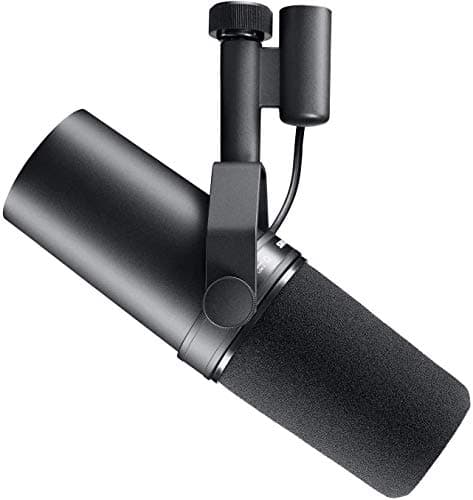
Shure SM7B
Top pickShure · The default upgrade, if your preamp can feed it
Buy it if your interface supplies 60 dB or more of clean gain, or if you are budgeting for a booster alongside it. Buy something else if your only interface is a Scarlett Solo and you are not prepared to add hardware.
Why it is here
- Rejects room and computer-fan noise better than any condenser at any price
- Two voicing switches let one mic cover a thin voice and a boomy one
- Internal shockmount and a yoke that actually holds position on a boom arm
What it costs you
- At -59.0 dBV/Pa it is one of the quietest mics sold, so it demands a loud preamp
- Total cost is the mic plus, very often, a booster
- Heavy enough that a cheap desk arm will droop under it
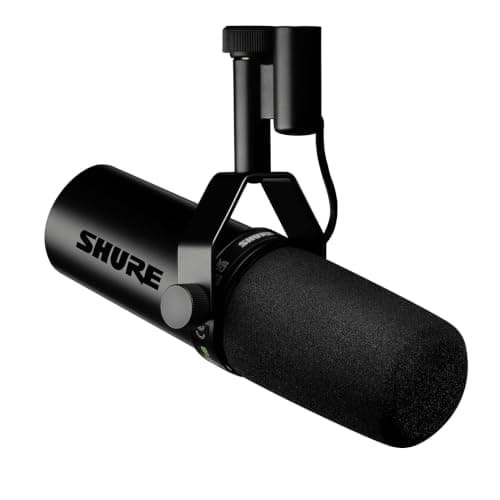
Shure SM7dB
Shure · An SM7B with the booster problem already solved
The right SM7 for anyone whose interface tops out near 55 dB and who wants one purchase instead of two. Skip it if you already own a Cloudlifter or a 69 dB-gain interface, because you are paying twice for the same 25 dB.
Why it is here
- The +28 dB setting turns a 55 dB-gain interface into enough headroom for this capsule
- One XLR cable, no inline box, no second phantom-power dependency to reason about
- Bypassable, so it behaves as a plain SM7B when you move it to a big preamp
What it costs you
- You pay for the preamp whether your interface needed it or not
- A separate booster can be reused with other low-output mics; this one cannot
- No gain setting between +18 dB and +28 dB
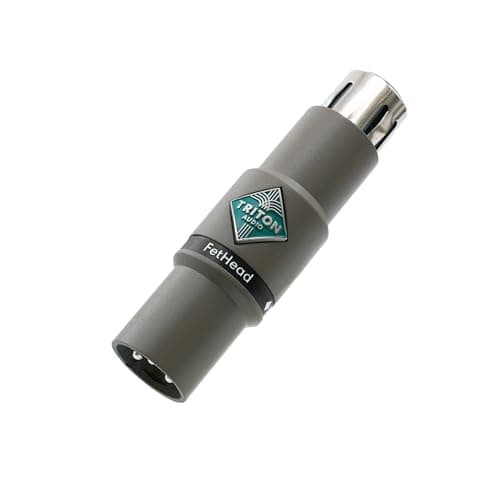
Triton Audio FetHead
Triton Audio · The most gain in the smallest package
The pick for most people boosting an SM7B or PodMic: more gain than the alternative, in nothing. Choose the Cloudlifter instead if the mic is on a long unsupported arm or if you own a ribbon.
Why it is here
- 27 dB is 2 dB more than a Cloudlifter, from something the size of a cable barrel
- 22 kohm input impedance lets a dynamic capsule behave the way its designer intended
- No desk space, no second cable
What it costs you
- Hangs off the back of the mic, adding weight and leverage to your boom arm
- Nothing to see — no LED, so a phantom-power mistake is silent
- Not for condensers, which need the phantom power it blocks
The two switches on the back
- Bass rolloff. Reduces the low end, which counteracts the proximity buildup from close working distance and the rumble from a desk or a floor. The switch most SM7B owners end up leaving engaged.
- Presence boost. Lifts the upper midrange, which adds intelligibility and bite to a voice that reads as dull. Unlike the rolloff, this is a character decision rather than a correction.
Both are analog and both print into the recording, so they are decisions you cannot revisit in the edit. For spoken word the usual sensible default is bass rolloff in, presence out, and then adjust once you have heard yourself back on the system your audience will use.
What it is not
- Not a condenser. It will not give you the top-end air of an AT4040 or a Rode NT1, and it does not want phantom power.
- Not a USB microphone. There is no converter and no computer connection; it needs an interface or a preamp. USB vs XLR microphones.
- Not an active dynamic. That is the SM7dB, which is the same capsule with a switchable +18 or +28 dB preamp inside the body.
- Not a ribbon. Ribbons are also passive and also quiet, and they are mechanically fragile in a way the SM7B emphatically is not.
- Not a large-diaphragm studio microphone. The capsule is small, the body is big, and the size of the housing has nothing to do with the size of the diaphragm.
Who it is the right microphone for
Spoken word in a room you cannot treat, recorded through an interface that publishes enough gain. That is the brief it was designed for, it has held the broadcast standard for decades, and nothing in the category rejects a bad room better.
If your interface is modest, or you also want to record acoustic instruments, or your room is already treated, there are better-matched purchases. Is the Shure SM7B worth it takes that question on directly, and best SM7B alternatives lists the capsules that get close for less gain and less money.