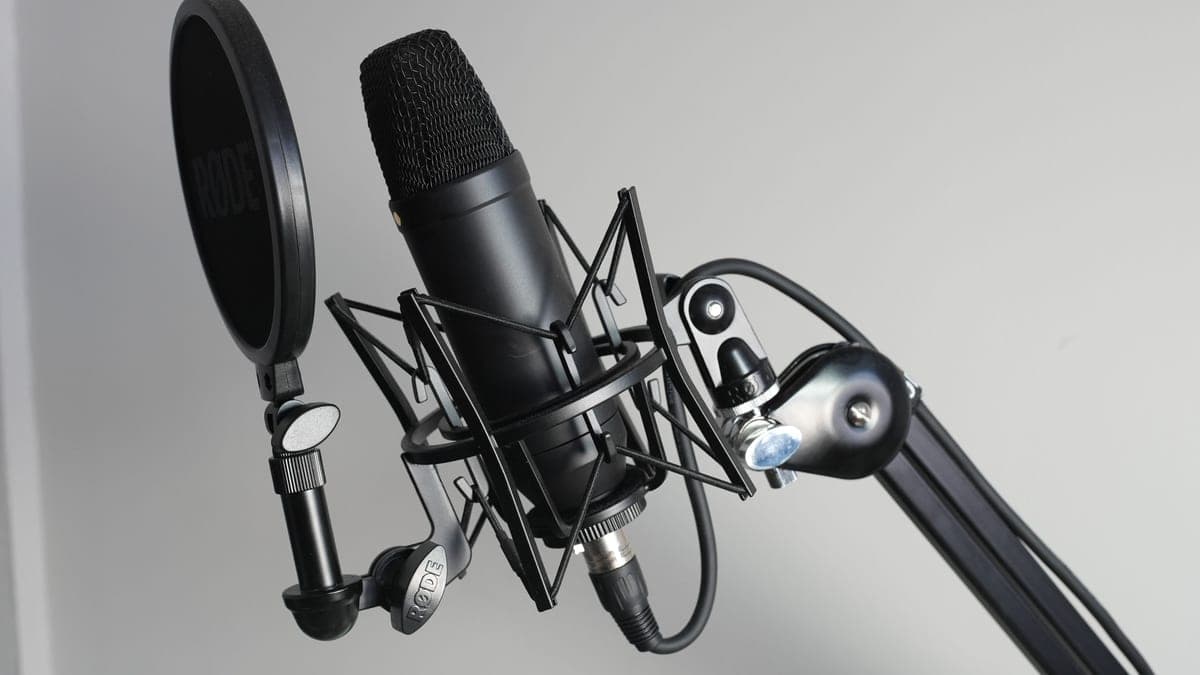
Buy the Shure SM7B if your room is untreated and your interface publishes 60 dB or more of clean gain — it rejects the room better than any condenser at any price. Buy the Rode NT1 5th Generation if your room is treated, or if your interface cannot feed a microphone that sits 27 dB quieter than the Rode does. These two are not competing on quality; they are competing on which problem you have.
This is the single most common crossroads on the way out of a USB microphone, and it gets argued as though one of them is simply better. They are different tools. One is a broadcast dynamic designed to ignore everything that is not directly in front of it. The other is a studio condenser designed to capture everything faithfully, which includes everything you wish it would not.
The 27 dB that decides whether you can buy the SM7B at all
Sensitivity is how much voltage a microphone produces for a given sound pressure, it is published as a negative number, and more negative means quieter. The SM7B sits at -59.0 dBV/Pa. The NT1 sits at -32 dB re 1 V/Pa. That is a 27 dB difference, and it is the largest practical gap between any two microphones on this site.
In practice the NT1 will reach a healthy recording level on any interface sold — including every box in best audio interfaces under $100. The SM7B wants roughly 60 dB of clean gain for spoken word at a normal working distance, and interfaces publishing 55 dB or 58 dB will get there with the knob at the end of its travel and audible hiss underneath. How much gain does the SM7B need walks the arithmetic; how much clean gain do you need has the published figure for every interface here.
Room rejection: the reason broadcast studios use dynamics
A dynamic capsule moves a coil through a magnetic field, and that needs real air movement to produce any signal at all. A reflection that has bounced off the wall behind you has lost most of its energy by the time it returns, so a dynamic produces almost nothing from it. A condenser capsule needs a tiny fraction of that energy to respond — which is exactly why it also hears your keyboard, your chair, the fridge in the next room, and the flat wall two feet away.
This is not a flaw in condensers. It is what makes the NT1 the right tool in a treated room and the wrong one in a bare bedroom. In a room with drywall, a window and a hard floor, the loudest problem on your recording is not the microphone — it is the wall arriving a couple of milliseconds after you do, and the NT1's 4 dBA noise floor is completely beside the point next to it.
The honest test takes thirty seconds: clap once in your recording position and listen to the tail. If you hear the room ring after the clap, the SM7B will give you a cleaner result than the NT1 for the same money. Dynamic vs condenser microphones is the longer version of this argument.
Both microphones, and the condenser that undercuts the Rode
Shure SM7B
Top pickShure · The default upgrade, if your preamp can feed it
Buy it if your interface supplies 60 dB or more of clean gain, or if you are budgeting for a booster alongside it. Buy something else if your only interface is a Scarlett Solo and you are not prepared to add hardware.
Why it is here
- Rejects room and computer-fan noise better than any condenser at any price
- Two voicing switches let one mic cover a thin voice and a boomy one
- Internal shockmount and a yoke that actually holds position on a boom arm
What it costs you
- At -59.0 dBV/Pa it is one of the quietest mics sold, so it demands a loud preamp
- Total cost is the mic plus, very often, a booster
- Heavy enough that a cheap desk arm will droop under it
Rode NT1 5th Generation
Rode · The quietest capsule most home studios can justify
The right condenser if you have treated the room, or are about to. If your room is bare drywall, the 4 dBA noise floor is irrelevant because the loudest thing on the recording will be the room.
Why it is here
- 4 dBA self-noise is quieter than the room you are recording in, which is the whole point of a condenser
- -32 dB sensitivity means no interface on this site struggles to drive it
- 32-bit float over USB makes clipping a non-event on the digital path
What it costs you
- A condenser hears your room, your keyboard and your fridge — treatment is not optional
- The USB path duplicates an interface you probably also want
- Bright enough that a sibilant voice needs a de-esser
Audio-Technica AT2035
Audio-Technica · The value condenser with the switches you actually need
The condenser to buy if you are choosing on value: the high-pass filter and the 8 dB quieter noise floor are worth more in a real room than anything else in this price band. Skip it if you have not treated the room, in which case a dynamic is the better purchase.
Why it is here
- 12 dB self-noise against the AT2020's 20 dB is an audible 8 dB of quiet for a small price step
- The 80 Hz high-pass is the single most useful switch on a desk-mounted condenser
- Ships with a real shockmount, not a plastic clip
What it costs you
- Still a condenser, so the room rules apply
- Slightly forward upper midrange that some voices find harsh
- The 10 dB pad is mostly irrelevant for voice work
What the NT1 gives you that the SM7B cannot
Detail, and a 4 dBA noise floor that is close to the quietest figure published for any studio condenser at any price. On acoustic guitar, on singing, on anything where air and the top of the frequency range carry the performance, the NT1 resolves material the SM7B simply does not reach — the SM7B is voiced for speech and it sounds like it.
It also puts XLR and USB-C in one connector, recording in 32-bit float over the USB path, which means clipping stops being something you can do. If you are mid-way through building a chain and do not yet own an interface, that is a genuine advantage: the NT1 works on your laptop today and on the interface you buy next month. Upgrading from USB to XLR covers that transition, and Rode NT1 vs NT1-A settles which NT1 belongs on your shortlist first.
What the SM7B gives you that the NT1 cannot
- Two voicing switches. A bass rolloff and a presence boost, which between them let one microphone serve a boomy voice and a thin one. The NT1 has no switches at all, so every tonal decision happens in the DAW.
- Plosive and proximity tolerance. The internal shockmount and the windscreen are built for someone talking a hand's width away for two hours, which is the job.
- No phantom power requirement. It will work off anything with a preamp, which matters if your chain is a mixer or a field recorder rather than an interface.
- Room rejection you cannot buy any other way. This is the whole case, and in an untreated room it outweighs everything in the column above.
What it does not give you is a cheap entry. The SM7B is the microphone people buy, discover it sounds thin and quiet on their interface, and then blame. That is a gain problem rather than a microphone problem, and it is predictable from the spec sheet before you spend anything: is the Shure SM7B worth it is the purchase-justification version of this page.
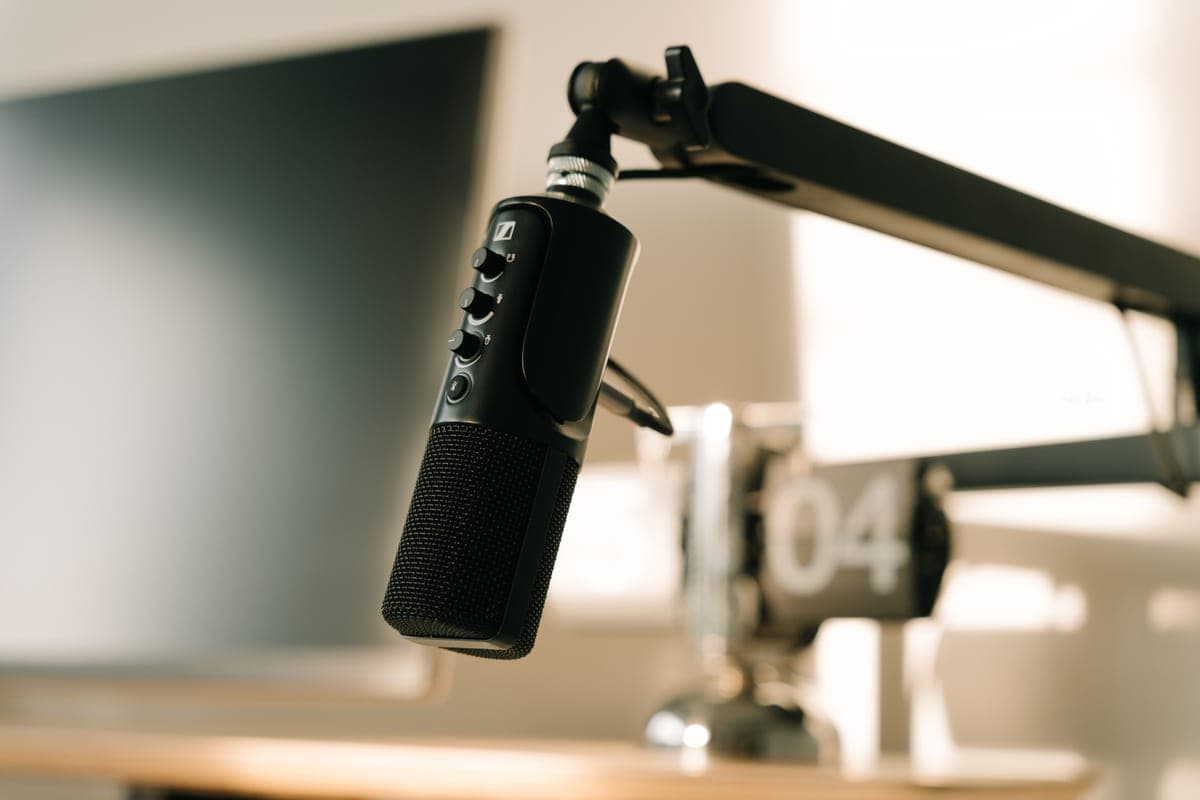
The third option most of these comparisons ignore
The Audio-Technica AT2035 is in this conversation whether or not anyone puts it there. It publishes 12 dB SPL self-noise, a sensitivity of -33 dB — effectively the same easy load as the NT1 — a switchable 80 Hz high-pass filter that neither of the other two microphones has, and a -10 dB pad. It costs a fraction of either.
If you want a condenser and your interface is modest, the AT2035 gets you most of the way to the NT1 and adds the one control that matters most on a desk, which is the filter that stops rumble reaching the converter. If you want the quietest capsule and voicing closer to flat, the NT1 is the better microphone. AT2035 vs Rode NT1 is the direct comparison, and best condenser microphones for home studio ranks the whole field.
How to decide in four questions
- Does your room ring after a clap? Yes, and it is staying that way: SM7B. No, or you are about to treat it: NT1.
- What maximum mic gain does your interface publish? 60 dB or more: either. Under that: NT1, or budget for a booster alongside the SM7B.
- Is the job speech or music? Podcast, voice-over and streaming favor the SM7B. Singing and acoustic instruments favor the NT1.
- Do you need the microphone to work without an interface? Only the NT1 does, over its USB-C connector.
If the answers conflict — a ringing room and a 55 dB interface, say — treat the room rather than splitting the difference. Two acoustic panels at the first reflection points cost less than the gap between these two microphones and change more about your recordings than either of them will.
If you cannot fix anything to the walls — a rental, a shared room, a corner of a living room — the portable option is next: do reflection filters work sets out what a shield around the microphone does absorb, what it does not, and why getting closer to the capsule beats both.