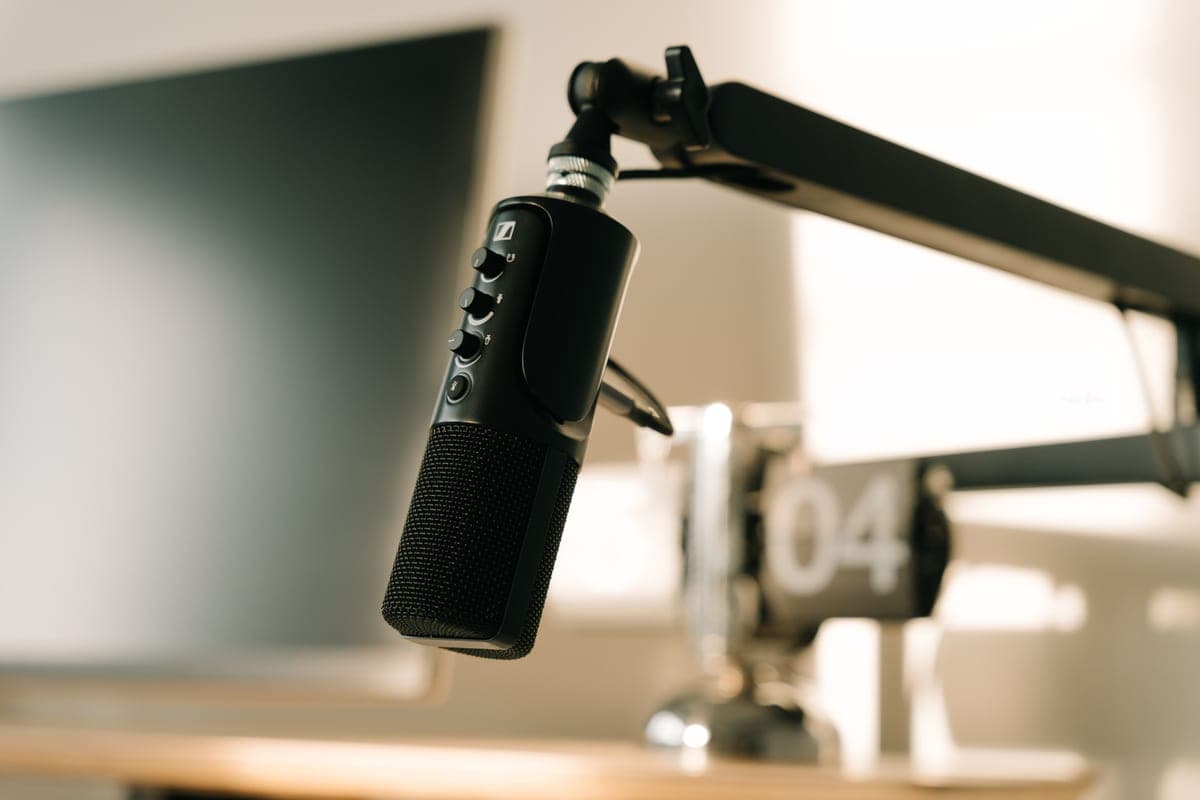
Buy the SM7B if your interface publishes 60 dB or more of clean gain and voice is your main output — the bass-rolloff and presence switches plus a far more studio-appropriate voicing are what you are paying for. Buy the SM58 if you want to find out whether a dynamic microphone fixes your room before committing: at -54.5 dBV/Pa it is 4.5 dB hotter, works on modest preamps, and costs a quarter as much.
These two get compared constantly because they are both Shure cardioid dynamics and because the SM58 is the microphone almost everyone already has access to. The useful framing is not whether the SM7B is four times better — it is not — but what specifically the extra money buys, and whether you need those things. There are three answers and they are all concrete.
The gain gap is 4.5 dB, and it decides the purchase
-59.0 dBV/Pa against -54.5 dBV/Pa is a 4.5 dB difference, which does not read as dramatic. In practice it is the line between two different purchases. An interface with 55 dB of gain — a Universal Audio Volt 2, say — drives an SM58 to a working level on a normally-projected voice. Put an SM7B on the same box and you are at the top of the gain range with the preamp's own noise floor audible behind a quiet sentence.
That is the entire reason the SM7B has a reputation for needing a Cloudlifter, and the reason how much gain does the SM7B need is one of the most-searched questions in home recording. The SM58 simply does not have that problem, and an SM58 on an interface you already own will sound better than an SM7B on an interface that cannot feed it.
What the extra money actually buys
- A studio voicing instead of a stage one. The SM58 is shaped for a vocalist in front of a PA: a presence lift to cut through a band, and a response that stops at 15 kHz. The SM7B is shaped for a voice a few inches from the grille in a quiet room. On spoken word the difference is immediate and it is not subtle.
- Two switches. Bass rolloff and presence boost mean one microphone covers a thin voice and a boomy one. On the SM58 you fix tone in the DAW, which works, but you are correcting rather than capturing.
- An internal shockmount and a yoke. The SM7B is built to hang off a boom arm with the mount built in. The SM58 needs a clip, and the clip transmits desk thumps straight into the take.
Where the SM58 wins outright
- It is the cheapest honest test of the dynamic-versus-condenser question. If your complaint is that your room is audible on every take, an SM58 answers whether a dynamic fixes it for about a quarter of the SM7B's money. That is a genuinely useful purchase even if you replace it later.
- It works on anything. -54.5 dBV/Pa into 150 ohms is an easy load for any interface on this site, including the ones in best audio interfaces under $100.
- It survives. The SM58's reputation for indestructibility is earned, and a used one sells for most of what you paid.
- `298 g`. Any stand or arm you already own holds it. An SM7B on a cheap desk arm droops, and you will buy the arm twice.
Both microphones, plus the one in between
Shure SM7B
Top pickShure · The default upgrade, if your preamp can feed it
Buy it if your interface supplies 60 dB or more of clean gain, or if you are budgeting for a booster alongside it. Buy something else if your only interface is a Scarlett Solo and you are not prepared to add hardware.
Why it is here
- Rejects room and computer-fan noise better than any condenser at any price
- Two voicing switches let one mic cover a thin voice and a boomy one
- Internal shockmount and a yoke that actually holds position on a boom arm
What it costs you
- At -59.0 dBV/Pa it is one of the quietest mics sold, so it demands a loud preamp
- Total cost is the mic plus, very often, a booster
- Heavy enough that a cheap desk arm will droop under it
Shure SM58
Shure · The cheapest way to hear what a dynamic does for you
The right first XLR mic if the real question is whether a dynamic fixes your room, because it answers that for very little money on the interface you already own. It is a diagnostic, not a destination.
Why it is here
- At -54.5 dBV/Pa it is the hottest dynamic here, and works on genuinely modest preamps
- Light enough for any stand or arm you already own
- Effectively indestructible, and resells for most of what you paid
What it costs you
- Response stops at 15 kHz and it is voiced for a PA, not a studio
- Handheld grille shape is awkward on a desk boom
- You will outgrow it if voice is your main output
Rode PodMic
Rode · The best value in a broadcast dynamic
The pick for most people upgrading from a USB mic: it gets you 90 percent of the broadcast-dynamic sound without the booster arithmetic. Choose the SM7B instead if your voice is already bass-heavy and you want the bass-rolloff switch.
Why it is here
- At -57 dBV/Pa it needs about 2 dB less gain than an SM7B, which is enough to matter on a 58 dB interface
- Internal pop filter means one less thing clamped to your arm
- All-metal body at a fraction of the SM7B's price
What it costs you
- Voiced with more low-mid weight than the SM7B, so a boomy voice can get boomier
- No voicing switches, so you fix tone in the DAW rather than on the mic
- Still low enough output that a 55 dB interface will be working hard
The third option most people should actually consider
If the SM58 feels like a compromise and the SM7B feels like a stretch, the honest answer is the Rode PodMic: -57 dBV/Pa, so 2 dB hotter than the SM7B, with an internal pop filter and internal shockmount in an all-metal body, at a fraction of the SM7B's price. It is voiced for the same job as the SM7B rather than for a stage. SM7B vs PodMic is the direct comparison; best SM7B alternatives is the wider field.
What else you need
- For the SM7B: an interface with published gain of 60 dB or more. Best audio interfaces for the Shure SM7B lists every box on this site that clears it, and best preamps for the SM7B covers the inline-booster route if your interface is fixed.
- For either: a stand that is not a desk tripod. Best mic stands for the SM7B applies to both.
- For the SM58 on a desk: a pop filter, because the ball grille is a windscreen and not a plosive filter at close range. Best pop filters.