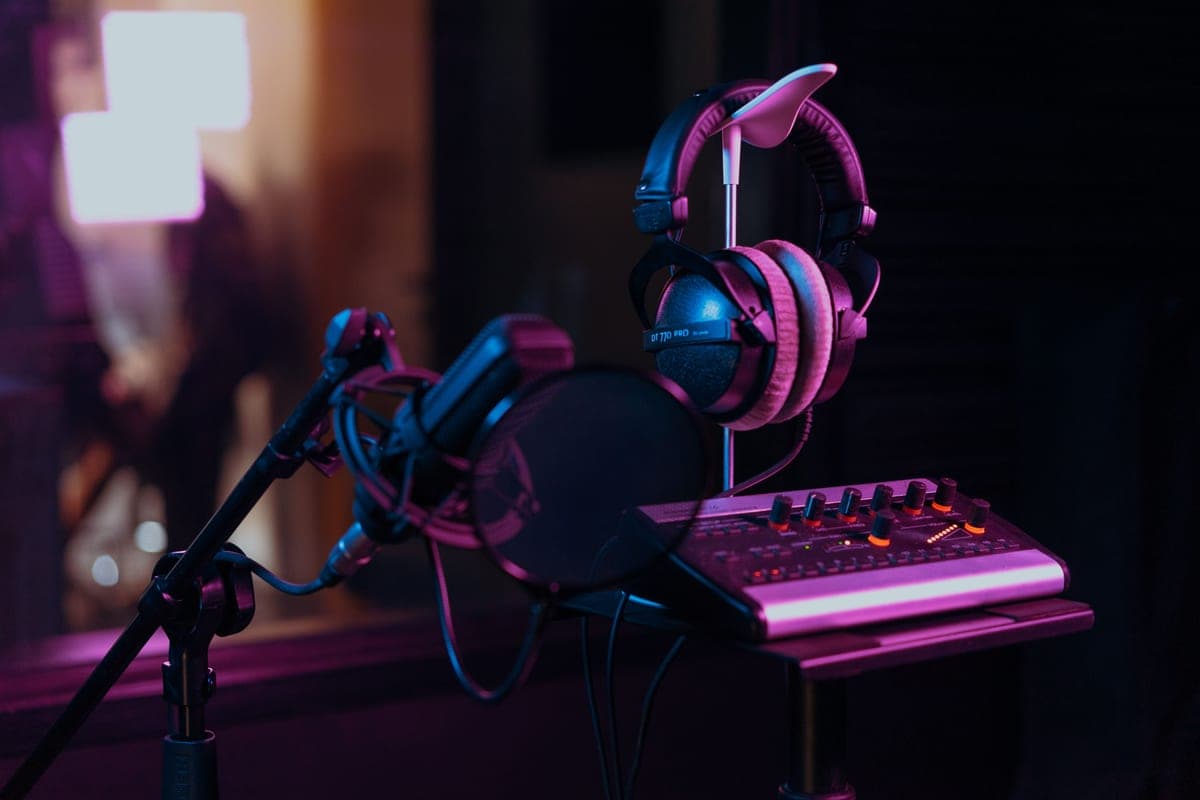
For four people you need four microphone preamps and four independent headphone outputs — and most interfaces sold as four-input boxes have two preamps and one headphone socket. The Zoom PodTrak P4 is the direct answer at the lowest price: 70 dB of gain on four channels and four headphone outs with individual level control. The RodeCaster Pro II is the answer if one person has to run the show live, with 76 dB of gain and -131.5 dBV EIN.
Group recording fails in a specific, predictable order. People buy for microphone count, discover they cannot give everyone headphones, work around it with a splitter, and then find that the splitter leaves everyone quiet and all on the same mix. Buy for the headphone feeds and the preamp count together, and the rest of the rig is straightforward.
What four people actually require
- Four microphone preamps, not four inputs. A four-input interface frequently means two mic preamps and two line inputs. A line input cannot power or amplify a microphone. Check the preamp count on the specification sheet, not the model number.
- Four independent headphone outputs with their own level control. Everyone needs to hear themselves, and nobody wants the volume that suits the loudest person in the room. This is the requirement that decides the purchase.
- Enough gain for four dynamics at once. Four broadcast dynamics means four low-output microphones. 70 dB on the PodTrak and 76 dB on the RodeCaster cover every microphone on this site; a 58 dB interface does not.
- Four dynamic microphones, not condensers. Four open condensers around one table hear each other, each other's headphone bleed and the room. Dynamics reject all three. Best dynamic microphones for vocals.
- Four sets of closed-back headphones. Open-backs leak into the nearest microphone, and with four microphones live there is always a nearest microphone. Best closed-back headphones for recording.
- Four mounts and four cables long enough to reach across a table with slack. Best boom arms for microphones and best XLR cables.
That table is the whole guide in four rows. The two interfaces are excellent boxes — the 4i4 has the highest published gain of any interface on this site and adds MIDI and loopback — and neither of them is a four-person podcast solution, because two mic preamps and one headphone output is not four and four.
Multitrack capture or live mixing?
This is the real fork in the decision, and it is about your time rather than your audio.
Multitrack capture records every microphone to its own track and leaves every decision to the edit. If someone coughs, you mute one track. If one guest is quiet, you fix one track. It is forgiving and it costs you editing hours. The PodTrak P4 does this, records to its own storage so a laptop crash is not a lost episode, and runs on AA batteries so you can record anywhere.
Live mixing means one person rides faders, applies processing and produces a finished-sounding show as it happens. The RodeCaster Pro II is built for that: six physical faders, nine assignable channels, onboard processing, and 24-bit or 32-bit float recording. The honest caveat is that its processing is a commitment unless you also keep the raw tracks — and that most of what you are paying for is features a solo host never touches.
The four-channel options, ranked for a four-person show
Ranked on whether they actually solve four-and-four: the two purpose-built recorders first, then the two interfaces that are better boxes for a different job.
Zoom PodTrak P4
Top pickZoom · Four mics, four headphone outs, battery power
The best value in group podcast recording: four hot preamps and four headphone feeds is the whole job. Step up to the RodeCaster Pro II only if you need live mixing rather than multitrack capture.
Why it is here
- 70 dB of gain feeds four SM7Bs, which nothing else at this price does
- Four headphone outputs with individual level control — the actual bottleneck in group recording
- Runs on AA batteries, so it records anywhere
What it costs you
- No faders, no onboard EQ or compression
- Only 2 channels reach the computer over USB, so live-streaming four separate mics is out
- Plastic build and a small screen
Rode RodeCaster Pro II
Rode · A multi-guest show with no engineer
The right purchase when you regularly record three or four people and post-production time is your real constraint. For one or two voices an interface plus a DAW does the same job for a fraction of the money.
Why it is here
- 76 dB of gain and -131.5 dBV EIN means any microphone on this site works with room to spare
- Six physical faders and onboard processing let one person run a four-person show live
- Records multitrack to its own storage, so a laptop crash is not a lost episode
What it costs you
- Far more money than an interface, and most of it buys features a solo host never uses
- The onboard processing is a commitment unless you record raw tracks alongside
- Big, and it owns your desk
Focusrite Scarlett 4i4 (4th Gen)
Focusrite · The most gain, plus MIDI and loopback
The most complete interface under $500 for someone who records voice and plays keys and streams. If you do none of those extra things, the 2i2 has identical gain for less money.
Why it is here
- `69 dB` of gain, the same as the 2i2, so no microphone on this site needs a booster
- MIDI and loopback in one box — the two features that usually force a second purchase
- Four line outputs, so monitors and a separate headphone amp can both be fed
What it costs you
- Costs meaningfully more than the 2i2 for features a solo voice recordist may never touch
- Still only two mic preamps despite the four-in name
- Larger footprint than the desktop boxes
MOTU M4
MOTU · Four channels, MIDI and the best converters here
The pick if you want MOTU's conversion plus MIDI and a couple of extra line inputs. If you only ever record one or two microphones and do not need MIDI, the M2 does the same job for less.
Why it is here
- 60 dB of published gain and `-129 dBu` EIN is a genuinely quiet channel, and unlike the M2 the figure is published
- MIDI in and out on a box this size saves a separate interface if you play keys
- Full-color LCD metering for all four channels, which is more useful daily than any software mixer
What it costs you
- 60 dB is enough for an SM7B but without much headroom to spare
- Two of the four inputs are line-only, so it is not a four-microphone box
- No onboard voicing or DSP at all
The table is a bigger problem than the gear
Four people in one domestic room is an acoustics problem before it is an equipment problem. You now have four sources, four pairs of headphones leaking, and everybody's voice arriving at everybody else's microphone. The fix is not a better interface.
- Get the microphones close. A hand's width from the mouth, every time. Proximity is the cheapest signal-to-room ratio improvement there is, and it is free.
- Angle microphones away from each other. A cardioid dynamic rejects what is behind it. Point the back of each microphone at the next person along.
- Treat the ceiling, not just the walls. Four people round a table sit under one hard parallel surface. Acoustic treatment for a ceiling.
- Keep headphone levels sane. Bleed from loud headphones is recorded on every open microphone in the room and cannot be removed later.
What this costs you to get wrong
The common failure is buying a two-preamp interface because the name implies four channels, then adding a second interface to make up the difference. That introduces two unsynchronised clocks and a drift problem across a long recording: can you use two audio interfaces at once explains why that is a repair job waiting in the edit rather than a solution.
The second common failure is a headphone splitter. It works in the sense that four people hear something, and it gives everyone the same mix at a reduced level with no individual control. For an interview where one guest simply needs to hear, it is fine. For four hosts talking over each other, it is not.
If you are not there yet
Four-person gear is a real step up in cost, and most shows that think they need it are recording three people occasionally. If that is you, read two-person podcast setup first and buy for two properly — two good dynamics and an interface with two real headphone outputs — then add a dedicated four-channel recorder when the fourth chair is genuinely regular.
And whatever the channel count, the fundamentals do not change: dynamics over condensers in an untreated room, microphones close, headphones closed-back, levels checked before anyone starts talking. How to record a podcast at home is the whole process, and best audio interfaces for podcasting ranks the smaller boxes.