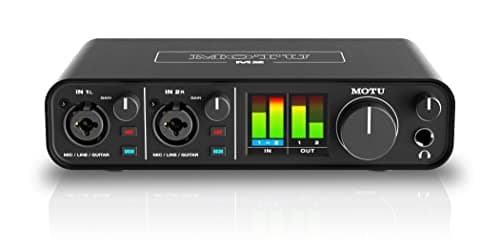
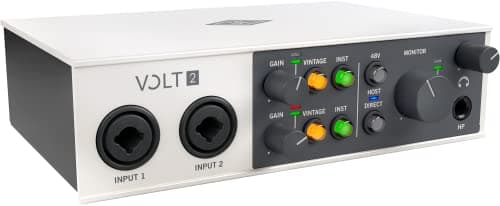
Buy the MOTU M2 if you want the cleanest, best-measuring box at this price: -129 dB equivalent input noise, 120 dB of output dynamic range through an ESS Sabre32 Ultra DAC, and a full-colour meter on the unit. Buy the Universal Audio Volt 2 if you want a published gain figure and an analog preamp colour on the way in — 55 dB of mic gain and a UA 610-style Vintage mode. If your microphone is a low-output dynamic, neither figure is generous, and the 69 dB Scarlett 2i2 is the safer purchase.
These two land on the same shortlist because they are priced alike and reviewed alike, and they are built around opposite philosophies. MOTU's pitch is measurement: the quietest preamp, the best converters, the most honest monitoring path. Universal Audio's pitch is character: a switchable emulation of their own 610 tube preamp, applied in analog, before the converter.
The gain figure, and the figure MOTU will not print
Universal Audio publishes 55 dB of mic gain. MOTU publishes -129 dB EIN — a figure for how quiet the preamp is — and no maximum gain figure at all. Those two facts pull in different directions for anyone planning a microphone purchase.
55 dB is not much. A condenser is entirely happy with it: an AT2035 at -33 dB needs roughly 40 dB for speech and leaves 15 dB in hand. A Shure SM7B at -59.0 dBV/Pa wants about 60 dB, which the Volt 2 does not have. The M2 may well have it, but with no published number you are guessing — and guessing is exactly what a specification sheet exists to prevent.
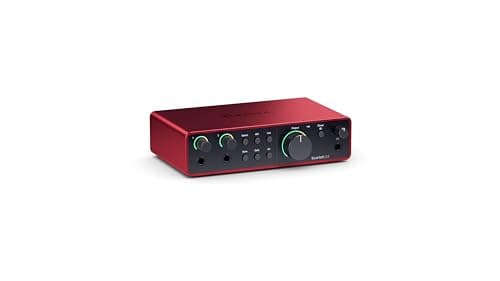
If your microphone is a low-output dynamic, the honest answer is that this comparison is the wrong one. A Scarlett 2i2 publishes 69 dB, costs less than either of these, and removes the question. That is why it sits on this page as a third pick rather than as a footnote. How much clean gain do you need has the full table.
What the Volt 2's Vintage mode actually does, and what it costs
The Vintage Mic Preamp Mode is an all-analog circuit modelled on Universal Audio's 610 tube preamp. It is a real effect rather than a marketing label: a gentle top-end softening and some low-order harmonic content that flatters a thin voice and takes the edge off a bright condenser.
The cost is that it happens before the converter, so it is printed permanently into the file. That is the standard trade with any analog colour on the way in: you are making a decision now that you would otherwise make later, in the edit, where you can change your mind. For spoken word the safe default is to record clean and add character afterwards. For a singer who responds to hearing a flattering sound in the headphones, printing it is a legitimate choice. Audio interface vs preamp covers where colour belongs in a chain.
Why the M2's metering matters more than its converters
The M2's headline specifications are its converters — ESS Sabre32 Ultra DAC, 120 dB of output dynamic range — and they are genuinely excellent. They are also better than any domestic room will reveal, which makes them the least useful reason to buy it.
The full-colour LCD meter on the front of the box is the thing you will notice every day. It shows input and output levels at a glance, without opening a software mixer, without alt-tabbing out of the DAW and without reading a three-LED traffic light. Combined with the best listening chain at this price, it makes the M2 the more pleasant box to work on alone — particularly if the same interface also feeds your studio monitors.
Both interfaces, and the cheaper box with more gain
MOTU M2
Top pickMOTU · The best converters and metering at the price
The pick if you care most about conversion quality and want to see your levels without alt-tabbing. If your mic is an SM7B and you want a published gain number you can check against the mic's sensitivity, the 2i2 is the safer buy.
Why it is here
- -129 dB EIN is genuinely quiet, and it shows on low-output dynamics
- Full-color LCD metering on the box is more useful day to day than any software mixer
- Independent phantom power and monitor switching per input
What it costs you
- MOTU does not publish a maximum mic-gain figure the way Focusrite does, so gain headroom is harder to plan around
- No onboard voicing or DSP at all
- Loopback needs the software, not a front-panel switch
Universal Audio Volt 2
Universal Audio · A hardware color option on the way in
Buy it if you want character on the way in and your mic is a condenser or a hot dynamic. With a low-output broadcast dynamic, 55 dB means a booster, and that changes the price comparison entirely.
Why it is here
- Vintage mode is a real analog-style color, not a plug-in you could add later
- Two combo inputs and a clean, legible front panel
- The UA software bundle is worth actual money
What it costs you
- 55 dB is the lowest gain ceiling in this group and the least SM7B-friendly
- 112 dB dynamic range trails the Focusrite and MOTU converters
- Vintage mode is a commitment printed into the recording
Focusrite Scarlett 2i2 (4th Gen)
Focusrite · The most gain per dollar in a two-input box
The default answer for someone buying an SM7B or PodMic: it supplies enough clean gain that you never need a booster, which makes it the cheaper total purchase even when it is not the cheaper box. Look elsewhere only if you need MIDI or four outputs.
Why it is here
- 69 dB is the most gain of any interface at this price, and enough for an SM7B with headroom to spare
- 120 dB dynamic range means the converters are not the weak link
- Two inputs, so a second person does not mean a second purchase
What it costs you
- Air mode is a fixed voicing, not an EQ you can dial
- Plastic-and-metal build feels less solid than the SSL or Audient competition
- No MIDI, which matters if you also play keys
What neither of them has
- A second headphone output. One each. If anyone else is ever in the room, look at the SSL 2+ MKII instead.
- MIDI on the M2. The Volt 2 has none either; the step-up Volt 276 and the MOTU M4 do.
- More than two inputs. Two mic preamps covers a host and a guest and stops there. Best audio interfaces for multiple mics.
- Enough gain for a low-output dynamic, with certainty. The Volt 2's 55 dB is short of it and the M2 will not say.
Which to buy
- Solo work, condenser or hot dynamic, you want the best listening and metering: MOTU M2.
- You want a published gain figure and an analog colour option: Universal Audio Volt 2.
- Your microphone is an SM7B or similar: neither at face value — the Scarlett 2i2's 69 dB, or one of these plus a booster.
- You will record a second person: neither. Buy two independent headphone outputs instead.

Both are a clear step past the budget tier in build and documentation, and the choice between them is a choice about philosophy rather than quality. If you are not sure the step up from a cheap box is justified at all, are cheap audio interfaces worth it is the more honest first question, and does an audio interface improve sound quality is the one after it.