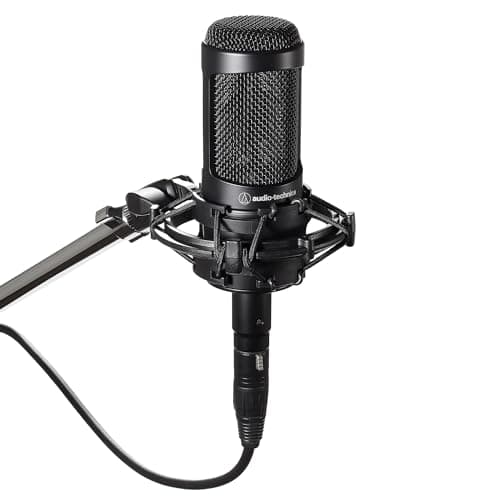
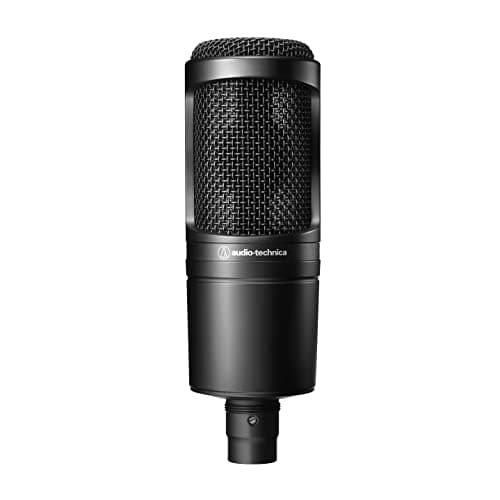
The Audio-Technica AT2035 is the condenser to put on a podcast desk: 12 dB SPL self-noise, a switchable 80 Hz high-pass that removes desk rumble and boom-arm thumps before they reach the recording, and a real shockmount in the box. The budget pick is the AT2020 at a noticeably lower price, with the warning that comes with it - 20 dB self-noise and no filter at all. Read the next paragraph before you buy either: in an untreated room, a broadcast dynamic beats every microphone on this page.
This page exists because the query exists, and the honest answer has a condition attached. A condenser is roughly 20 dB more sensitive than a broadcast dynamic, and it has a wider pickup pattern in practice. Both of those are advantages in a treated room: more detail, more air, less dependence on exact mic position. Both are liabilities in a spare bedroom with bare drywall, a laptop fan and a mechanical keyboard, because the capsule faithfully records all of it. That is why the best XLR microphones for podcasting is dynamic-led and this page is not a replacement for it. If your room has nothing on the walls, go there instead.
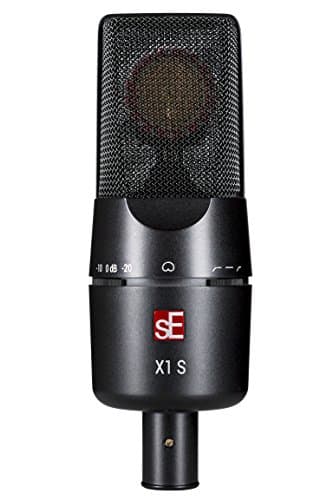
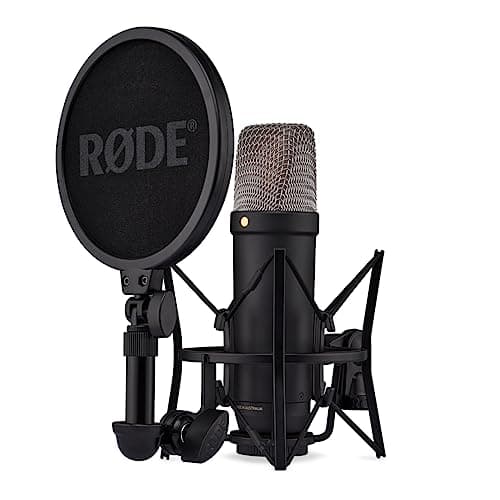
The ranking follows that table rather than the self-noise column alone, which is where most roundups of this shelf go wrong. The NT1 5th Generation has the quietest capsule sold at this price - 4 dBA, genuinely remarkable - and it is third here, because a 4 dBA noise floor is irrelevant when the dominant noise on your recording is a desk and a room arriving through a mic with no high-pass. The X1 S is second and would be first if it shipped with a shockmount: two low-cut frequencies and two pad settings is the most control on this list, and 9 dB(A) undercuts both Audio-Technicas.
The six condensers, ranked for a podcast desk
Each card carries the published figure with its source and says who the microphone is for. The verdict line on each one states who should not buy it, which is usually the more useful half.
Audio-Technica AT2035
Top pickAudio-Technica · The value condenser with the switches you actually need
The condenser to buy if you are choosing on value: the high-pass filter and the 8 dB quieter noise floor are worth more in a real room than anything else in this price band. Skip it if you have not treated the room, in which case a dynamic is the better purchase.
Why it is here
- 12 dB self-noise against the AT2020's 20 dB is an audible 8 dB of quiet for a small price step
- The 80 Hz high-pass is the single most useful switch on a desk-mounted condenser
- Ships with a real shockmount, not a plastic clip
What it costs you
- Still a condenser, so the room rules apply
- Slightly forward upper midrange that some voices find harsh
- The 10 dB pad is mostly irrelevant for voice work
sE Electronics X1 S
sE Electronics · The most on-mic control of any condenser here
The best-specified condenser on this site for a real home studio: quieter than the Audio-Technicas and the only one with a choice of low-cut frequencies. Choose the AT4040 instead if you want a flatter, more forgiving top end.
Why it is here
- `9 dB(A)` self-noise undercuts the AT2035 and AT4040 while costing less than the latter
- **Two** low-cut frequencies rather than one — `160 Hz` is genuinely useful on a boomy voice in a small room
- Two pad settings take it to `160 dB`, so it doubles as an instrument microphone
What it costs you
- Brighter than the AT4040, which suits some voices and not others
- Smaller dealer network than Audio-Technica or Rode
- The switch count makes it easy to leave a filter engaged by accident
Rode NT1 5th Generation
Rode · The quietest capsule most home studios can justify
The right condenser if you have treated the room, or are about to. If your room is bare drywall, the 4 dBA noise floor is irrelevant because the loudest thing on the recording will be the room.
Why it is here
- 4 dBA self-noise is quieter than the room you are recording in, which is the whole point of a condenser
- -32 dB sensitivity means no interface on this site struggles to drive it
- 32-bit float over USB makes clipping a non-event on the digital path
What it costs you
- A condenser hears your room, your keyboard and your fridge — treatment is not optional
- The USB path duplicates an interface you probably also want
- Bright enough that a sibilant voice needs a de-esser
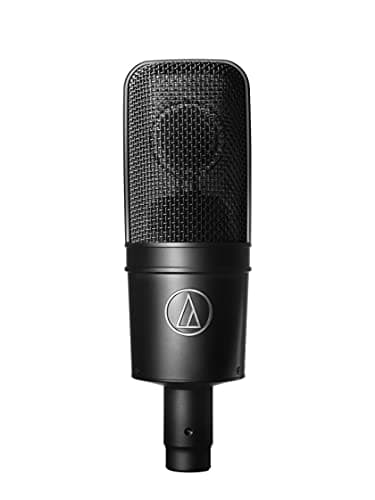
Audio-Technica AT4040
Audio-Technica · The step up from the budget condensers
The right condenser once your room is genuinely treated and the AT2035 has become the limiting factor. In an untreated room it will faithfully reproduce your walls and you will have spent the money for nothing.
Why it is here
- The same `12 dB(A)` self-noise as the AT2035 but with a noticeably more even midrange and a `133 dB` dynamic range
- Keeps the `80 Hz` high-pass filter, which is the control that matters on a desk
- A 2-micron diaphragm and transformerless output at a price well below the boutique tier
What it costs you
- Several times the price of the AT2035 for a difference you only hear in a treated room
- No shockmount in some bundles — check before ordering
- Still a condenser, so the room rules apply unchanged
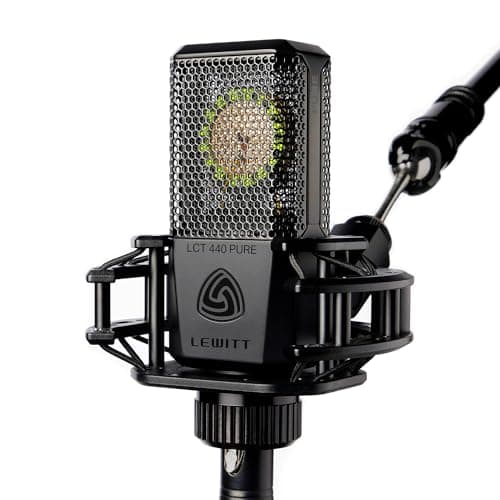
Lewitt LCT 440 Pure
Lewitt · A flatter alternative to the bright budget condensers
Worth the step up if the budget condensers have sounded harsh to you and you want flat rather than flattering. If you want on-mic filtering, the AT2035 gives you more control for less.
Why it is here
- 7 dB(A) is competitive with mics costing considerably more
- Voiced flatter than the NT1-A, so less de-essing on a sibilant voice
- Deliberately stripped of switches, which keeps the signal path simple
What it costs you
- No high-pass filter or pad at all, by design
- Costs more than the AT2035 without adding features
- Smaller dealer network than Rode or Audio-Technica
Audio-Technica AT2020
Audio-Technica · The entry condenser, if the budget is truly fixed
Buy it only if the AT2035 is genuinely out of reach — the step up buys a high-pass filter and a quieter capsule, which are the two things that matter in an untreated room. On a fixed budget the money is better spent on a dynamic and a panel.
Why it is here
- Cheapest credible XLR condenser, and it has been in production long enough to be a known quantity
- -37 dB sensitivity drives easily from any interface
- Light, so it works on a modest stand
What it costs you
- 20 dB self-noise is 8 dB noisier than the AT2035 and audible on a quiet voice-over
- No high-pass filter, so desk rumble goes straight into the take
- Plastic stand mount rather than a shockmount
Before you buy a condenser for a podcast
- Clap once in the room, hard. If you hear a short ringing tail after the clap, that is flutter echo and a condenser will record it. Two panels fix it - best acoustic panels.
- Open a recording and listen to the silence. Fan noise, traffic, a fridge: a condenser is 20 dB more sensitive to all of it than a PodMic is. That 20 dB is not recoverable in post.
- Check your boom arm is damped. A condenser on an undamped arm transmits every desk knock. Best boom arms for microphones covers which ones are quiet.
- Count the hosts. Two people at one desk with condensers will each record the other, which makes editing far harder than it needs to be. For a multi-host show, dynamics and a four-person podcast setup are the right shape.
- Confirm your interface supplies clean 48 V. Every microphone here needs phantom power. Gain is not the problem a condenser has - best audio interfaces for podcasting covers the boxes that do it well.
What we did not pick, and why
- The Neumann TLM 102. An excellent capsule whose price only makes sense in a room good enough to deserve it. A treated room and an AT2035 beats an untreated room and a TLM 102 every time.
- The Rode NT1-A matched pair. Two microphones for stereo recording. A podcast needs one per host, not a matched pair, and the single NT1 is quieter.
- Any USB condenser. The gain and the converters are fixed, and the upgrade path ends at the day you buy it. Upgrading from USB to XLR is the version of this purchase that lasts.
- The Shure SM7B and the Rode PodMic. Not condensers, and better for most podcast rooms - which is the point of the paragraph at the top. They are ranked on best XLR microphones for podcasting.
- A condenser with a multi-pattern switch. Figure-of-eight across a table sounds like a neat solution for two hosts and records both hosts and both walls. Two cardioid dynamics is the boring answer that works.
How these are ranked
- On-mic low-cut filtering. Published, switchable, and ranked first because the desk is the dominant noise source in this use.
- Published self-noise, in dB(A) or dB SPL as the manufacturer states it.
- What ships in the box. A real shockmount is worth money a spec sheet does not show.
- Pad range, which matters for a loud laugh at close range more than for speech.
- Buyable now, with a live Amazon listing and a price from the daily price check at the time this page was written.
Pair it with
- A damped boom arm. Best boom arms for microphones.
- Two panels at the first reflection points. Best acoustic panels for a home office is the version of that purchase for a room that also has to look like a room.
- An interface with clean phantom power. Best audio interfaces for podcasting.
- Closed-back headphones so your monitoring does not leak. Best headphones for podcasting.
If you take one thing from this page, take the order of operations. A condenser is the right podcast microphone in a room that has been treated, and the wrong one in a room that has not - and the treatment costs less than the difference between the AT2020 and the AT4040. Buy the panels, then buy the AT2035, and the 12 dB SPL noise floor and the 80 Hz filter will do the rest. Acoustic treatment for voice over is the cheapest version of that first step.