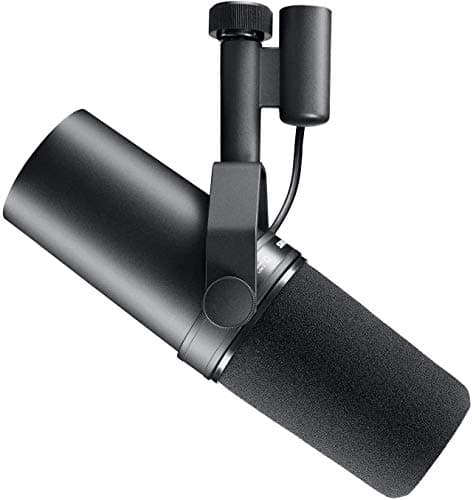
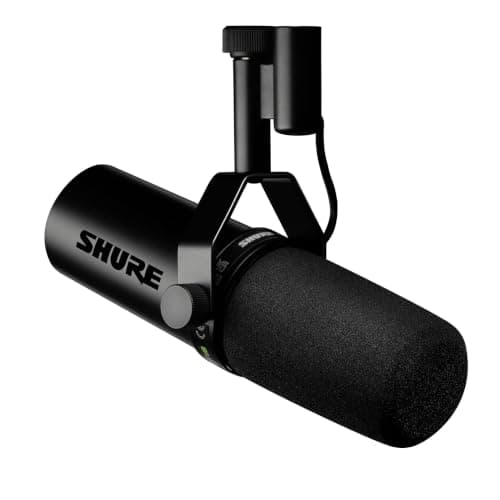
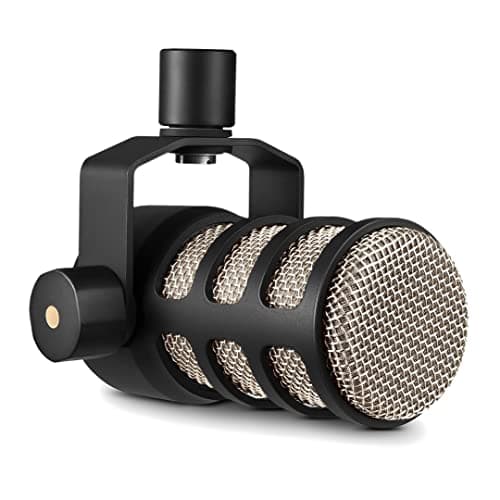
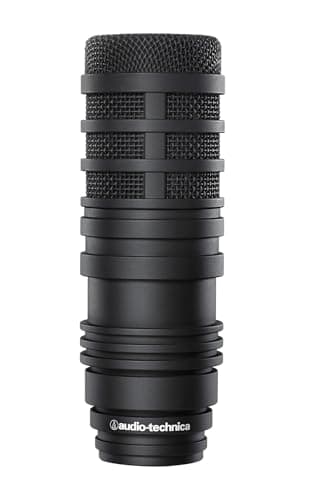
The Shure SM7B is still the broadcast reference, and the condition attached to it is the whole story: at -59.0 dBV/Pa it is one of the quietest microphones sold, so it needs 60 dB or more of clean gain or a booster alongside it. The Shure SM7dB is the pick if your interface cannot supply that, because its switchable +18/+28 dB preamp removes the problem. The budget pick is the Rode PodMic at -57 dBV/Pa with an internal pop filter and shockmount already in the body.
What makes a microphone a broadcast microphone is not a marketing tier, it is a set of engineering choices made in one direction: a large moving-coil dynamic capsule, a tight cardioid or hypercardioid pattern, an internal shockmount, an internal pop screen, and a frequency response rolled off below the chest register and lifted gently in the presence band. The result is a microphone that hears a voice 6 inches away and largely ignores a room, a keyboard and a computer fan. The cost is output level, and that cost is what trips up most first purchases.
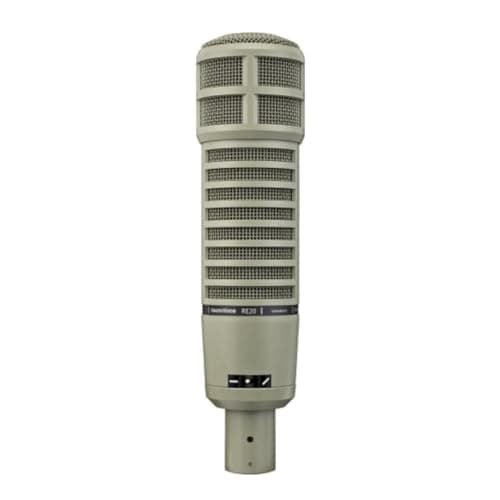
Two rows in that table solve problems the others do not. The RE20's Variable-D design makes proximity effect nearly constant across working distance, which is why it has lived in radio studios for decades - a presenter who leans in and out does not change tone, only level. The BP40's -48 dB sensitivity is 11 dB hotter than the SM7B's, which means a modest interface drives it cleanly, and its hypercardioid pattern is tighter still at the sides.
The five broadcast microphones, ranked
Each card carries the published sensitivity with its source, what gain the microphone demands, and who should buy something else.
Shure SM7B
Top pickShure · The default upgrade, if your preamp can feed it
Buy it if your interface supplies 60 dB or more of clean gain, or if you are budgeting for a booster alongside it. Buy something else if your only interface is a Scarlett Solo and you are not prepared to add hardware.
Why it is here
- Rejects room and computer-fan noise better than any condenser at any price
- Two voicing switches let one mic cover a thin voice and a boomy one
- Internal shockmount and a yoke that actually holds position on a boom arm
What it costs you
- At -59.0 dBV/Pa it is one of the quietest mics sold, so it demands a loud preamp
- Total cost is the mic plus, very often, a booster
- Heavy enough that a cheap desk arm will droop under it
Shure SM7dB
Shure · An SM7B with the booster problem already solved
The right SM7 for anyone whose interface tops out near 55 dB and who wants one purchase instead of two. Skip it if you already own a Cloudlifter or a 69 dB-gain interface, because you are paying twice for the same 25 dB.
Why it is here
- The +28 dB setting turns a 55 dB-gain interface into enough headroom for this capsule
- One XLR cable, no inline box, no second phantom-power dependency to reason about
- Bypassable, so it behaves as a plain SM7B when you move it to a big preamp
What it costs you
- You pay for the preamp whether your interface needed it or not
- A separate booster can be reused with other low-output mics; this one cannot
- No gain setting between +18 dB and +28 dB
Electro-Voice RE20
Electro-Voice · Movers, leaners and anyone who cannot hold mic distance
Worth the premium if you move while you talk, gesture, or share a mic with someone whose technique you cannot control. If you sit still at a fixed distance, the SM7B's proximity effect is a feature you will use, not a problem you need engineered away.
Why it is here
- Variable-D means the tone barely changes as you drift closer to or further from the grille
- Integral blast filter handles close talking without a separate pop screen
- The bass tilt-down switch is a genuinely useful second voicing, not a gimmick
What it costs you
- Costs more than an SM7B while sounding less immediately flattering on most voices
- Same low-output problem as every broadcast dynamic
- Large and beige, which some people mind
Rode PodMic
Rode · The best value in a broadcast dynamic
The pick for most people upgrading from a USB mic: it gets you 90 percent of the broadcast-dynamic sound without the booster arithmetic. Choose the SM7B instead if your voice is already bass-heavy and you want the bass-rolloff switch.
Why it is here
- At -57 dBV/Pa it needs about 2 dB less gain than an SM7B, which is enough to matter on a 58 dB interface
- Internal pop filter means one less thing clamped to your arm
- All-metal body at a fraction of the SM7B's price
What it costs you
- Voiced with more low-mid weight than the SM7B, so a boomy voice can get boomier
- No voicing switches, so you fix tone in the DAW rather than on the mic
- Still low enough output that a 55 dB interface will be working hard
Audio-Technica BP40
Audio-Technica · Tighter pickup than a cardioid in a live room
The pick when your problem is a live-sounding room and a weak preamp at the same time: the narrow pattern and the hot output solve both. Avoid it if you or your guests cannot stay on-axis.
Why it is here
- At -48 dB it is dramatically hotter than an SM7B and needs no booster on anything modern
- Hypercardioid pattern narrows the pickup further than the cardioid competition
- Switchable 100 Hz rolloff at 6 dB/octave for close work
What it costs you
- 632 g needs a serious arm or stand
- Hypercardioid punishes sloppy mic technique — step off-axis and you vanish
- Voiced large and forward, which is not every voice's friend
How these are ranked
- Published sensitivity, with the gain consequence stated. A microphone that needs hardware you do not own is not cheap, and no pick here hides that behind a sticker price.
- Room and off-axis rejection. The reason to own a broadcast dynamic at all. Pattern, capsule size and grille design, from published specifications.
- Voicing control on the microphone itself. A bass rolloff or presence switch covers a thin voice and a boomy one with one purchase; a fixed voicing does not.
- What is already in the body. An internal shockmount and pop screen are real money and real desk space you do not then spend.
- Buyable now, with a live listing and a price from the daily price check when this page was written. The order is editorial, not a price order.
What we did not pick, and why
- A large-diaphragm condenser. Better detail, far more room. In an untreated room a condenser records your walls alongside your voice, which is the opposite of what a broadcast microphone is for - dynamic vs condenser microphones is the full comparison.
- The Shure SM58. A superb, durable cardioid dynamic and a handheld stage microphone by design, with a shorter working distance and a smaller capsule. It is the cheapest way to hear what a dynamic does for you: Rode PodMic vs Shure SM58.
- USB broadcast-style microphones. Convenient, and they lock the preamp, the converter and the capsule into one purchase you cannot upgrade in pieces. USB vs XLR microphones.
- Ribbon microphones. Lovely on a voice and even quieter than an SM7B, with a fragile element and an absolute dependency on a high-gain preamp. Not a first broadcast microphone.
- Anything sold as a podcast bundle with a mixer you did not choose. The microphone in those boxes is rarely the one you would have picked. Best audio interfaces for podcasting separates the two decisions.
Pair it with
- Enough gain, or a booster. Best preamps for the Shure SM7B and best inline mic preamps.
- An arm that will hold the weight. The BP40 is 632 g and the SM7B is not far off: best boom arms for microphones.
- A room that is not working against you. Best acoustic panels.
- Headphones you can monitor on with a live mic. Best headphones for podcasting.
If you are choosing between two of these, the head-to-head pages close it faster than a roundup can. SM7B vs PodMic is the value question, SM7B vs SM7dB is whether to pay for the built-in preamp, RE20 vs SM7B is Variable-D against a fixed cardioid, and is the SM7B worth it is the honest answer for someone whose room and interface are both modest.