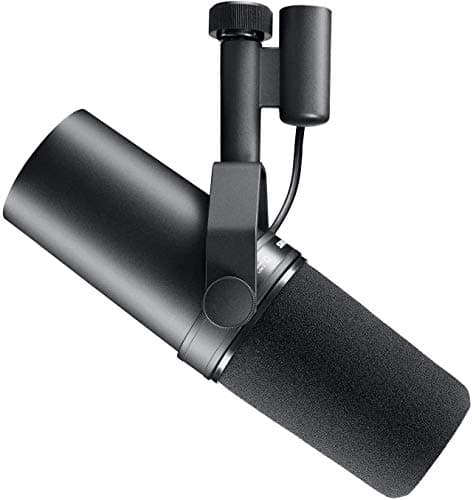
The Elgato Wave DX is the best Rode PodMic alternative for most people: the same price class and internal pop filter, at -52 dBV/Pa, which is 5 dB hotter than the PodMic and enough to settle a modest interface. If the PodMic's low-mid weight is your problem, the Shure SM7B adds the bass-rolloff switch it lacks.
The PodMic is the microphone this site recommends most often to someone leaving a USB mic, so it is worth being blunt about why anyone would want something else. There are five real reasons, and only one of them is price.
One reason is missing from that table on purpose: wanting to spend less. The PodMic is already close to the floor of this category, and the only microphone here that undercuts it meaningfully is the Shure SM58 — a stage microphone with a 15 kHz ceiling that this site treats as a diagnostic rather than a destination. If budget is the whole constraint, best XLR microphones under $100 is the more useful page.
What the PodMic actually does well
An alternative has to replace something specific, so here is the thing you are replacing. Four published properties do the work, and together they explain why it keeps winning value rankings on this site.
- `-57 dB` re 1 V/Pa sensitivity. About 2 dB hotter than an SM7B, which is small on paper and decides the purchase on a 58 dB interface.
- An internal pop filter and internal shockmount. Two accessories you do not buy, and nothing extra clamped to your arm.
- `20 Hz to 20 kHz` published range. Wider than the speech-only dynamics it competes with, so it is usable on instruments as well as voice.
- An all-metal body at a fraction of the price of the microphone everyone compares it to.
Nothing on this page matches all four. The Wave DX is hotter and has the internal filter, but stops at 15 kHz and has no voicing controls. The SM7B adds two switches and takes 2 dB of output away. The BP40 is dramatically hotter and 632 g heavy. The RE20 solves distance and costs more than the SM7B. Those are the trades, and your room and your voice decide which is acceptable.
How these are ranked
- Published sensitivity, from the manufacturer's own specification sheet, because it decides whether your interface can feed the microphone at all.
- What the capsule is voiced for. A speech-only response is not a fault, but it is a limit, and it is stated for every pick rather than glossed over.
- Room rejection. Pattern and off-axis behavior matter more than frequency response in an untreated room, which is where almost all of this gear lives.
- What is built in. An internal pop filter or shockmount is a purchase you skip; a microphone that needs both is more expensive than its price.
- Buyable now. Every pick had a live listing when this page was written, and the ranking is for the buyer leaving a PodMic, not a price order.
The six alternatives, ranked
Ranked for the buyer leaving a PodMic rather than by price. The Wave DX and the SM58 are the two that do not cost more than the microphone they replace.
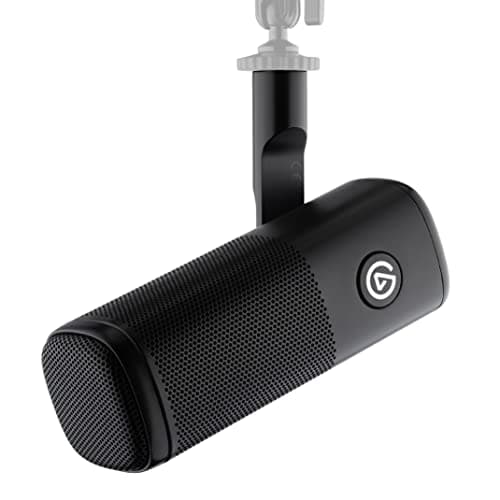
Elgato Wave DX
Top pickElgato · A streaming dynamic that needs no booster
The most sensible streaming dynamic if you want to plug into a modest interface and stop thinking about gain. If you also record music, the `15 kHz` ceiling is a real limit and a wider-band dynamic is the better buy.
Why it is here
- At `-52 dBV/Pa` it is the hottest broadcast-style dynamic here — `7 dB` above an SM7B, so no interface on this site struggles
- Internal pop filter, so nothing extra clamps to your arm
- Light at `440 g`, which any arm holds comfortably
What it costs you
- Response stops at `15 kHz`, so it is a speech microphone and not a music one
- No voicing switches at all
- Voiced for a close, forward streaming sound that is less neutral than an SM7B
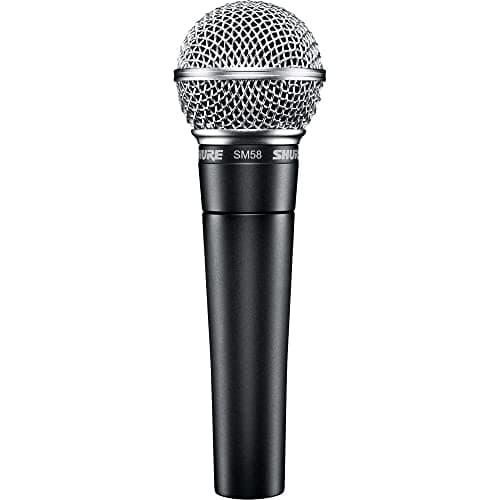
Shure SM58
Shure · The cheapest way to hear what a dynamic does for you
The right first XLR mic if the real question is whether a dynamic fixes your room, because it answers that for very little money on the interface you already own. It is a diagnostic, not a destination.
Why it is here
- At -54.5 dBV/Pa it is the hottest dynamic here, and works on genuinely modest preamps
- Light enough for any stand or arm you already own
- Effectively indestructible, and resells for most of what you paid
What it costs you
- Response stops at 15 kHz and it is voiced for a PA, not a studio
- Handheld grille shape is awkward on a desk boom
- You will outgrow it if voice is your main output
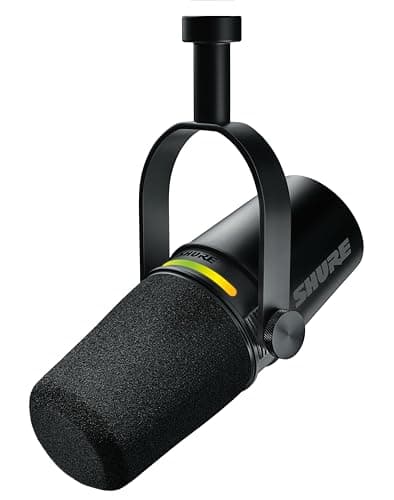
Shure MV7+
Shure · Keeping a USB fallback while you move to XLR
The honest transition mic: it works on your laptop today and on your interface next month. If you know you are committing to XLR and never going back, the same money buys a better-sounding pure-XLR dynamic.
Why it is here
- -55 dBV/Pa is roughly 4 dB hotter than an SM7B, which removes the booster question entirely
- USB side keeps working when you travel without the interface
- DSP and the LED panel are genuinely useful for a solo host with no engineer
What it costs you
- Frequency response stops at 16 kHz, so it is voiced for speech rather than music
- The DSP features only exist on the USB path, not the XLR path
- You are part-paying for a converter you stop using the day the interface arrives
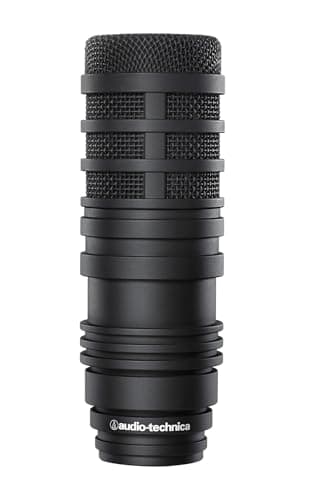
Audio-Technica BP40
Audio-Technica · Tighter pickup than a cardioid in a live room
The pick when your problem is a live-sounding room and a weak preamp at the same time: the narrow pattern and the hot output solve both. Avoid it if you or your guests cannot stay on-axis.
Why it is here
- At -48 dB it is dramatically hotter than an SM7B and needs no booster on anything modern
- Hypercardioid pattern narrows the pickup further than the cardioid competition
- Switchable 100 Hz rolloff at 6 dB/octave for close work
What it costs you
- 632 g needs a serious arm or stand
- Hypercardioid punishes sloppy mic technique — step off-axis and you vanish
- Voiced large and forward, which is not every voice's friend
Shure SM7B
Shure · The default upgrade, if your preamp can feed it
Buy it if your interface supplies 60 dB or more of clean gain, or if you are budgeting for a booster alongside it. Buy something else if your only interface is a Scarlett Solo and you are not prepared to add hardware.
Why it is here
- Rejects room and computer-fan noise better than any condenser at any price
- Two voicing switches let one mic cover a thin voice and a boomy one
- Internal shockmount and a yoke that actually holds position on a boom arm
What it costs you
- At -59.0 dBV/Pa it is one of the quietest mics sold, so it demands a loud preamp
- Total cost is the mic plus, very often, a booster
- Heavy enough that a cheap desk arm will droop under it
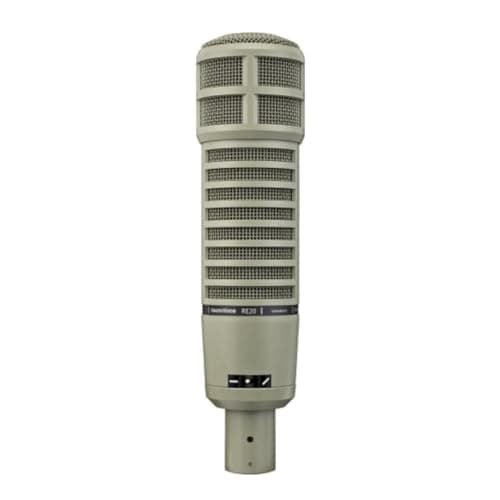
Electro-Voice RE20
Electro-Voice · Movers, leaners and anyone who cannot hold mic distance
Worth the premium if you move while you talk, gesture, or share a mic with someone whose technique you cannot control. If you sit still at a fixed distance, the SM7B's proximity effect is a feature you will use, not a problem you need engineered away.
Why it is here
- Variable-D means the tone barely changes as you drift closer to or further from the grille
- Integral blast filter handles close talking without a separate pop screen
- The bass tilt-down switch is a genuinely useful second voicing, not a gimmick
What it costs you
- Costs more than an SM7B while sounding less immediately flattering on most voices
- Same low-output problem as every broadcast dynamic
- Large and beige, which some people mind
What we did not pick, and why
- Condensers. An AT2035 or a Rode NT1 is not a PodMic alternative, it is a different tool for a different room — one that hears your reflections, your chair and your keyboard. Dynamic vs condenser microphones explains why swapping one for the other usually disappoints.
- The Shure SM7dB. It is an SM7B with +18 dB or +28 dB of preamp built in, which is a solution to the gain problem rather than an alternative to the PodMic. If that is your problem, SM7B vs SM7dB has the arithmetic.
- USB microphones. They are a capsule and a converter welded together, so every later upgrade is a replacement. If you are still weighing the connector, start with USB vs XLR microphones rather than a product page.
- The lookalike broadcast dynamics under unfamiliar brand names. Some are competent. This ranking runs on published sensitivity figures we can cite, and most of them publish nothing verifiable.
Pair it with
- Enough clean gain. If you choose the SM7B or the RE20 you are going the quiet direction, so check the interface first — best Scarlett 2i2 alternatives ranks the boxes by published gain, and only two of them beat 69 dB.
- A booster, if the interface stays. Best preamps and boosters for the SM7B applies to every low-output dynamic here.
- An arm rated for the weight. The BP40 is 632 g before you add a cable. Best boom arms for microphones.
- A pop filter, for the two that do not have one built in. The SM7B and the SM58 both want one — best pop filters.
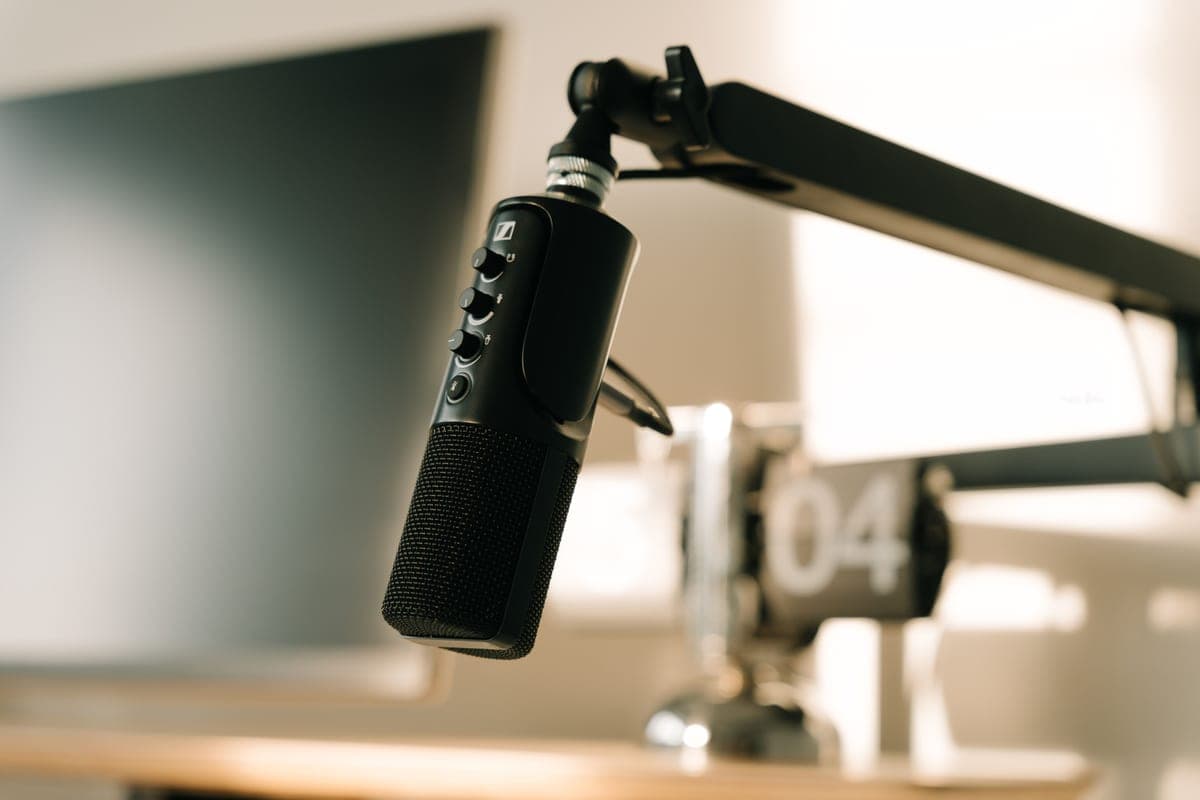
If you have narrowed it to two microphones, the head-to-head pages are quicker than a ranking. SM7B vs PodMic is the comparison most of this page hangs on, PodMic vs SM58 is the budget version of it, MV7+ vs PodMic is the hybrid question, and RE20 vs PodMic is the one to read if you move while you talk.