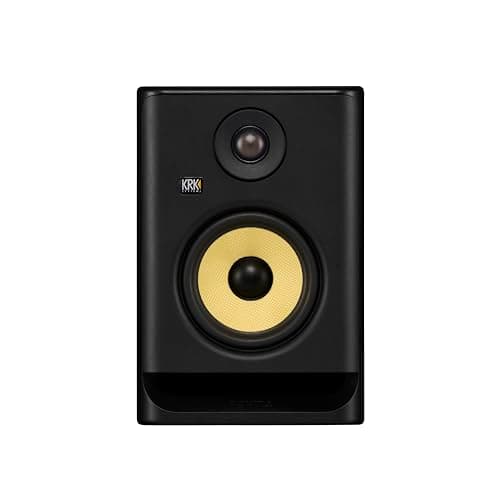
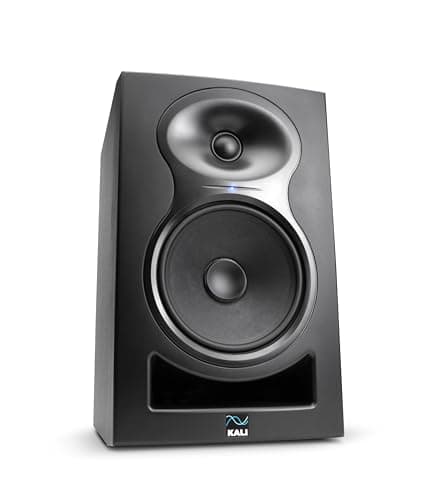
Buy the Kali LP-6 V2 if you want more honest low end for less money: published 39 Hz to 25 kHz at -10 dB and 47 Hz to 21 kHz at +/-3 dB, from a 6.5-inch woofer with 80 W of Class D amplification. Buy the KRK Rokit 5 G5 if you need the DSP: three voicing modes and 25 boundary and EQ combinations let you dial the speaker to a desk or a wall position, which matters when the monitor cannot be moved.
These two sit at almost the same price and take genuinely different approaches to the same problem. Kali's answer to a difficult room is extension plus a simple boundary EQ and good engineering. KRK's answer is onboard DSP with a lot of presets. Both are defensible; which one is right depends on how much control you have over where the speakers go.
The extension difference is real, and so is the caveat
The LP-6 V2's 6.5-inch woofer and 80 W of amplification produce a published 115 dB max SPL against the Rokit's 104 dB, and reach 39 Hz at -10 dB against the Rokit's 54 Hz at +/-3 dB. Those two figures are measured to different conventions and are not directly comparable — but the 6.5-inch driver with more power behind it is doing more work in the bottom octave, and that part is not in dispute.
The caveat matters as much as the number. In a small untreated room, a monitor that reaches lower excites more room modes, and the result can be a less trustworthy low end rather than a more trustworthy one. The Kali's extension is an asset once the corners are treated and a liability before that. Best bass traps is the purchase that converts it from one to the other.
11 dB of extra max SPL is less interesting than it looks for a home studio, because you should not be mixing at a level where 104 dB is a constraint. How loud should studio monitors be covers the reference level that actually works.
What the Rokit's DSP does and does not fix
The Rokit 5 G5 ships with onboard DSP offering three voicing modes and 25 combinations of boundary and EQ settings, adjustable from the rear panel with a small display. The boundary settings compensate for the predictable low-frequency lift you get from putting a speaker close to a wall or on a desk surface.
That is genuinely useful, and it is important to be clear about its limits. Boundary compensation corrects a broad, predictable shelf caused by a nearby surface. It does not correct room modes, which are narrow peaks and nulls at specific frequencies set by your room's dimensions, and which move depending on where your head is. A null caused by a reflection arriving out of phase cannot be filled in by turning that frequency up — the cancellation happens in the air, after the speaker.
So the DSP earns its keep in exactly one scenario: the speakers have to sit against a wall or flat on a desk and cannot be moved. If you can get them on stands, away from the wall, in a symmetrical position, studio monitor placement will do more than any preset.
Both monitors, and the midrange reference people compare them to
KRK Rokit 5 G5
Top pickKRK · Onboard DSP room correction presets
Reasonable if the DSP presets genuinely match your placement and you cross-check mixes on headphones. As a sole reference, the flatter HS5 or 305P MkII will teach you more about your own mixes.
Why it is here
- Publishes its response with a tolerance — `54 Hz to 30 kHz, +/-3 dB` — which the previous generation did not
- Onboard DSP gives three voicing modes and 25 boundary settings without external hardware
- Kevlar woofer and silk-dome tweeter are physically tough
What it costs you
- `104 dB` max SPL is the lowest headroom in the 5-inch group here
- The Rokit voicing is historically flattering rather than flat — mixes translate less predictably
- `54 Hz` qualified at `+/-3 dB` is less low-end reach than the unqualified figures rivals quote
Kali Audio LP-6 V2
Kali Audio · The most low end per dollar, with boundary EQ
The best value here if you set the boundary EQ honestly and have corner traps in. In a bare bedroom with the switches left at default, the extra low end makes your mixes worse, not better, and the HS5 is the wiser buy.
Why it is here
- 47 Hz at +/-3 dB is real low end, not a marketing figure
- Boundary EQ switches on the back are the only honest answer to a speaker jammed against a wall
- 115 dB max SPL means huge headroom for a desk speaker
What it costs you
- That low-end reach is a liability in an untreated room — you will chase room modes, not mix decisions
- 6.5-inch driver in a small room needs the boundary EQ set correctly or it is worse than an HS5
- Paper cone is more fragile than the alternatives
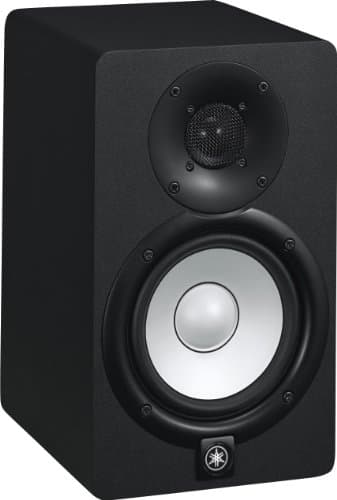
Yamaha HS5
Yamaha · The flat midrange reference for a small room
The right monitor for an untreated or lightly treated small room, precisely because it does not pretend to have low end your room could not reproduce honestly anyway. If you need to hear below 74 Hz, add a treated room before you add a bigger speaker.
Why it is here
- The honest -3 dB figure of 74 Hz tells you what it will not do, which is rarer than it should be
- Midrange is flat and unflattering, which is the entire job of a monitor
- Small enough to sit at ear height on a desk without dominating the room
What it costs you
- Nothing below about 74 Hz, so you mix low end by trust rather than by ear
- Unforgiving — a rough mix sounds rough, which some people hate
- Rear port needs clearance from the wall
Voicing, and the thing KRK is known for
KRK's reputation — earned across earlier Rokit generations — is for a voicing with a lifted low end and a forward top, which is flattering to listen to and risky to mix on, because a monitor that exaggerates bass leads you to under-deliver it. The G5's voicing modes exist partly to answer that criticism: one of them is a flat setting intended for mix work.
Kali's approach is to voice flat from the start and give you a boundary EQ for the room. In practice that makes the LP-6 V2 the less exciting speaker to listen to music on and the more straightforward one to make decisions on, which is the correct priority for a monitor. KRK Rokit 5 vs Yamaha HS5 and Kali LP-6 vs JBL 305P MkII approach the same question from either side.
Which to buy
- Speakers can go on stands, away from walls, in a treated or partly treated room: Kali LP-6 V2. More extension, more power, less money.
- Speakers must sit against a wall or flat on a desk, and cannot be moved: KRK Rokit 5 G5, for the boundary DSP.
- Small untreated room, you care most about midrange decisions: the Yamaha HS5, which rolls off at 74 Hz and therefore excites less of the problem.
- You produce bass-heavy music and will treat the corners: LP-6 V2, or step up to the Kali IN-5.
Neither is a mistake. The LP-6 V2 is the better engineering per dollar and the Rokit is the better answer to a room you cannot change, and both are a clear step above multimedia speakers. If you are weighing whether this tier is worth it at all, are studio monitors worth it is the honest version of that question.