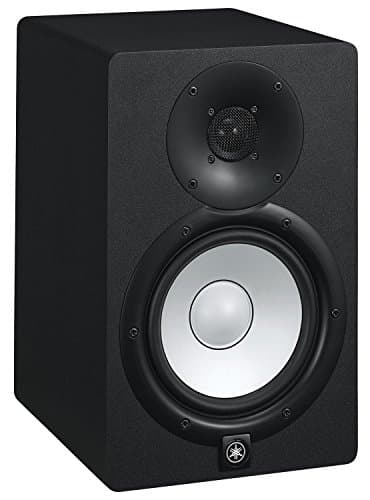
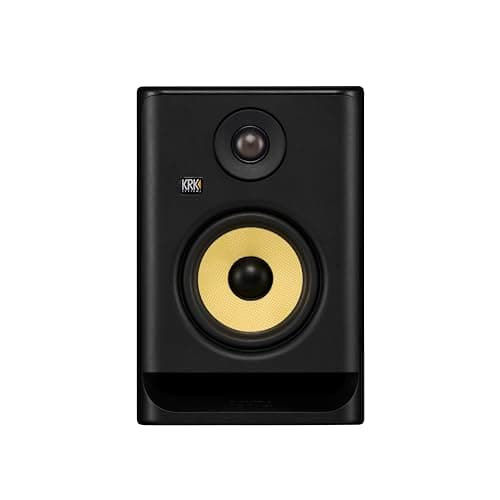
Buy the KRK Rokit 5 G5 if your room is small and bare - a 5-inch woofer excites fewer modes, and the DSP presets help with a compromised placement. Buy the Yamaha HS7 once the corners are treated: 55 Hz at -3 dB and 95 W is the genuinely bigger speaker.
This is a cross-size comparison, which makes it more interesting than the usual two-five-inch shootout and also easier to get wrong. One of these is a 5-inch two-way with onboard DSP. The other is a 6.5-inch two-way with nearly twice the amplifier and no DSP whatsoever. The spec sheets are not directly comparable, and the headline numbers actively mislead.
The driver size decides this, and smaller is often right
A 6.5-inch woofer moves more air than a 5-inch one, which in a treated room means more usable output and less strain at the level you actually mix at. In a small untreated bedroom it means something else: more energy delivered into the region where your walls behave worst.
A small room's lowest standing waves sit roughly where both of these speakers stop, and they produce peaks and nulls of 10 dB or more at your listening position. That is larger than every difference in the table above, combined. Add output down there and you do not reveal more low end - you reveal more room. 5-inch vs 8-inch studio monitors sets the size question out by room rather than by driver, and the conclusion holds here: under roughly 150 square feet, the smaller cabinet is usually the better buy.
This is why the HS7 is an upgrade with a prerequisite attached. Bought after bass traps go in the corners, it is clearly the better speaker. Bought before, it mostly shows you your room's problems at a higher volume, and the 5-inch Rokit will give you more trustworthy decisions for less money.
What the DSP is for, and what it cannot do
The Rokit's onboard DSP gives three voicing modes and 25 boundary-and-EQ combinations - KRK's answer to the fact that almost nobody can place a monitor properly. If your speaker has to sit against a wall or on a desk surface, that EQ addresses a real and predictable problem, and the Yamaha has nothing equivalent.
What it cannot do is restore a cancellation. If your room nulls a frequency at your chair, boosting that frequency does not bring it back, because the cancellation happens in the air between the speaker and your ears rather than inside the cabinet. DSP flattens a response measured at one point; absorption changes how the room behaves. Only one of those two is a fix. Monitor isolation pads vs stands is the cheaper half of the same diagnosis.
Voicing: flattering versus flat
The two cabinets are voiced from opposite philosophies. The Rokit line has historically carried more low-frequency emphasis than flat, which is more impressive in a shop and produces a specific failure: you under-mix low end, because the speakers are supplying some of it for you, and the mix lands thin everywhere else.
The HS voicing is the opposite, and deliberately unflattering. Nothing is added, the midrange is the flattest in this hub, and your mistakes are audible. That is the point of it, and it is why the HS line keeps turning up in rooms that could afford something else. The trade is that the HS7 is not a pleasant speaker to listen to music on, and nobody at Yamaha was trying to make it one.
If you want the Yamaha voicing in a cabinet the size of the Rokit, that is the HS5, and Yamaha HS5 vs HS7 is the in-family version of this decision. KRK Rokit 5 G5 vs Yamaha HS5 is the same-size version of this one.
Headroom is the HS7's real advantage
95 W split 60 W to the woofer and 35 W to the tweeter against 55 W split 35 W and 20 W is close to twice the amplifier. The Rokit's 104 dB maximum SPL is the lowest figure in this hub, and Yamaha does not publish a comparable number at all - but the power rating and the driver area both point the same way.
At nearfield distances and sensible levels the Rokit is enough. The difference shows up when you push: a speaker working near its limit distorts, and low-frequency distortion is exactly the kind you least want when you are trying to judge a bass part. If you mix loud, or your desk is unusually wide, the HS7 is the more conservative engineering.
Choose the KRK Rokit 5 G5 if
- Your room is small and has no treatment in it yet.
- Your placement is compromised - against a wall, on a desk, off-center - and you will actually use the DSP presets.
- You already have a reliable headphone reference and will cross-check every mix on it.
- The budget is the budget, and the difference buys corner treatment instead.
- You want DSP room correction built into the cabinet rather than bought as a separate box.
Choose the Yamaha HS7 if
- Your corners are treated, or they will be before the speakers arrive.
- You produce music rather than speech, and you need to hear the bottom two octaves honestly.
- You want the flat, unflattering voicing that teaches you your own mixes.
- You mix at real levels and want the 95 W of headroom behind you.
- Your desk is deep enough to get a 6.5-inch cabinet the distance it needs from the wall and from you.
Both monitors in detail
Yamaha HS7
Top pickYamaha · The HS voicing with usable low end
The upgrade once the room has bass traps in the corners. Bought before the treatment, it will simply show you your room's problems louder — which is why the HS5 is the better first monitor in a bare room.
Why it is here
- The same flat voicing as the HS5 with meaningfully more low-frequency reach
- 95 W means it stays clean at the level you actually mix at
- 2 kHz crossover keeps the vocal range on one driver
What it costs you
- A 6.5-inch woofer in an untreated bedroom excites room modes the HS5 never touches
- Needs more distance from the wall and from you than most desks allow
- Costs and weighs noticeably more than the HS5
KRK Rokit 5 G5
KRK · Onboard DSP room correction presets
Reasonable if the DSP presets genuinely match your placement and you cross-check mixes on headphones. As a sole reference, the flatter HS5 or 305P MkII will teach you more about your own mixes.
Why it is here
- Publishes its response with a tolerance — `54 Hz to 30 kHz, +/-3 dB` — which the previous generation did not
- Onboard DSP gives three voicing modes and 25 boundary settings without external hardware
- Kevlar woofer and silk-dome tweeter are physically tough
What it costs you
- `104 dB` max SPL is the lowest headroom in the 5-inch group here
- The Rokit voicing is historically flattering rather than flat — mixes translate less predictably
- `54 Hz` qualified at `+/-3 dB` is less low-end reach than the unqualified figures rivals quote
What else you need to buy, either way
- Stands or isolation. A monitor sitting flat on a desk has a resonance no EQ removes. Best studio monitor stands.
- Corner treatment. The thing neither speaker can do for itself. Best bass traps.
- An interface with balanced outputs. Both take XLR or TRS at line level. Best audio interfaces for a home studio.
- A headphone cross-reference. Especially with the Rokit, whose voicing needs one. Best headphones for mixing.
If neither: the third option
If you want more reach than either for the money, the Kali LP-6 V2 publishes 47 Hz at +/-3 dB from a 6.5-inch cabinet with boundary EQ of its own - Yamaha HS5 vs Kali LP-6 and KRK Rokit 5 G5 vs Kali LP-6 V2 are both that argument. If your seating position cannot be centered, the JBL 305P MkII's waveguide holds its image better than either of these: KRK Rokit 5 vs JBL 305P MkII.