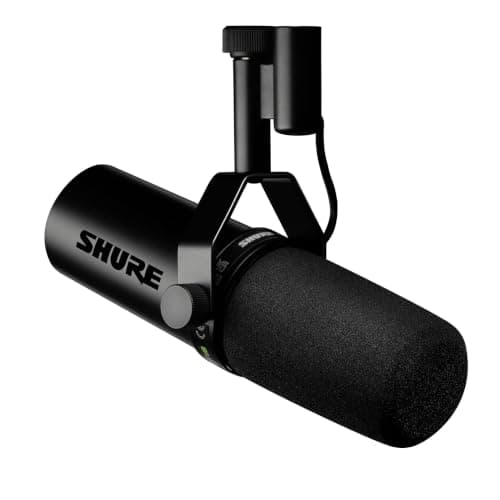
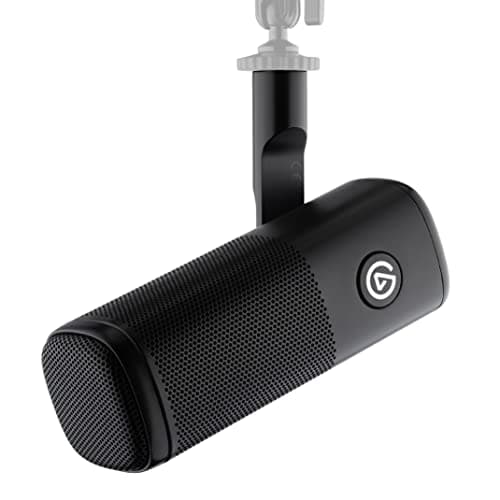
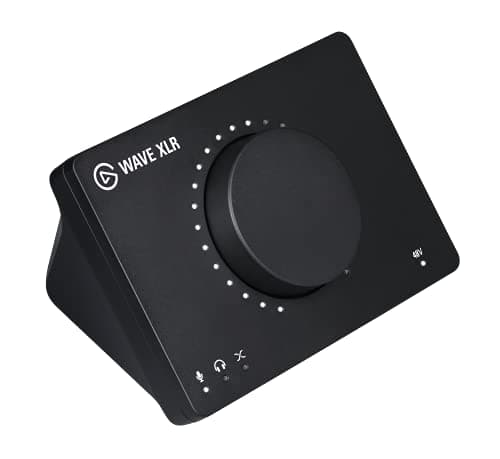
The Shure SM7dB is the best MV7 alternative if what you liked about the MV7 was that it made gain somebody else's problem: a selectable +18 dB or +28 dB preamp inside the microphone, a better capsule than the MV7's, and the preamp is bypassable when you move to a bigger interface. The budget pick is the Elgato Wave DX at -52 dBV/Pa - hotter than the MV7's XLR output, with an internal pop filter, for well under half the MV7's price. If what you actually wanted was the USB side, read the Elgato Wave XLR card: 75 dB of gain plus a software mixer rebuilds the MV7's convenience around any XLR microphone.
The MV7 and MV7+ are the most sensibly designed microphones Shure sells for someone in transition. They are dynamic, cardioid and voiced for speech; the XLR output is -55 dBV/Pa, roughly 4 dB hotter than an SM7B, which removes the booster question that dominates every other broadcast-dynamic purchase; and the USB-C side carries a 24 bit / 48 kHz converter with Auto Level Mode and a digital pop filter so a solo host with no engineer can record a usable take on the first attempt. People look for alternatives for a short list of reasons, and the table below is that list.
One reason is missing on purpose: wanting a hotter microphone. At -55 dBV/Pa the MV7's XLR output is already hot enough for any interface on this site, and only the Wave DX on this page beats it. If your MV7 recordings are quiet and noisy, the problem is the gain structure in front of it rather than the capsule - how much clean gain do you need has the arithmetic, and it is usually a free fix.
What the Shure MV7 actually does well
An alternative has to replace something specific, so here is what you are replacing. Four things make the MV7 what it is, and three of them are not about sound at all:
- `-55 dBV/Pa` on the XLR output. About 4 dB hotter than an SM7B. That one figure is why MV7 owners never have the booster conversation.
- A USB-C path that works with no interface. Travel with a laptop and you still have a microphone, which no pure-XLR pick here can claim.
- Auto Level Mode and a digital pop filter on the USB path. Genuinely useful for a solo host, and genuinely absent the moment you switch to XLR - the DSP lives on the USB side only.
- A capsule voiced tightly for speech, 50 Hz to 16 kHz. Narrow by music standards and deliberately so: there is nothing above 16 kHz in a spoken voice that you want more of.
Nothing on this page matches all four, and nothing matches the second at all. That is the honest shape of this decision: the microphones below are better at being microphones, and the MV7 is better at being a complete recording chain in one hand. The Wave XLR card exists on this page precisely because it is the only way to get the fourth point back - a software mixer, tap-to-mute and 75 dB of gain in front of whichever capsule you pick.
How these are ranked
- What it does about gain. Either the capsule is hot enough on its own, or the microphone carries its own preamp, or the box in front of it supplies the headroom. This is the MV7's defining advantage and the first thing an alternative has to answer.
- Total cost to a working recording, not the price of the item. A microphone that needs a booster is a two-item purchase and is ranked as one.
- Published sensitivity and bandwidth, from the manufacturer, with the measurement stated.
- What it does about convenience - an internal pop filter, an internal shockmount, a software mixer - because that is the half of the MV7 nobody mentions until it is gone.
- Buyable now, with a live Amazon listing and a price from the daily price check at the time this page was written. Each button carries its own date.
The six alternatives, ranked
Each card carries the published figure with its source, the live price with the date it was checked, and the cons as the spec sheet states them. We have not tested these products; the ranking is a reading of published figures against the criteria above.
Shure SM7dB
Top pickShure · An SM7B with the booster problem already solved
The right SM7 for anyone whose interface tops out near 55 dB and who wants one purchase instead of two. Skip it if you already own a Cloudlifter or a 69 dB-gain interface, because you are paying twice for the same 25 dB.
Why it is here
- The +28 dB setting turns a 55 dB-gain interface into enough headroom for this capsule
- One XLR cable, no inline box, no second phantom-power dependency to reason about
- Bypassable, so it behaves as a plain SM7B when you move it to a big preamp
What it costs you
- You pay for the preamp whether your interface needed it or not
- A separate booster can be reused with other low-output mics; this one cannot
- No gain setting between +18 dB and +28 dB
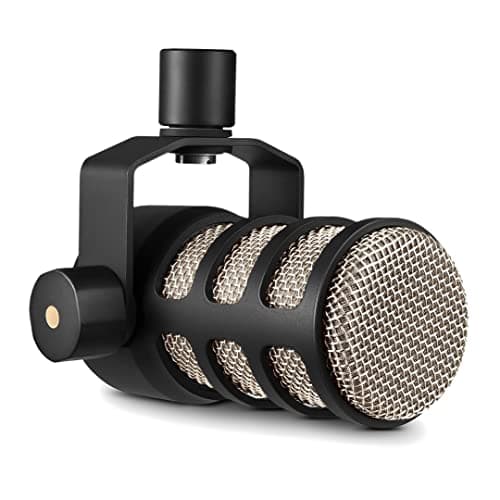
Rode PodMic
Rode · The best value in a broadcast dynamic
The pick for most people upgrading from a USB mic: it gets you 90 percent of the broadcast-dynamic sound without the booster arithmetic. Choose the SM7B instead if your voice is already bass-heavy and you want the bass-rolloff switch.
Why it is here
- At -57 dBV/Pa it needs about 2 dB less gain than an SM7B, which is enough to matter on a 58 dB interface
- Internal pop filter means one less thing clamped to your arm
- All-metal body at a fraction of the SM7B's price
What it costs you
- Voiced with more low-mid weight than the SM7B, so a boomy voice can get boomier
- No voicing switches, so you fix tone in the DAW rather than on the mic
- Still low enough output that a 55 dB interface will be working hard
Elgato Wave DX
Elgato · A streaming dynamic that needs no booster
The most sensible streaming dynamic if you want to plug into a modest interface and stop thinking about gain. If you also record music, the `15 kHz` ceiling is a real limit and a wider-band dynamic is the better buy.
Why it is here
- At `-52 dBV/Pa` it is the hottest broadcast-style dynamic here — `7 dB` above an SM7B, so no interface on this site struggles
- Internal pop filter, so nothing extra clamps to your arm
- Light at `440 g`, which any arm holds comfortably
What it costs you
- Response stops at `15 kHz`, so it is a speech microphone and not a music one
- No voicing switches at all
- Voiced for a close, forward streaming sound that is less neutral than an SM7B
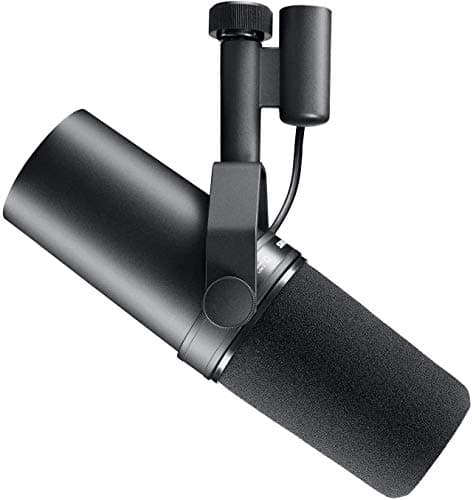
Shure SM7B
Shure · The default upgrade, if your preamp can feed it
Buy it if your interface supplies 60 dB or more of clean gain, or if you are budgeting for a booster alongside it. Buy something else if your only interface is a Scarlett Solo and you are not prepared to add hardware.
Why it is here
- Rejects room and computer-fan noise better than any condenser at any price
- Two voicing switches let one mic cover a thin voice and a boomy one
- Internal shockmount and a yoke that actually holds position on a boom arm
What it costs you
- At -59.0 dBV/Pa it is one of the quietest mics sold, so it demands a loud preamp
- Total cost is the mic plus, very often, a booster
- Heavy enough that a cheap desk arm will droop under it
Elgato Wave XLR
Elgato · The most gain of any single-channel box, built for streaming
The right box if you stream or record alone with a low-output dynamic and want the gain problem to simply not exist. It is not a general-purpose interface, and it is the wrong buy if you also record instruments.
Why it is here
- `75 dB` of gain drives an SM7B with room to spare and no booster, which is the single most common streaming problem solved outright
- Clipguard catches a shout that would otherwise clip the take
- Capacitive tap-to-mute on the top surface, which is genuinely better than reaching for a key bind
What it costs you
- One microphone input, so a co-host needs a second unit
- The mixing lives in Elgato's software, so it is a Wave Link setup rather than a neutral interface
- No MIDI, no line inputs, no instrument input
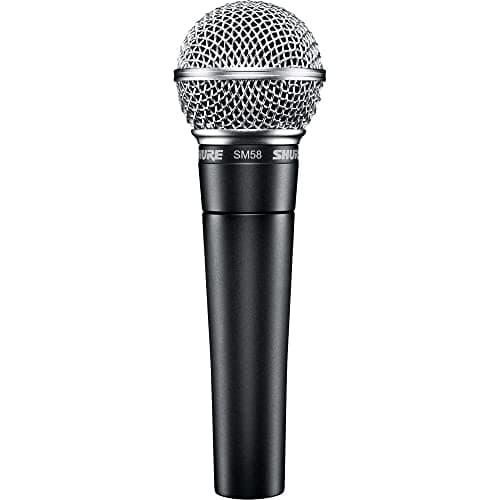
Shure SM58
Shure · The cheapest way to hear what a dynamic does for you
The right first XLR mic if the real question is whether a dynamic fixes your room, because it answers that for very little money on the interface you already own. It is a diagnostic, not a destination.
Why it is here
- At -54.5 dBV/Pa it is the hottest dynamic here, and works on genuinely modest preamps
- Light enough for any stand or arm you already own
- Effectively indestructible, and resells for most of what you paid
What it costs you
- Response stops at 15 kHz and it is voiced for a PA, not a studio
- Handheld grille shape is awkward on a desk boom
- You will outgrow it if voice is your main output
Who should stay with the MV7
- Anyone who records in more than one place. The USB-C side means a laptop and a cable is a complete studio. Every alternative here needs an interface in the bag as well.
- Anyone who has never set a gain level and does not want to learn. Auto Level Mode is a real feature for a solo host, and the closest replacement on this page is a software mixer you also have to learn.
- Anyone recording only speech. The 16 kHz ceiling is not a weakness for a podcast or a voice-over, and the voicing is tuned for exactly that job.
- Anyone one purchase into their setup. If you own the MV7 and no interface, the cheapest real upgrade is treatment, not another microphone - best acoustic treatment under $100 will change your recordings more than any swap on this page.
What we did not pick, and why
- The Electro-Voice RE20 and Audio-Technica BP40. Both are excellent broadcast dynamics and both are quieter than the MV7, so each one re-opens the gain question the MV7 closed. They are ranked on best broadcast microphones.
- Any condenser. A condenser is a different decision rather than an alternative: more detail, far more room. Dynamic vs condenser microphones covers the trade, and in an untreated room it goes the MV7's way.
- The Rode RodeCaster Pro II and Zoom PodTrak P4. Multi-host consoles. If the reason you are shopping is a second host, those are the right shape and four-person podcast setup is the page for it.
- Another USB-plus-XLR hybrid. The MV7 family is the only hybrid this site covers with a verified listing, which is the honest reason this page cannot replace its second half with one product.
- Anything we could not price. Every pick above had a live listing at the last price check. Where a listing loses its offer the button reads Check price on Amazon rather than a number this page cannot stand behind.
Pair it with
- An interface, since five of the six picks need one. Best audio interfaces for podcasting.
- A damped boom arm, because every pick here is heavier than it looks. Best boom arms for microphones.
- Closed-back headphones so monitoring does not leak onto the take. Best headphones for podcasting.
- The whole rig, if you are starting from nothing. Best podcast gear.
- The interface side of the same decision. Best Audient iD4 alternatives ranks the small single-preamp boxes five of these six picks need.
If you have narrowed it to two, the head-to-head pages are faster than a ranked list: Shure MV7 vs Rode PodMic is the value question most MV7 shoppers are actually asking, Shure SM7B vs Shure MV7 is the capsule question, and Shure SM7B vs SM7dB explains what the built-in preamp on this page's top pick is really worth.