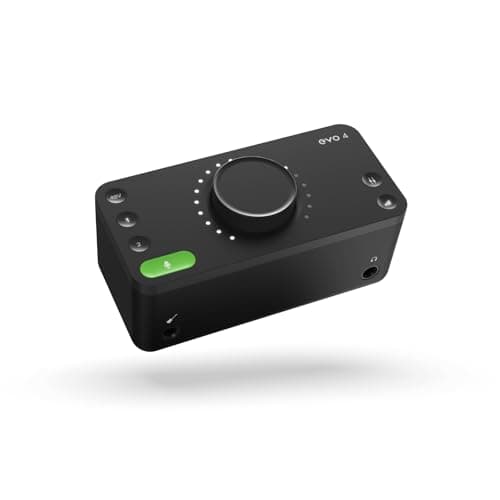
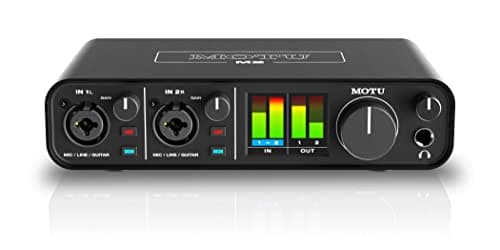
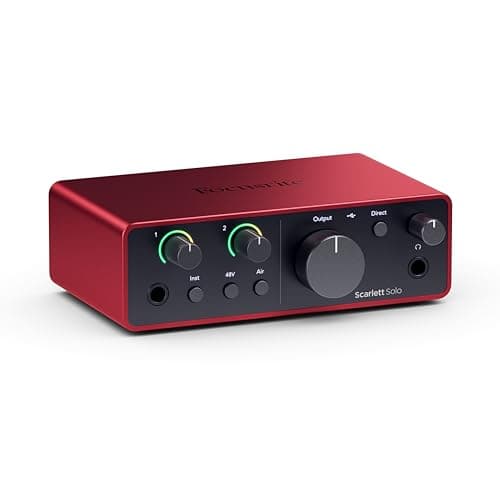
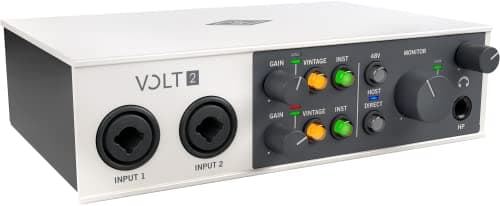
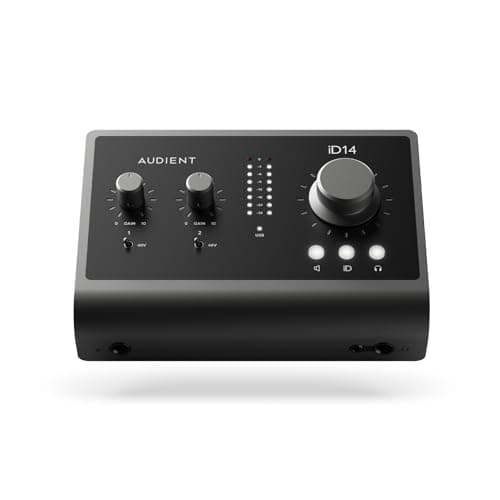
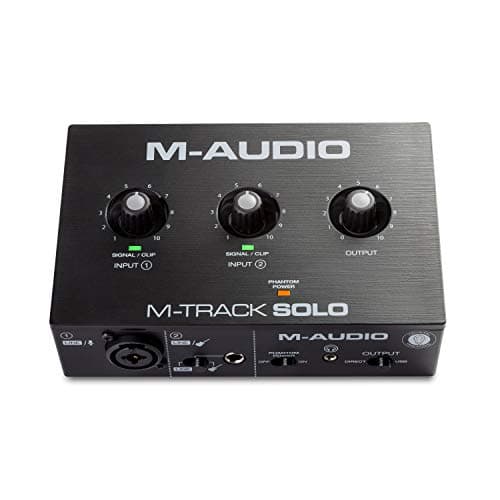
The Audient EVO 4 is the best iD4 MKII alternative for most people, and it is from the same company: two microphone preamps instead of one, Smartgain to set the levels for you, and a lower price than the iD4. The budget pick is the M-Audio M-Track Solo at 54 dB of gain and 16 bit conversion - genuinely the floor of the category, named as such. If what you want is the iD4's preamp quality with a second channel rather than a cheaper box, skip to the Audient iD14 MKII.
The iD4 MKII is the best-sounding single-preamp interface this site covers, and this page is not an argument against it. Audient put its console mic preamp in a desktop box: 0 to 58 dB of gain, -129 dB(A) equivalent input noise and 0.0017% THD+N at 0 dBu. Those are the numbers of a considerably more expensive interface. People look past it for reasons that are almost never about sound quality, and the table below is those reasons.
One reason is deliberately missing from that table: wanting a quieter preamp. At -129 dB(A) the iD4 is already tied with the quietest figures published by anything on this site, including interfaces costing twice as much. If your recordings are noisy with an iD4 in the chain, the cause is in front of it - a microphone too quiet for 58 dB, or an untreated room - and how much clean gain do you need is the arithmetic that tells you which.
What the Audient iD4 MKII actually does well
An alternative has to replace something specific, so here is what you are replacing. Four things define the iD4 MKII, and the first two are the reason it keeps appearing in our rankings:
- An Audient Class-A console mic preamp, which is the same circuit family Audient puts in its larger desks rather than a desktop-only design.
- `-129 dB(A)` equivalent input noise with `0.0017%` THD+N at `0 dBu`. Those two figures together are what people mean when they say the iD4 punches above its price.
- `0` to `58 dB` of gain. Enough for every condenser on this site and for a PodMic, and 2 dB to 11 dB short of what a Shure SM7B wants - see best audio interfaces for the Shure SM7B before you assume otherwise.
- A deliberately small box with one microphone input. That is a design decision rather than an omission, and it is the single thing most people are shopping away from.
Nothing on this page improves on the second point. The EVO 4 and iD14 MKII are the same company and the iD14 shares the discrete Class-A topology; the MOTU M2 matches the -129 dB noise figure with different converters in front of it; the Scarlett Solo and M-Track Solo are honest price-led choices that do not pretend to match it. Which means this page is really about input count and money, and it is ranked that way.
How these are ranked
- Input count against price. The iD4's one input is the reason most people are here, so a second preamp at or below the iD4's price ranks first.
- Published equivalent input noise, where the manufacturer states it. Several do not, and that absence is reported rather than filled in.
- Published maximum gain, checked against the sensitivity of the microphones this site recommends.
- Conversion figures and metering, where published - the second-order difference once gain and noise are settled.
- Buyable now, with a live Amazon listing and a price from the daily price check at the time this page was written. Each button carries its own date.
The six alternatives, ranked
Each card carries the published figure with its source, the live price with the date it was checked, and the cons as the spec sheet states them. We have not tested these interfaces; the ranking is a reading of published figures against the criteria above.
Audient EVO 4
Top pickAudient · Anyone who keeps getting gain-staging wrong
The pick for a second host on a budget, or for anyone whose recordings keep coming back too quiet. Not the pick if your mic is an SM7B, where the gain ceiling forces a booster.
Why it is here
- Smartgain removes the single most common beginner mistake in one button
- Two mic preamps at the price of most one-input boxes
- Genuinely small and bus-powered
What it costs you
- 58 dB again falls short of an SM7B's appetite
- Single encoder for everything means more button-pressing than knob-turning
- Plastic build
MOTU M2
MOTU · The best converters and metering at the price
The pick if you care most about conversion quality and want to see your levels without alt-tabbing. If your mic is an SM7B and you want a published gain number you can check against the mic's sensitivity, the 2i2 is the safer buy.
Why it is here
- -129 dB EIN is genuinely quiet, and it shows on low-output dynamics
- Full-color LCD metering on the box is more useful day to day than any software mixer
- Independent phantom power and monitor switching per input
What it costs you
- MOTU does not publish a maximum mic-gain figure the way Focusrite does, so gain headroom is harder to plan around
- No onboard voicing or DSP at all
- Loopback needs the software, not a front-panel switch
Focusrite Scarlett Solo (4th Gen)
Focusrite · One microphone, one guitar, nothing else
Fine with a hot mic like an MV7+, a BP40 or an SM58. Do not pair it with an SM7B unless you are also buying a booster, and at that point the 2i2 is cheaper overall.
Why it is here
- Same converter generation as the 2i2 for less money
- A dedicated instrument input means mic and guitar at once
- Small enough to live permanently on a crowded desk
What it costs you
- One mic input is a hard ceiling — a guest means a new interface
- Historically the interface people pair with an SM7B and then wonder why it hisses
- No MIDI
Universal Audio Volt 2
Universal Audio · A hardware color option on the way in
Buy it if you want character on the way in and your mic is a condenser or a hot dynamic. With a low-output broadcast dynamic, 55 dB means a booster, and that changes the price comparison entirely.
Why it is here
- Vintage mode is a real analog-style color, not a plug-in you could add later
- Two combo inputs and a clean, legible front panel
- The UA software bundle is worth actual money
What it costs you
- 55 dB is the lowest gain ceiling in this group and the least SM7B-friendly
- 112 dB dynamic range trails the Focusrite and MOTU converters
- Vintage mode is a commitment printed into the recording
Audient iD14 MKII
Audient · The quietest two-channel preamp pair here
The best-sounding two-channel box in this price band, and the right buy if your microphones are condensers or hot dynamics. With a low-output broadcast dynamic the gain ceiling still forces a booster.
Why it is here
- Two of the same Class-A console preamps as the iD4, at `-129 dB(A)` EIN
- ADAT input means it grows to ten inputs without replacing the box
- JFET instrument input that takes being driven hard
What it costs you
- 58 dB is marginal for an SM7B, exactly as on the iD4
- No MIDI, which at this price is a real omission
- ADAT expansion needs a separate preamp unit you do not own yet
M-Audio M-Track Solo
M-Audio · A published gain figure under $100
The most honest sub-$100 interface, because it tells you what it can do. Pair it with a hot microphone and it is a genuinely usable first chain; pair it with a broadcast dynamic and it will disappoint.
Why it is here
- It publishes its gain figure, which almost nothing else under $100 does — `54 dB` is a number you can plan against
- USB bus powered and genuinely pocketable
- Clean, neutral preamp with no attempt at color
What it costs you
- 16-bit conversion, same ceiling as the cheap Behringers
- `54 dB` is not enough for an SM7B-class dynamic
- One microphone input only
Who should stay with the iD4 MKII
- Anyone recording one microphone, ever. A second preamp you never use is money spent on nothing, and the iD4's preamp is better than the one in every cheaper box here.
- Anyone whose microphone is a condenser. 58 dB and -129 dB(A) is a comfortable match for every condenser on this site - best condenser microphones for vocals is the shelf in question.
- Anyone who cares about THD+N. 0.0017% at 0 dBu is published, specific and better than anything else on this page states.
- Anyone with desk space as the real constraint. The small footprint is part of the product, and the alternatives that add a second input add width with it.
What we did not pick, and why
- The Focusrite Scarlett 2i2. A strong box with 69 dB of gain, and it is the obvious pick for a quiet dynamic rather than an iD4 alternative - the gain is the reason to buy it. It leads best audio interfaces under $200.
- The SSL 2+ MKII. Two headphone outputs and a console voicing, and the daily price check showed no live offer when this page was written. We do not rank a pick we cannot price.
- The Behringer UMC204HD and U-Phoria UMC22. Cheaper than the M-Track Solo in some weeks and the honest floor of the category rather than an alternative to a Class-A preamp. Are cheap audio interfaces worth it is the straight answer.
- The Elgato Wave XLR. 75 dB of gain and a software mixer, built for streaming rather than for general recording, with no instrument input. It is ranked on best audio interfaces for streaming.
- Anything Thunderbolt. Nothing in this price range is, and for one or two microphones the latency difference does not justify the step - are Thunderbolt audio interfaces worth it.
Pair it with
- The microphone the interface has to drive. Best XLR microphones.
- Headphones its output can actually drive. Best studio headphones under $300.
- The band page, if price is the real constraint. Best audio interfaces under $200 and best audio interfaces under $300.
- The same shelf with no reference product. Best 2-channel audio interfaces.
- The microphone that needs no interface at all. Best Shure MV7 alternatives, if the hybrid route is still open to you.
If you have narrowed it to two boxes, the head-to-head pages settle it faster than a ranked list: Audient iD4 vs Audient EVO 4 is this page's top pick against the original, Audient iD4 vs Audient iD14 is what the step up inside the family buys, and Audient iD4 vs MOTU M2 is the preamp-against-converters question that decides most of these purchases.